









First Read is a morning briefing from Meet the Press and the NBC Political Unit on the day’s most important political stories and why they matter.
How tomorrow’s New York primary can change the delegate math
For the most part, Ted Cruz and Bernie Sanders have had a good last couple of weeks, winning additional contests and cutting into the delegate leads that front-runners Donald Trump and Hillary Clinton have enjoyed. But that is about to change if the public polling holds in tomorrow’s New York primary. Why? Just look at the delegate math. Let’s start with the Republican contest.
Trump currently holds a 197-delegate lead over Cruz
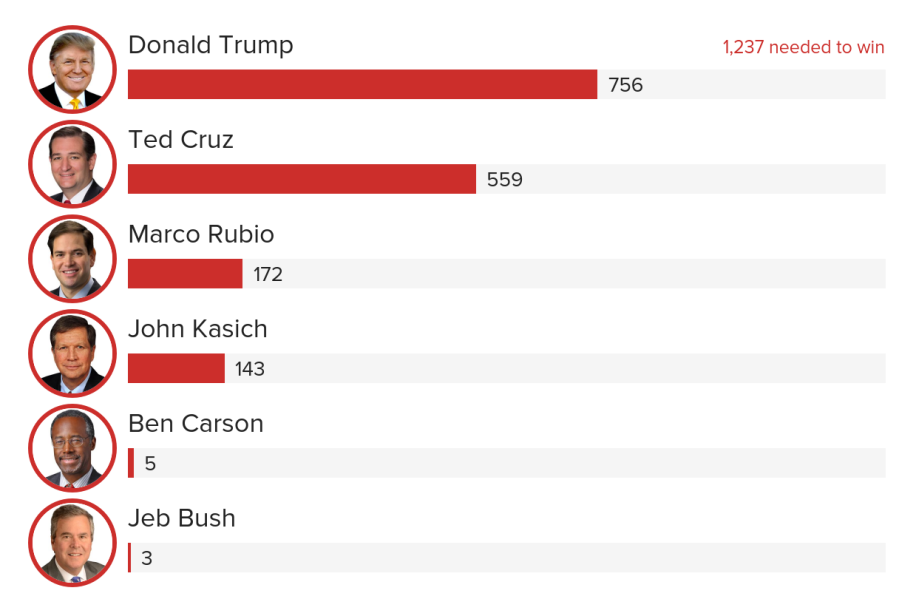
Trump needs to win 61% of remaining delegates to reach 1237 magic number
Cruz needs to win 86% of remaining delegates to reach 1237 magic number
Kasich needs to win 140% of remaining delegates to reach 1237 magic number
But say Trump wins 85 delegates out of New York — which is entirely doable given the state’s winner-take-all rules both statewide and in each congressional district — while Cruz gets five and Kasich gets five. Well, that would lower the 61% of remaining delegates that Trump needs to 57%. And it would all but mathematically eliminate Cruz’s chance of getting a majority on a first ballot. Under that scenario:
Trump would hold a 277-delegate lead over Cruz
- Trump 841
- Cruz 564
- Rubio 172
- Kasich 148
Trump needs to win 57% of remaining delegates to reach 1237 magic number
Cruz needs to win 98% of remaining delegates to reach 1237 magic number
Kasich needs to win 158% of remaining delegates to reach 1237 magic number
And if Trump runs the table in the April 26 states of Connecticut, Delaware, Maryland, Pennsylvania, and Rhode Island, that 57% could get close to 50%, and Cruz’s 98% would go to about 120%.
How a 10-point Clinton win in New York would change the math
As for the Democratic contest, a 10-point New York win for Hillary Clinton — as the current polling suggests — could result in her picking up a net gain of 25 delegates. Here’s how that could change the delegate math:
In pledged delegates, Clinton currently holds a lead of 244 delegates (with Washington delegates to still be allocated)
- Clinton 1287 (55%)
- Sanders 1043 (45%)
Clinton must win 43% of remaining pledged delegates to get a majority in pledged delegates
Sanders must win 57% of remaining pledged delegates to get a majority in pledged delegates
In overall delegates (pledged + super), Clinton holds an overall lead of 664 delegates
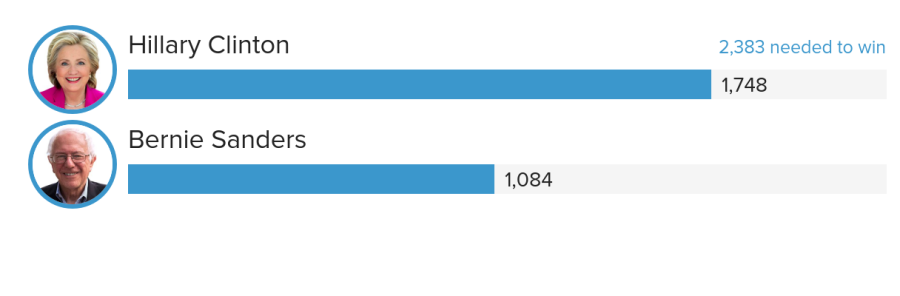
Clinton must win 33% of remaining delegates to reach 2383 magic number
Sanders must win 67% of remaining delegates to reach 2383 magic number
Yet here’s how a 10-point win in New York could change the math:
In pledged delegates, Clinton would hold a lead of 269 delegates (with Washington delegates to still be allocated)
- Clinton 1423
- Sanders 1154
Clinton must win 41% of remaining pledged delegates to get a majority in pledged delegates
Sanders must win 59% of remaining pledged delegates to get a majority in pledged delegates
In overall delegates (pledged + super), Clinton would hold an overall lead of 691 delegates
Clinton must win 30% of remaining delegates to reach 2383 magic number Sanders must win 70% of remaining delegates to reach 2383 magic number So if Clinton wins New York by 10 percentage points, Sanders’ magic-number percentage would go up to 70% — and it would become 78% if Clinton wins the April 26 contests by a 55%-45% average. Sanders appeared on “Today” this morning, and he acknowledged the current public polls that show him trailing in New York. “Let’s look at the real poll tomorrow,” he said. “We have a message that is resonating all over this country.” Most votes vs. majority rule? A new national NBC/WSJ poll released Sunday found 62% of Republican voters believing that, if no GOP presidential candidate wins a majority of delegates before the convention, the one with the most votes should be the party’s nominee. That’s compared with 33% of Republicans who say the nominee instead should be the candidate whom convention delegates think would be the party’s best standard-bearer. Asked about this result on “Meet the Press” and how that might impact Donald Trump (who is leading in the vote race but might not get a majority, RNC Chair Reince Priebus responded, “Well, look, if Donald Trump, if he was winning the majority of votes, he’d likely have the majority of delegates. But that’s not actually what’s happening. He’s winning a plurality of votes, and he has a plurality of delegates. And under the rules and under the concept of this country, a majority rules on everything.” Well, not exactly — congressional candidates don’t need majority support to win general-election races, just more than the opposition. Mr. (and Mrs.) Unpopular Here’s another set of numbers from our new NBC/WSJ poll: The only popular candidates for president in 2016 have one thing in common — they’re not winning. Here are the favorable/unfavorable scores for major political figures and parties, from best to worst: Trump’s -41 score is the worst EVER for a major presidential candidate in the history of the NBC/WSJ poll — down from -39 last month. And Clinton’s -24 is a more than 10-point drop from a month ago (when she was -13). The rest of the NBC/WSJ poll comes out later today. Clooney defends pricey fundraiser On “Meet the Press” yesterday, George Clooney defended the pricy Clinton/Democratic fundraiser he participated in over the weekend. “The overwhelming amount of money that we’re raising, and it is a lot, but the overwhelming amount of the money that we’re raising, is not going to Hillary to run for President, it’s going to the down-ticket,” Clooney said. “It’s going to the congressmen and senators to try to take back Congress. And the reason that’s important and the reason it’s important to me is because we need, I’m a Democrat so if you’re a Republican, you’re going to disagree but we need to take the senate back because we need to confirm the Supreme Court justice because that fifth vote on the Supreme Court can overturn Citizens United and get this obscene, ridiculous amount of money out so I never have to do a fundraiser again. And that’s why I’m doing it.” Clinton jumps on Sanders’ comment about the Deep South Meanwhile, on ABC yesterday, Hillary Clinton jumped on Sanders’ recent comments about losing “Deep South” states to Clinton because they’re more conservative. “Last time I looked at a map of the United States, the South was a part of our country, like every other region. And I’m thrilled to have support — you know, when you win Virginia, North Carolina, Georgia, Florida, those are all states that we can put into play in the general election… I’m not writing [off] any individual, and I’m certainly not writing off any state or region of our country.” On the trail Hillary Clinton stumps in Midtown Manhattan, while Bill Clinton campaigns in Buffalo… Donald Trump holds a 7:00 pm ET rally in Buffalo… Ted Cruz is in Maryland… And John Kasich hits Syracuse and Schenectady.
Chuck Todd
Chuck Todd is NBC News' chief political analyst and the former moderator of "Meet The Press."
Carrie Dann
Mark Murray Recommended


