








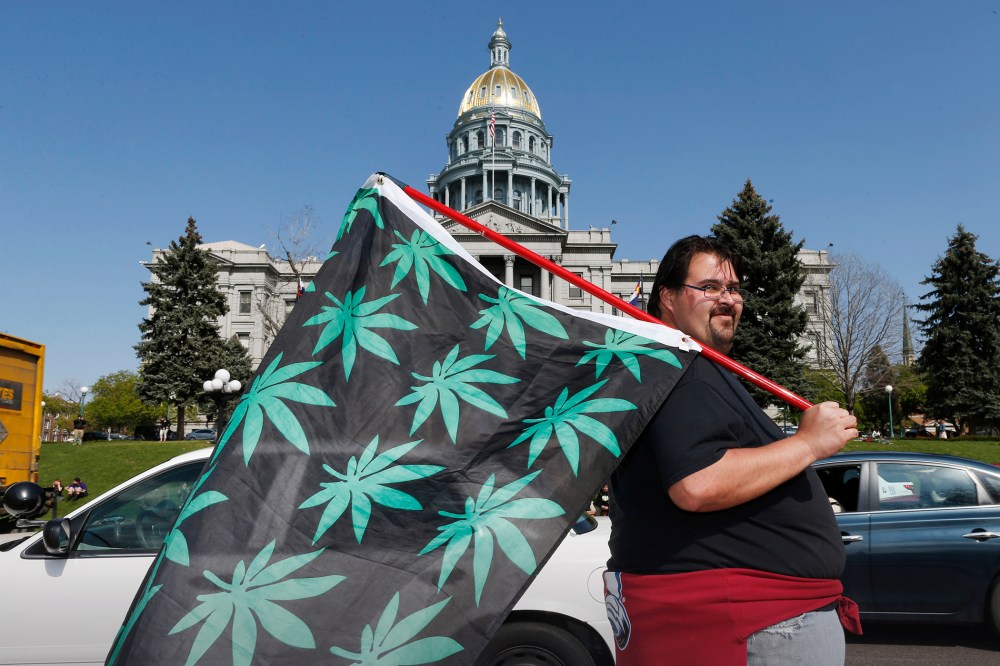
Last year, Colorado created the world’s first full-scale commercial cannabis market. Now, at 8 p.m. ET on Wednesday in Boulder, the state is set to mark another milestone, hosting the first presidential debate in a land where marijuana is regulated like alcohol.
It could get ugly.
The Republican candidates could—without fear of a career-ending arrest—buy up to a quarter-ounce of pot, seven grams of hash oil or food infused with up to 700mg of THC, the chemical that gets you high. But while all have enjoyed the regional delicacies of the campaign trail, don’t expect any red-eyed selfies from inside the Centennial State.
This GOP field opposes marijuana with an almost Reagan-esque fervor, implying that the drug leads to ruined lives, shattered families and lost productivity. None of the Republican candidates support federal legalization. Their support for state-level legalization, meanwhile, is patchy, tentative and uniformly gruff.
RELATED: Clinton and Sanders are wrong when it comes to pot and prison
Only five of the candidates explicitly support the right of states to legalize just-for-fun cannabis. That includes former Florida Gov. Jeb Bush, Kentucky Sen. Rand Paul, Former Arkansas Gov. Mike Huckabee and former Hewlett-Packard CEO Carly Fiorina. A quarter-century ago, real estate mogul Donald Trump said he believed in legalizing all drugs, but not any more.
And no one in this field has a soft word for pot itself. Drug reformers say marijuana is no more dangerous than alcohol, an idea echoed by President Obama last year. But the Republican field has displayed a more alarmist understanding of marijuana’s risks and its rank among the more dangerous drugs.
Paul has taken the softest approach, saying that marijuana’s “only victim” is the individual. But even he called pot use “a crime” at the second GOP debate last month in California. The rest of the field thinks legalization is a bad idea made tolerable only by the principle of self-governance at the state level.
That’s why Texas Sen. Ted Cruz and Ohio Gov. John Kasich have said they’re also inclined to let local governments make up their own mind. That gave the issue a feeling of closure during the last debate. If most of the field supports letting the states decide, that clears the way for an explosion of new pro-pot ballot initiatives in 2016.
But New Jersey Gov. Chris Christie and Florida Sen. Marco Rubio are still in the race, and still promising to enforce federal laws against marijuana. Ben Carson, a retired neurosurgeon who is gaining on Trump’s lead in the polls, wants to go even further. Last week he said that he not only disagreed with marijuana legalization but that he would “intensify” the war on drugs.
The Democratic presidential field hasn’t evolved much further on the issue. Although 58% of Americans support legalization, according to the latest Gallup poll, none of the presidential candidates have endorsed legalization. Vermont Sen. Bernie Sanders came close at this month’s Democratic debate. Asked if he would vote “yes” in a state where legalization was on the ballot he said, “I suspect I would.”
RELATED: Christie: ‘I believe marijuana is a gateway drug’ Many of the candidates seem to be taking a wait-and-see approach to legalization. They want more evidence from the four states that have legalized so far — Colorado, Oregon, Alaska and Washington. But while Colorado has the most mature market, it’s still hard to say whether the move has been mostly good or mostly bad. Each side of the debate is still playing with its own facts. “The War on Marijuana has been a failure. Prohibition has led to violent criminal organizations controlling the marijuana market throughout most of the United States. In Colorado, we have chosen to drive the black market out by creating a safe, regulated, and taxed marijuana industry,” said Michael Elliott, director of the Marijuana Industry Group, Colorado’s leading pot lobby, in a statement. Kevin Sabet, the co-founder of Project Sam, the nation’s leading anti-legalization lobby, told MSNBC that Colorado’s pot industry is so bad that its very existence makes the case for prohibition. But both Sabet and Elliot lack the kind of data it will take to make anything like an objective, politically bullet-proof case for one or the other position. “It’s going to take 10 or 15 years to know what the effects have been,” said Sabet, who believes more pot use could mean more mental illness. “You’re not going to get the psychosis or schizophrenia trend lines in just a year or two. You’re not going to see the effect on school dropout rates.” He may be wrong about the dangers of pot, but Sabet is right about the timeline. It will probably take about the same amount of time for presidential candidates to try anything stronger than some Colorado craft beer.
Tony Dokoupil Recommended


