








KINLOCH, Missouri— It was technology that ran Rev. Earbie Bledsoe out of Mississippi 57 years ago. He was a sharecropper back then, young and strong. But those virtues were becoming less valuable as farmers, who owned the land he worked and all of the tools he used, were turning to machines that could pick as much cotton and corn as 100 men.
So he did what thousands of other southern blacks of his generation had done for one reason or another. He headed north. The Great Migration swept him into Missouri and to the small towns that dot the border with St. Louis.
%22Ferguson%20been%20a%20bad%20city%20for%20black%20people%20since%20it%E2%80%99s%20been%20a%20city.%22′
He met a woman who was born in nearby Ferguson and the two moved to Kinloch, the oldest black incorporated town in Missouri.
Kinloch had its own movie theater, a black police force, a school and a hardware store. It was self-sufficient and proud, he said.
“We was a complete city,” Bledsoe said. “But you look around today and tell me what you see.”
In recent decades the decline in Kinloch has been rapid. The city of St. Louis, which owns the airport, bought up most of the land in town and bought out many of the long-time homeowners there too. Most of the public buildings have been shuttered. Abandoned homes sit hulking on overgrown plots. It has become a dumping ground as bags of trash, old-furniture and other detritus of life’s leftovers pile from illegal dumping.
Kinloch’s population has dwindled from more than 6,000 decades ago to just about 300 today, according to 2010 Census data.
“In the old days they had us boxed in and we couldn’t get out,” he said. “We were forced here because blacks couldn’t live where you wanted.”
On either side of the town was hostile territory, so-called “sundown towns” like Berkley and Ferguson, where blacks couldn’t be caught after nightfall.
“The police would get you out one way or the other,” he said.
By far, he said, the city of Ferguson was the worst for blacks.
“Ferguson been a bad city for black people since it’s been a city,” Bledsoe said on Thursday afternoon inside his office at the Devotional Baptist Church in Kinloch.
“We always knew there was a problem in Ferguson.”
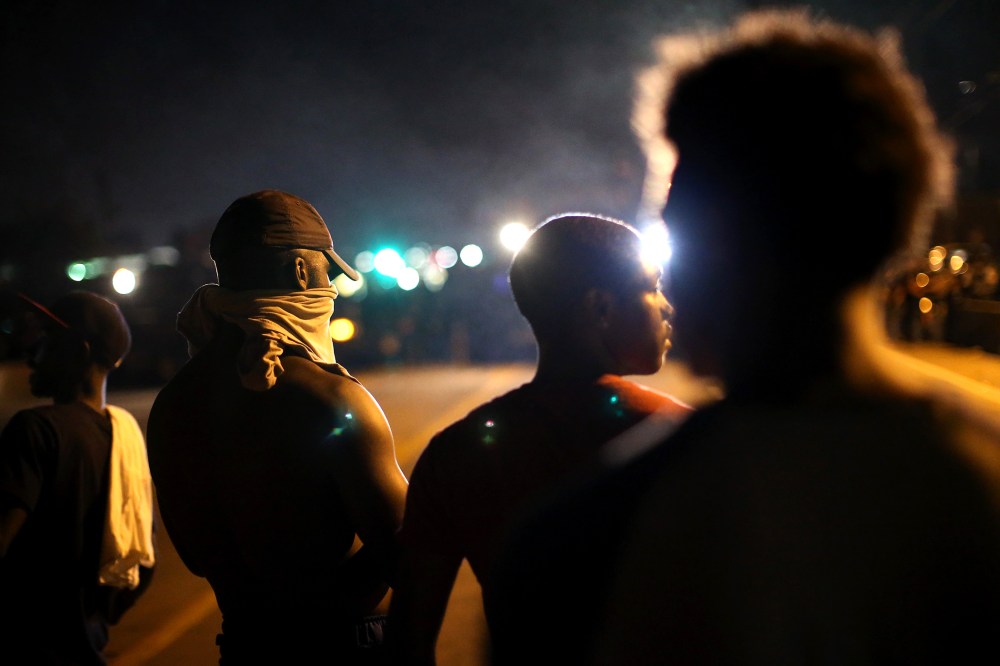
When rioting and protests broke out last week over the shooting death of unarmed black teenager Michael Brown by a Ferguson police officer, Bledsoe said it reignited generations of pent up angst and hurt.
“When the wood and the paper are dry, don’t take but a spark to set it on fire,” he said. “They can see what the spark did; the spark is what set it off.”
%22They%E2%80%99ve%20had%20a%20war%20against%20us%20for%20a%20very%20long%20time.%22′
Police say Brown was shot and killed after he tried to wrestle away an officer’s gun. But witnesses say the officer, Darren Wilson, who is white, first accosted Brown and a friend in the street and then fired several shots at the teen as he attempted to flee.
Witnesses say that many of those shots came as Brown held up his hands in surrender. Brown was struck with six shots from Wilson’s gun, according to an autopsy performed at the behest of the dead man’s family.
In the wake of his death there’s been rioting, looting and what could be described as an overzealous and violent response by police. For days peaceful protests devolved into confrontations that ended many nights with tear gas and rubber bullets being fired into crowds of mostly peaceful protesters. A state of emergency was declared and the National Guard was brought in for a time.
The episode has reignited old tensions not just in Ferguson but in the neighboring black towns where residents say unfair treatment and brutality go a long way back.
The Brown killing and its ugly aftermath are eerily reminiscent of another killing of an unarmed black teenager more than 50 years earlier.
In 1962, 19-year-old Donnell Dortch was pulled over by a police officer while driving in Kinloch. According to reports at the time, the officer, Israel Mason, was attempting to give Dortch some sort of ticket when an altercation ensued. Mason, who was also black, ended up shooting Dortch dead.
Mason reportedly said that the gun accidentally discharged. A local newspaper, though, spoke to witnesses who said they saw Mason pull Dortch from his car, pistol whip him with his revolver then step back about five feet and shoot the teen.
According to a report this week on NPR’s Code Switch, “Kinloch exploded with anxiety and protest.”
Kinloch was a 6,500 person town back then. And its residents went ballistic in the wake of Dortch’s killing, protesting outside of city hall with chants of “We want Mason! We want Mason!” An elementary school and several empty homes were torched. The police station was shot at and someone even tried to set the police chief’s house on fire, according to NPR’s story.
Protestors at the time carried signs that could’ve been taken from the streets of Ferguson this week: “Was Murder Necessary?” and “Will Our Son Be Next?”
An Associated Press story about Dortch’s killing and riots that followed ran in The New York Times under the headline, “8 Fires Set in Negro Suburb of St. Louis After Shooting”.
Bledsoe didn’t want to talk much about the Dortch incident. He just said the racial problems in these little towns have long been a burden to black folks.
Ferguson residents say the police department has targeted them unfairly and sometimes with beatings and harassment. On any given day in court, many said, the line of people with simple summonses or traffic tickets stretches out of the building and nearly all of them are black. According to an analysis of municipal court records by Mother Jones, Ferguson police hand out three warrants per household every year. While the town (about 67% black) is relatively poor and with an about average crime rate, fines and fees associated with petty infractions is lucrative business in Ferguson. A new report from Arch City Defenders, a non-profit legal defense organization, estimates that fines and court fees make up the second largest source of revenue for the city totaling $2,635,400. City officers issued 24,532 warrants and handled 12,018 cases according to the group. The formula: “low level harassment involving traffic stops, court appearances, high fines, and the threat of jail for failure to pay.” Attorney General Eric Holder visited with Ferguson residents and community leaders Wednesday to assure them that the Justice Department would thoroughly investigate the Brown case in search of any civil rights violations but also that the department would be looking into past allegations of police department misconduct. On the day of Holder’s visit, the relative of a man killed by police in 2011 after officers hit him with a taser, filed two federal lawsuits against the police department. The latest suits are part of a growing body of legal complaints against the department in recent years that highlight what many say is a pattern of excessive use of force and civil rights violations of blacks. Back at his church in Kinloch, Bledsoe said he feels it’s more than just the police department that is prejudiced against blacks. He said he owns land in Ferguson that he has been trying to build a house on for years, but the city has refused to grant him a building permit. He said they won’t identify what’s wrong with his blueprint or plans, but just that what he’s providing isn’t up to par. He said other blacks have had the same troubles dealing with the nearly all-white bureaucracy. “They do what they wanna, if they wanna, when they wanna,” he said. “Always been like that.” He said relations between black and white folk here has remained largely the same as in decades past — cool at best. “No, I don’t think things have changed much. Not enough to write down,” he said. But in the aftermath of Brown’s killing, even with its scorched earth and tear gas, might be just the thing to open everyone’s eyes, he said. “An Italian man told me a long time ago that freedom is too good for anyone to just give it to you. Rights are too good to be given away. You want them, you have to take them,” he said. “Ferguson forgot that we done advanced,” he said. “The man that pulled the trigger didn’t know we got help in Washington. He didn’t know we’d have backup all over the world, all over the country, especially those young people willing to kick through a plastic bag to get their rights.” Watching the news coverage of the rioting and conflicts over in Ferguson, Bledsoe said it was clear what he was seeing. “Bottom line. They’ve had a war against us for a very long time. Any time you shoot an unarmed man that you don’t know, what do you call that? You call it war,” he said. Bledsoe stepped from the church and into the blaze of afternoon sun and thought back over all that has been and all that might soon be after the drama cools. He has been pastor at his church for 46 years and a member for about seven years before that. He built his church with his own hands. It took him 13 years to do it with the help of volunteers and donations. “Drug dealers, alcoholics, pimps and prostitutes,” he said, “they all volunteered to help build this church — Jews and gentiles.” More than anything he said he wants his four grandchildren to grow up with opportunity and he wants to build his house on his five-acre plot in Ferguson where he grows peas, beans, potato, carrots and okra. And he wants desperately for blacks in Ferguson and all over to be treated fairly. “I believe after this dies down they’re going to treat me right and give me that permit,” Bledsoe said. “They don’t want too much more of what they’ve been getting.”
Trymaine Lee
Trymaine Lee is an NBC News correspondent. Recommended


