








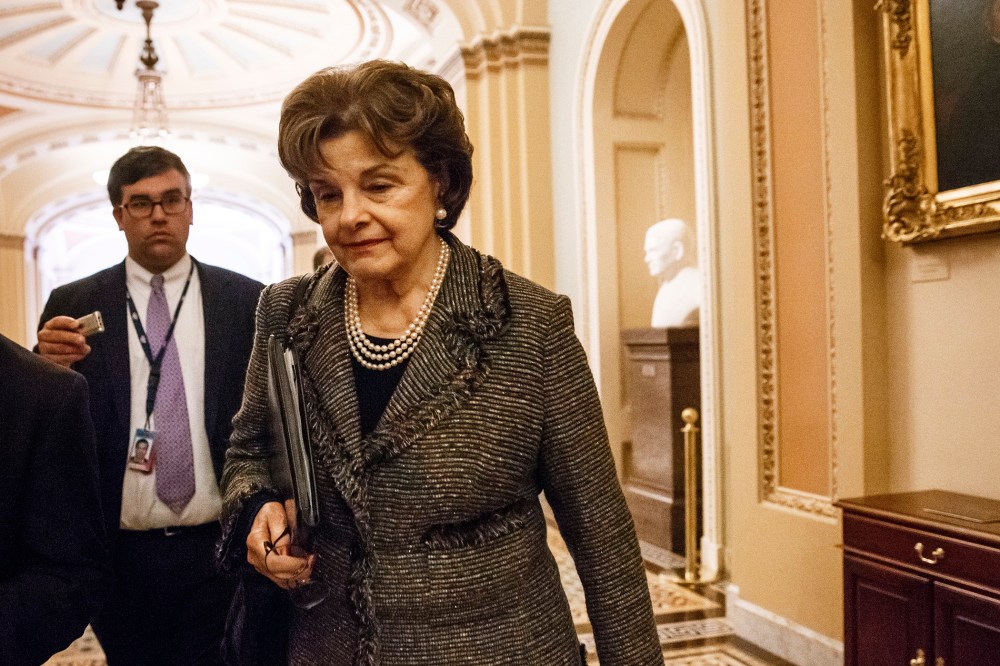
Senate Intelligence Committee Chair Dianne Feinstein accused the CIA on Tuesday of violating the law and the Constitution of the United States by interfering in a committee investigation into Bush-era torture of terror suspects.

Feinstein said the CIA had removed documents provided to the committee through a special, segregated network set up by the agency for the committee to pursue its investigation. Among the documents removed was an internal review of CIA interrogation techniques conducted by then-CIA Director Leon Panetta, which committee members have said corroborated committee findings critical of the agency’s interrogation program. In an interview with msnbc later Tuesday morning, CIA Director John Brennan disputed Feinstein’s allegations.
“The CIA just went and searched the committee’s computers,” Feinstein said on the Senate floor. Feinstein said that when it was discovered the documents were removed, the CIA initially blamed its IT staff, then said the documents were removed at the request of the White House. Feinstein said the White House denied doing so.
“This was done without the knowledge or approval of committee members or staff, and in violation of our written agreements. Further, this type of behavior would not have been possible had the CIA allowed the committee to conduct the review of documents here in the Senate,” Feinstein said. “In short, this was the exact sort of CIA interference in our investigation that we sought to avoid at the outset.”
Feinstein said that the CIA’s activities may have violated the Fourth Amendment, the Computer Fraud and Abuse Act, and executive order 12333, which bars the CIA from conducting domestic surveillance. Feinstein also said the CIA’s activities violated the separation of powers principles in the Constitution by interfering with congressional oversight of the executive branch. The CIA’s inspector general had referred the matter to the Justice Department, Feinstein, a Democrat from California, said.

Senate Majority Leader Harry Reid said he “unequivocally” supported Feinstein and called on the CIA to apologize. But several Democrats with whom Feinstein has butted heads while defending the intelligence community also backed her up.
Vermont Democratic Sen. Patrick Leahy, who chairs the judiciary committee, said shortly after Feinstein’s speech that “I cannot think of any speech by any member of either party as important as the one the senator from California just gave.” Oregon Democratic Sen. Ron Wyden said in a statement that he would “continue to support Chairman Feinstein’s efforts to get more answers and accountability from the CIA about this search.”
Although Senate Minority Leader Mitch McConnell declined to comment, other Republican senators weighed in on Feinstein’s side. Arizona Republican Sen. John McCain, who has criticized Brennan in the past, called Feinstein’s allegations “very disturbing” and said “we may need some kind of independent investigation.”
That Feinstein has long been seen as a reliable defender of the intelligence community made her allegations all the more shocking to experts and longtime observers.
“What is striking is not only the allegations themselves, but the fact that they are coming from Sen. Feinstein, who in other contexts has been such an outspoken champion of the intelligence community,” said Steven Aftergood, director of the Federation of American Scientists Project on Government Secrecy. “The possibility of CIA interference in congressional deliberations is shocking, and it may represent a historical crisis in intelligence oversight.”
The committee and the CIA have been at odds over the public release of a committee report on CIA interrogations that took place during the presidency of George W. Bush. The report is said to be harsh in its evaluation of the agency. That dispute broke out into the open last week, when McClatchy and the New York Times reported that the Department of Justice was looking into whether the CIA improperly accessed the committee’s computers, and whether the committee came into possession of documents it wasn’t supposed to have. The clash between the committee and the CIA is one of the most serious since the intelligence committees were established in the 1970s to oversee the intelligence community.
“This a fundamental breach of the oversight relationship between Congress and the intelligence community,” Mieke Eoyang, a former Senate Intelligence Committee staffer and current national security analyst at Third Way, said of Feinstein’s allegations. “It’s a violation of the CIA’s restriction from operating against American citizens; it’s a violation of separation of powers; it’s a violation of the legislative branch privilege.”
Feinstein said that releasing the report publicly was critical to ensuring that “an un-American and brutal program of detention and interrogation” will “never again be considered and permitted.” Feinstein said the CIA’s accusation that committee staff had somehow “hacked” into the CIA’s network were baseless and an attempt to intimidate the committee into abanonding its quest to release a version of the report to the public.
CIA Director John Brennan, who was a senior leader at the agency during the interrogation programs, pushed back against the Feinstein’s accusations later Tuesday morning during an interview with msnbc’s Andrea Mitchell.
“We are not in any way shape or form” trying to “thwart” the report’s release, Brennan said. The CIA “was in no way was spying on the” committee “or the Senate.” “Nothing could be further from the truth,” Brennan said to Mitchell, in response to whether the CIA had improperly breached the intelligence committee’s segregated computer network. “We wouldn’t do that. That’s beyond the scope of reason.” Brennan’s response to Feinstein was muted compared to last week, when he said in a statement he was “deeply dismayed that some members of the Senate have decided to make spurious allegations about CIA actions that are wholly unsupported by the facts.” In an implicit criticism of intelligence committee members, Brennan said, “I would encourage others to refrain from outbursts that do a disservice to the important relationship that needs to be maintained between intelligence officials and Congressional overseers.” Asked by Mitchell whether he would step down if Feinstein’s accusations turned out to be true, Brennan chuckled but later said President Obama was “the one who can ask me to stay or to go.” Paul Pillar, a former CIA official who is now a professor at Georgetown University, said the deteriorating relationship between the agency and the intelligence committee would harm oversight. “There could be posturing on the congressional side for the sake of looking like a hard-nosed adversarial overseer, which might not be in the national interest,” Pillar said. “In response to that you might have more defensiveness on the part of the agencies in terms of being willing to share stuff and cooperate.” But Aftergood said that the conflict might have “positive consequences.” “It may finally lead to the belated declassification and public release of the committee report on CIA interrogation practices,” Aftergood said. “Beyond that, this episode may ‘stiffen the spine’ of congressional overseers and help to promote a more skeptical, independent and critical approach to the task of intelligence oversight.” Feinstein said Tuesday that the resolution of the conflict between the agency and the committee would show whether the committee itself was cabable of overseeing the intelligence community. “How this is resolved will show whether the intelligence committee can be effective in monitoring and investigating our nation’s intelligence activities,” said Feinstein, “or whether our work can be thwarted by those we oversee.”
Adam Serwer Recommended


