








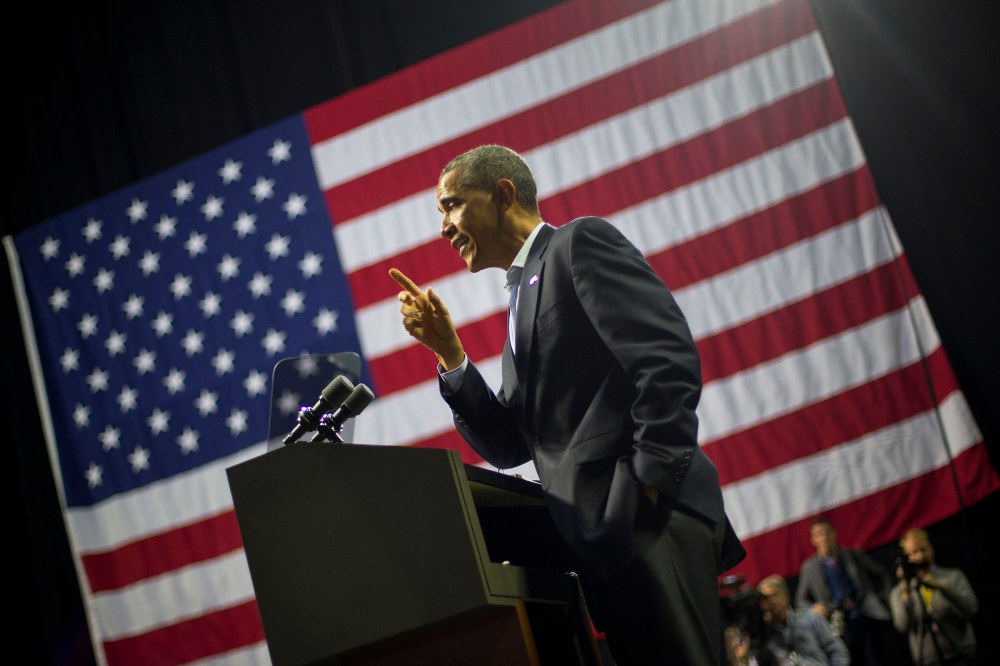
As early as this week, President Obama may take executive action to provide relief to as many as 5 million of the approximately 11 million undocumented immigrants living in the United States, and some Republicans are in a tizzy.
“It would be unconstitutional,” said Texas Sen. Ted Cruz, according to The Hill. “And it would be angry and defiant of voters … Congress will do everything humanly possible to stop them.”
%22Obama%20has%20both%20the%20law%20and%20precedent%20on%20his%20side.%22′
But the tea party leader, like many in the GOP, is wrong to argue that only Congress has the power to defer deportations of immigrants. In fact, Obama has both the law and precedent on his side.
The plan the president is considering would provide temporary relief from deportation to specific categories of undocumented immigrants, such as the parents of U.S. citizens, who register with the government, pay a fee and pass background checks. To do so, Obama would rely on the concept of “prosecutorial discretion,” the idea embedded in American law — and upheld by the Supreme Court — that the executive branch of the government can determine how immigration law is applied.
The legality of prosecutorial discretion is clear, according to over 100 law professors who specialize in immigration, and who signed a joint memo in September on the issues involved:
“The application of prosecutorial discretion to individuals or groups is grounded in the Constitution, and has been part of the immigration system for many years. Furthermore, court decisions, the immigration statute, regulations and policy guidance have recognized prosecutorial discretion dating back to at least the 1970s. Notably, in 2012, the U.S. Supreme Court reiterated: ‘A principal feature of the removal system is the broad discretion exercised by immigration officials … Federal officials, as an initial matter, must decide whether it makes sense to pursue removal at all…’”
Okay, so law professors think it’s legal. But what about those who argue that Obama is taking an unprecedented action?
As it turns out, every president since Dwight D. Eisenhower has taken executive action on immigration. The American Immigration Council has identified a total of 39 times since 1956 that presidents have used their authority to grant relief to immigrants. Sometimes the impacted group represented a small number of people, like when President Reagan granted Extended Voluntary Departure to 7,000 Poles in response to the Polish government declaring martial law, or when President George W. Bush granted deferred enforcement departure to 3,600 Liberians in 2007. Other executive actions have had a larger impact, like the series of actions that granted amnesty to 621,403 Cubans between the presidencies of Eisenhower and Nixon, or those that granted relief to 360,000 Vietnamese, Laotians and Cambodians under Presidents Ford and Carter.
%22Experts%20have%20identified%20a%20total%20of%2039%20times%20since%201956%20that%20presidents%20have%20used%20their%20authority%20to%20grant%20relief%20to%20immigrants.%22′ In many of these cases, the presidents involved acted because Congress failed to do so. Legislative inaction is what prompted President George H.W. Bush in 1990 when he deferred deportation of up to 1.5 million children and spouses of several million people previously granted legal status under President Reagan’s Immigration Reform and Control Act. Bush took executive action when the House delayed a bill passed by the Senate which addressed these families. Obama finds himself in a similar position. The Senate overwhelmingly passed S.744, a bipartisan comprehensive immigration reform bill in June 2013, but House Speaker John Boehner has refused to bring it up for a vote. In the absence of legislative action, the president is acting to solve a national problem. There are good policy reasons to provide relief from deportations. It would stop many children from being separated from their parents — one study found that 72,410 individuals deported last year had children who were American citizens. It would also speed up the economic recovery by creating new jobs, as newly legalized immigrants already in the U.S. earn more and thus have more to spend. People can disagree on whether these are good policy reasons for the president to take executive action, but he clearly has the authority to do so. Obama has the law on his side — as well as Presidents Eisenhower, Kennedy, Johnson, Nixon, Ford, Carter, Reagan, Bush Sr., Clinton and Bush Jr. Henry Fernandez is a senior fellow at the Center for American Progress. You can follow him on Twitter: @HenryFernandezJ.
Henry Fernandez Recommended


