








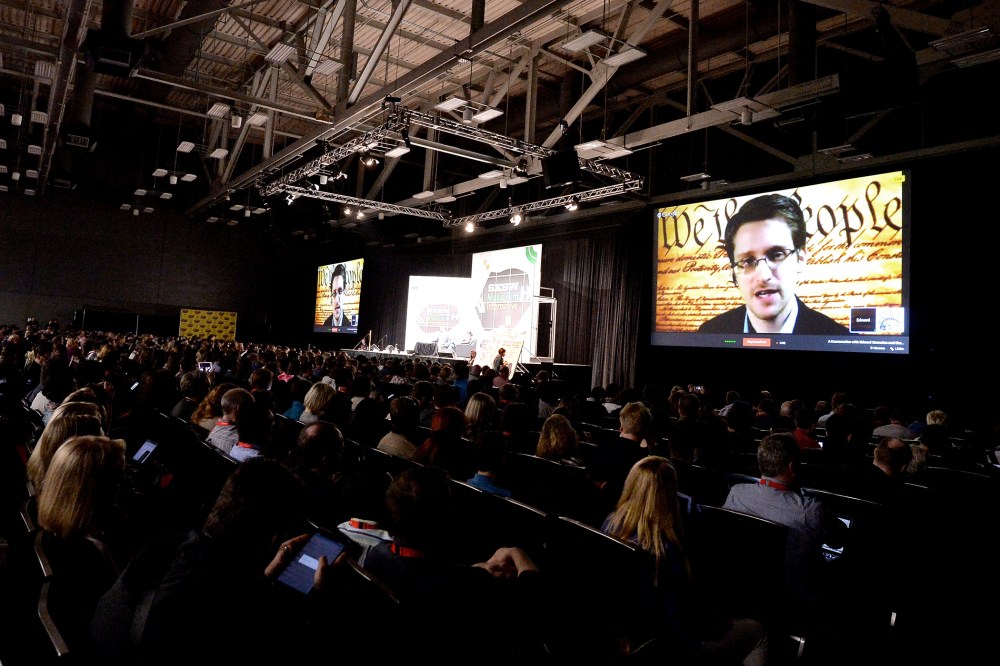
The expansion of mass surveillance to a global scale is “setting fire to the future of the Internet,” and threatening the civil rights of Americans, former NSA contractor Edward Snowden said at the South by Southwest Interactive conference Monday.
Snowden, who disclosed thousands of classified documents detailing National Security Agency surveillance and intelligence activities, said Americans are less safe thanks to the NSA.
“We rely on our ability to trust communications. Without that, we don’t have anything,” Snowden said.
During a conversation via teleconference from Russia (where he has been living under temporary asylum since August), Snowden responded to criticisms from NSA officials, talked about the future of privacy and technology, and answered questions about his disclosures which sparked outrage over U.S. government spying on Americans and eventually led President Obama to order a series of reforms to the programs.

“We need public advocates, we need public representatives, we need some sort of oversight,” Snowden said of the bulk data collection programs being run in the name of national security.
Michael Hayden and Keith Alexander, the NSA’s former and current director, “have harmed our Internet and security and national security” by prioritizing activities that meant the U.S. could gain access to networks and data around the world, while missing real threats, Snowden said.
Snowden was hopeful about increasing accountability for the spying programs through the courts – even through Congress’s intelligence committees. “We have an oversight model that could work,” Snowden said. “The key factor is accountability. We can’t have officials like [Director of National Intelligence] James Clapper lie to the country and face no criticism.”
Where the legal system is involved, the level of secrecy is so high that it’s virtually impossible to get answers, Snowden said. “If you challenge the government, the government throws it out and says, ‘you can’t even ask about this.’” When private companies collect data, on the other hand, the terms of any agreements are public. “That’s the difference and it’s something we need to watch out for.”
“If we’re not informed, we can’t consent to these policies,” Snowden said.
In a conversation with Ben Wizner and Christopher Soghoian of the American Civil Liberties Union, Snowden called on the technology community to build more secure products and to make security technology more usable for the average individual. Programmers, not legislators, Snowden said, are “the folks who can really fix things, to enforce our rights through technical standards, even if congress hasn’t gotten to that point.” The American government has charged the 30-year-old with three felonies for leaking classified information that exposed details of expansive U.S. surveillance activities on NSA spying to reporters at multiple news outlets. He faces decades in prison if convicted. He fled the U.S. for Hong Kong in June and was eventually granted permission to stay in Russia for one year. Because the U.S. government has revoked his passport, Snowden is unable to travel to any country that would potentially offer him permanent asylum. If something is not done now to reign in U.S. activities, other nations could follow suit, which could have dire consequences in more oppressive regimes. “Every citizen has something to lose, Snowden said to the SXSW audience. “If we allow NSA to continue unrestrained, it gives other governments the green light to do the same.” When asked if he would leak information again, despite what has happened in the past eight months, he said, “absolutely, yes.” “I took an oath to support and defend the Constitution, and I saw that the Constitution was being violated on a massive scale,” Snowden said.
Meredith Clark
Meredith Clark is a freelance writer and editor. She was previously a senior news producer for "Patriot Act with Hasan Minhaj," a reporter with MSNBC.com, the digital politics and culture editor at Glamour and a senior news and politics editor at Refinery29. She has written for Vulture, Rolling Stone, Self, Marie Claire, Cosmopolitan, The Daily Beast and Bustle. Recommended


