








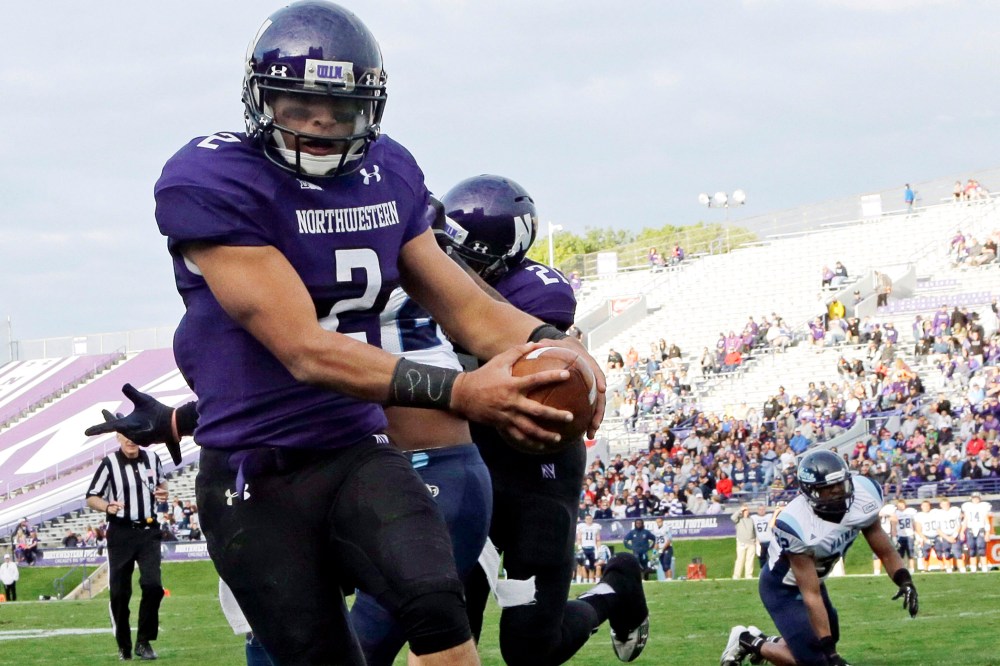
On Wednesday, Northwestern University formally challenged a National Labor Relations Board (NLRB) decision giving college athletes the right to form a union. The case will now be proceed from NLRB’s Chicago regional office to the board’s headquarters in Washington, D.C.
NLRB Regional Director Peter Sung Ohr issued the original ruling two weeks ago, after members of the school’s Division I football team petitioned for the right to hold a union election. The petition argued that members of the college football team are employees of the school, and therefore entitled to the labor rights enumerated under the National Labor Relations Act (NLRA).
“We applaud our players for bringing national attention to these important issues, but we strongly believe that unionization and collective bargaining are not the appropriate methods to address these concerns,” said Alan K. Cubbage, Northwestern’s vice president for University Relations, in a statement.
Ohr’s ruling was a considerable upset for both Northwestern University and the NCAA, which has long insisted that student-athletes are not employees. If the players do win on appeal and ultimately form a union, it could have reverberations throughout the entire NCAA.
In fact, the case is already sending shockwaves throughout the country. State legislators in both Ohio and Connecticut are now working on legislation directly inspired by the Northwestern labor dispute. Both the Ohio and Connecticut proposals would aim to clarify the relationship between the state and student-athletes at public universities. In Connecticut, state Rep. Patricia Dillon is researching whether it would be possible to define those athletes as employees of the state, with access to all the attendant labor rights that go along with that. In Ohio, Republican legislators have filed an amendment aiming to do the exact opposite.
If the NLRB ultimately rules in favor of the Northwestern Wildcats and against the university, then student-athletes at private colleges across the country will also have the right to form a union. But the same would not apply to athletes at public schools, which is why Dillon says she decided to get involved.
“If the NLRB decision holds, then it will apply to students in private schools, which means the student in public universities that are athletes would have fewer rights than those in private schools,” she told msnbc. “So it would take action on our part to give them the same opportunity.”
Mike Dittoe, the director of communications for the Ohio House Republicans, said the proposed amendment in that state was merely intended to “reaffirm what everyone else has thought.”
“I think generally it is just always a perceived notion or an unwritten assumption that students who are athletes are not employees of the university,” said Dittoe. “I think if you ask the average person what they thought of that, they would argue they are not employees of the universities.” Public opinion is evenly split on the question of whether student-athletes should be able to unionize, according to a recent Washington Post–ABC News poll. A nearly two-thirds majority of poll respondents did say they oppose paying salaries to the athletes, but there was a big racial gap in responses to that question: Whereas 73% of white respondents opposed paying college athletes, 51% of non-white respondents were in favor. State legislation is unlikely to settle the question, even in Connecticut and Ohio. Dillon said she is just beginning her research into whether the Connecticut State Legislature can take meaningful action, and the Republican chair of the Ohio House Finance and Appropriations Committee has admitted that his party’s amendment could end up having very little effect. Yet the fact that legislators in two other states are reacting to the Northwestern NLRB case is a testament to its national significance. Dillon said conditions within college sports had “really deteroriated” over the past twenty years, in large part because the seasons for various sports have gotten longer. She decided to legislate the issue, she said, because she doesn’t want young athletes to be “treated like raw material and tossed aside.” “If the working conditions are good, you want young people to be involved in organized sports,” she said. “For parts of the cities I represent in the legislature, team sports are seen as redemptive. It’s seen as an opportunity to get out, an opportunity to get an education. I don’t want them to be exploited.”
Ned Resnikoff is an urban policy analyst, researcher, writer, and editor. His byline has appeared in a variety of publications, including the New York Times, San Francisco Chronicle, Dissent, and The Nation. He writes the newsletter Public Comment, which can be found at publiccomment.blog. Recommended


