








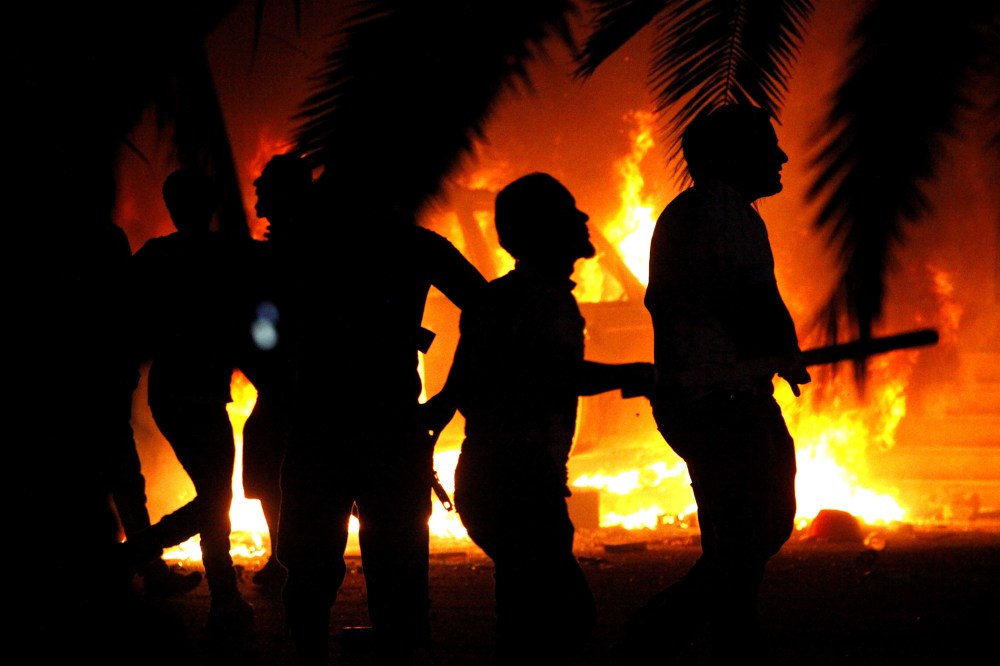
When the trailer for an upcoming film about the Benghazi terrorist attacks aired during Tuesday’s GOP presidential debate, speculation flared that the Michael Bay film may be a bombshell for the Hillary Clinton campaign.
The upcoming film, “13 Hours: The Secret Soldiers of Benghazi,” is an action-thriller which retells the story of rescue efforts undertaken to save the lives of Americans under siege at the U.S. embassy in Libya in 2012. And although the film isn’t scheduled to hit theaters until January, its trailers suggest that the film lays some of the blame for the deaths of four Americans at the feet of higher ranking government officials. In the past, director Bay has professed to not have a dog in political fights, but the film’s release, just weeks ahead of the Iowa caucuses, will surely be a talking point for critics of Clinton’s handing of the terrorist attacks.
However, history suggests that Hollywood has a mixed record when it comes to influencing presidential elections.
Films released in an election undoubtedly can capture a national mood. In 2008, more than a few critics viewed “The Dark Knight” as a somewhat fascistic homage to the last gasp of then-President Bush’s domestic surveillance state, while that year’s eventual Best Picture winner, the decidedly more sunny “Slumdog Millionaire,” was cast as the heralding of a more optimistic Obama era. There are also films that appear to be deliberately positioned to be a part of the electoral season conversation, or others that inadvertently become lightening rods. No movie can elect a president, voters do, but in a media landscape that can be increasingly dense and noisy, movies have an ability to help solidify perceptions or create new ones.
Here are a few examples of movies that had moment, or missed theirs, during the height of election season:
“All the President’s Men” (1976) – This Robert Redford-Dustin Hoffman classic was released in the Spring of 1976, when incumbent President Gerald Ford was fending off a challenge from Washington outsider Jimmy Carter. The film, which recreates Washington Post reporters Bob Woodward and Carl Bernstein’s historic coverage of the Watergate break-in and subsequent cover-up, was not just an enormous hit but it kept a major weakness for Ford (his pardon of Nixon for his Watergate-related crimes) in the public’s consciousness. To add insult to injury, Redford lent his Hollywood heartthrob charisma to the Carter campaign, helping the Georgia governor prep for his televised debates against Ford. “All the President’s Men” would be nominated for several Academy Awards, winning four, while Ford fell short that November.
“The Right Stuff” (1983) – Director Phiip Kaufman’s adaptation of the Tom Wolfe best-seller about the Mercury Seven astronauts and their first forays into space travel features a largely flattering portrait of John Glenn, who was a U.S. senator from Ohio and an aspiring Democratic presidential candidate around the time of the film’s release. Although the filmmakers and Glenn were in no way coordinating, the perception was created prior to “The Right Stuff”‘s release that the film was in some way meant to promote the ex-astronaut’s campaign. This may have hurt the film at the box office, it flopped despite rave reviews ranking it among the best films of the year. Glenn’s candidacy petered out too, but today the film is considered a cult classic.
“Fahrenheit 9/11” (2004) – In the summer of 2004, Michael Moore’s documentary savaging the George W. Bush administration, was the unexpected blockbuster of the year. The film functions as an indictment of Bush White House’s handling of both the September 11th terrorist attacks and the ongoing war in Iraq. The film stopped short of endorsing Bush’s Democratic opponent John Kerry, but the outspoken director made no secret of the fact that he hoped it would swing the election against the president. This may be the first time a film has this kind of impact,” Moore told USA Today at the time. Despite breaking box office records for a documentary film, Bush narrowly defeated Kerry that fall. “W” (2008) – Just a couple weeks before the U.S. elected then Sen. Barack Obama to replace President George W. Bush, director Oliver Stone did the unprecedented — releasing a biopic about the sitting president while he was still in office. The awkward timing of the movie wasn’t lost on critics or audiences, who by-and-large thought it might have been too soon to fully understand the scope of Bush 43’s presidency so close to its waning days. The film under-performed financially, but by that point Bush’s approval ratings were already historically low and Obama had begun to pull away from his GOP rival Sen. John McCain in the general election polls. “2016: Obama’s America” (2012) – Conservative writer Dinesh D’Souza was the brains behind this unabashedly partisan documentary which hit theaters in the run-up to the 2012 presidential campaign. The film sought to cast doubts on everything from the president’s patriotism to his heritage, and although received scathing reviews from most mainstream critics, it performed well — at least initially — in smaller markets. The film was particularly infamous for a scene filmed in Nairobi featuring the president’s Kenyan half-brother, George. D’Souza implies in the sit-down that President Obama had abandoned his African ancestors to live in poverty. The film failed to convert many voters; the president was re-elected handily, and D’Souza’s image took a hit last year when he was sentenced to five years probation for violating campaign finance laws. “13 Hours: The Secret Soldiers of Benghazi,” which is based on a non-partisan, non-fiction book by Mitchell Zuckoff, will expand to theaters nationwide on January 16, 2016, one year to the date that the controversial Chris Kyle biopic “American Sniper” reached mass audiences.
Adam Howard Recommended


