








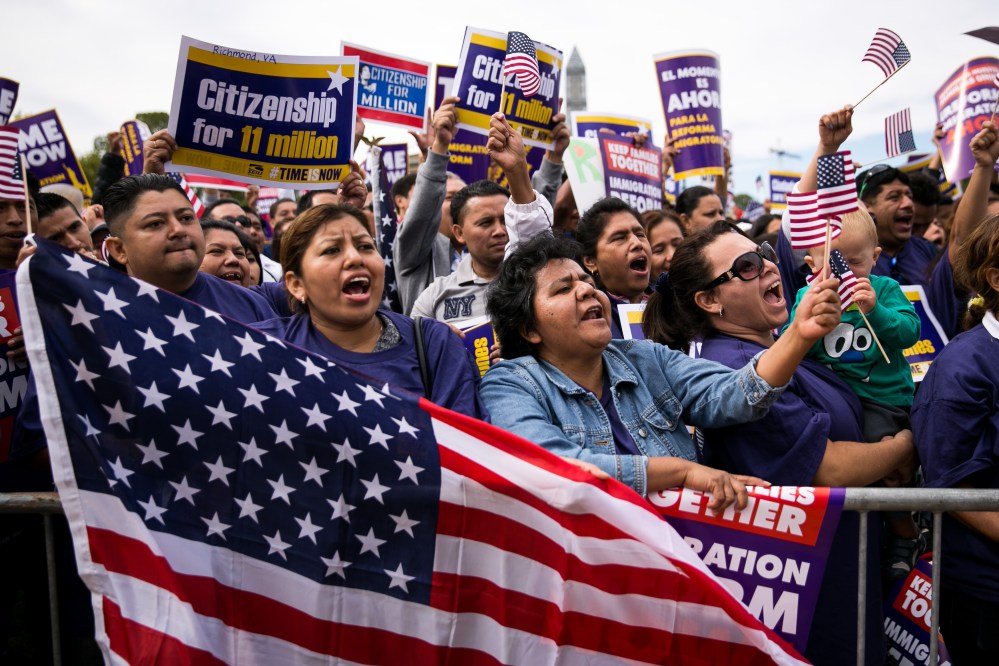
A federal court judge on Tuesday declared aspects of President Obama’s executive action on immigration as unconstitutional, taking a case that legal experts say has virtually no direct connection to questions of the president’s executive authority as an opportunity to denounce the looming policy changes.
U.S. District Court Judge Arthur J. Schwab, a George W. Bush appointee who serves in the western district of Pennsylvania, issued a scathing, 38-page memo Tuesday detailing how the new policies go “beyond prosecutorial discretion” and violate the separation of powers.
Though the court’s opinion will not likely have any direct impact or serve to invalidate the policy, it marks the first time a federal court has addressed the constitutionality of the president’s executive actions.
RELATED: Obama administration hit with lawsuit for locking up potential asylum seekers
The case involves an undocumented Honduran man named Elionardo Juarez-Escobar who pled guilty to charges of “illegal re-entry” after he was already deported in 2005. After returning to the United States a short time later, the Juarez-Escobar was eventually put on the Department of Homeland Security’s radar once again after he was arrested for drinking and driving and operating a vehicle without a driver’s license.
Schwab’s memo does not directly challenge the executive actions, but instead raises the issue while considering whether the new policies should affect how the court should sentence Juarez-Escobar. In order to determine whether the executive actions would apply to Juarez-Escobar’s case, the court must first determine whether the new measures are even legal, Schwab attests.
What remains unclear is whether Juarez-Escobar would even qualify for the executive actions in the first place. Under the new measures — which are being called the Deferred Action for Parental Accountability — undocumented immigrants who have lived in the U.S. for at least five years, have no criminal record and U.S.-born children can apply to temporarily live and work in the country for three years. Applicants who fit those qualifications will be reviewed on a case-by-case basis. But nowhere in Schwab’s memo is there mention that Juarez-Escobar has children who are U.S. citizens, and it is unclear whether his past run-ins with the law would count against him in seeking deferred action.
RELATED: Obama defends executive action: ‘Immigration benefits everyone’
The White House has argued repeatedly that President Obama does have the legal authority to use prosecutorial discretion in determining which undocumented immigrants are priorities for deportation, and which aren’t. But the lack of a direct connection between the case and the President’s executive action, and set months before the planned implementation of the measures, has legal experts scratching their heads over why the judge brought up the issue in the first place.
%22It%20strikes%20me%20as%20odd%20for%20a%20single%20judge%20to%20devote%20so%20many%20pages%20of%20a%20memo%20to%20his%20feelings%20about%20the%20president%E2%80%99s%20executive%20action%20when%20the%20case%20itself%20is%20about%20an%20individual%20immigrant%20who%20faces%20illegal%20re-entry%20charges.%22′
“It strikes me as odd for a single judge to devote so many pages of a memo to his feelings about the president’s executive action when the case itself is about an individual immigrant who faces illegal re-entry charges,” said Shoba Sivaprasad Wadhia, a law professor at Pennsylvania State University and expert in prosecutorial discretion in immigration law. “There’s a little bit of political theater, and maybe the judge had a bad day.”
Wadhia said many of the arguments raised in Schwab’s memo Tuesday are easily debunked by experts in immigration law and the history of prosecutorial discretion. In one sub-head, Schwab writes, “Inaction by Congress Does Not Make Unconstitutional Executive Action Constitutional.” Another reads, “Executive Action Goes Beyond Prosecutor Discretion — It is Legislation.” “That’s spin to me,” Wadhia said. “The reality is that Congress has failed to act and President Obama thought it wise to step in and use the proprietorial tools in his arsenal.” RELATED: GOP angry with Ted Cruz over immigration vote The court’s opinion will likely bolster conservative-led efforts to dismantle President Obama’s measures through the courts before the application process even begins early next year. Already some 24 states have joined in a coalition to sue the president for overstepping his authority at the expense of local governments. Meanwhile in Congress, some lawmakers have made clear their efforts to block the president’s executive actions may only ramp up once Republicans take over both chambers of Congress in January. “It’s tantamount to both sides lining up their troops for battle,” Brandon Rottinghaus, an associate professor of political science at the University of Houston, said of the judicial opinion Tuesday. The White House will likely have to issue a formal response, he added, one that will have to be just as much political as it is legal. “It could be a damaging public relation problem for a policy that is already controversial.” Schwab is no stranger to controversy himself. In circumstances that are exceptionally rare for federal judges, Schwab was pulled from a case not just once, but twice, in 2008 and 2012. And according to a survey released by the Allegheny County Bar Association, attorneys handed Schwab the lowest possible ranking among federal judges. His worst marks came in for categories of “impartiality” and “temperament.”
Amanda Sakuma Recommended


