








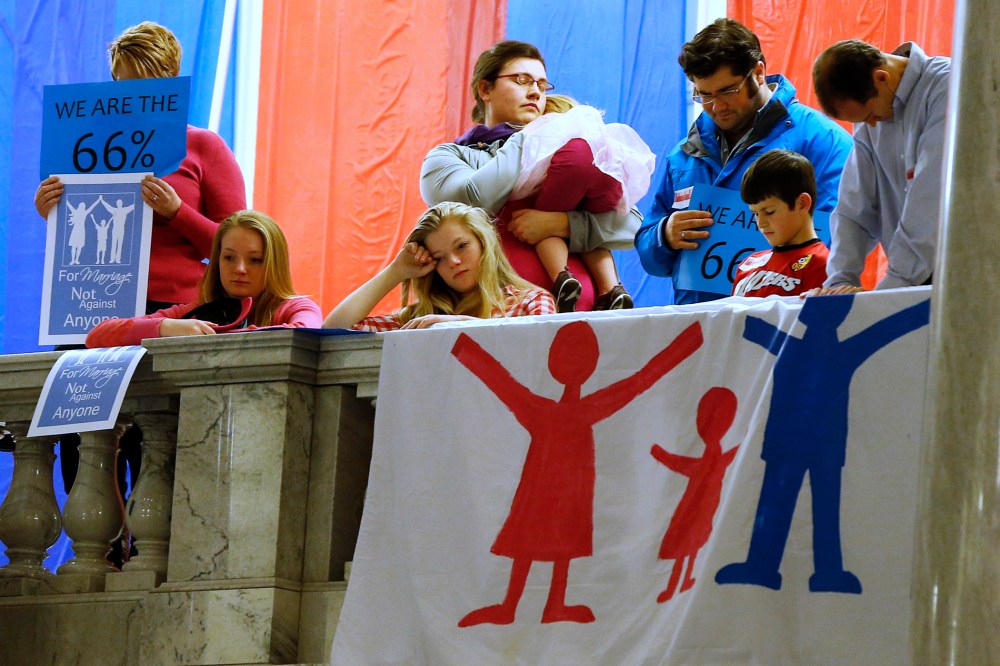
A new bill that would allow Kansans the right to deny same-sex couples a host of basic life needs– including goods, services, benefits or even employment–on the grounds of “sincerely held religious beliefs” just took one step closer to becoming law in the Sunflower State.
House Bill 2453 sailed through Kansas’ House Federal and State Affairs Committee on Thursday through a voice vote, and now heads to the Republican House leadership for a decision on whether to bring it up for debate in the full chamber. Seven lawmakers recorded their “no” votes, but none of bill’s supporters did the same.
If passed, the measure would allow a photographer, for example, whose religion condemns homosexuality, to refuse to take pictures at a same-sex couple’s wedding. Or it would similarly protect a car insurance salesman, who for religious reasons wouldn’t give a married gay person the same reduced premium offered to a married heterosexual person. In another scenario, it could allow a Catholic adoption agency employee to refuse to process the paperwork for a same-sex couple hoping to start a family.
And in each of these instances, the law would block lawsuits or government sanctions against those individuals or businesses who claim to have a strong religious objection to homosexuality.
“It’s not that we want to discriminate against someone because they’re gay,” said Republican state Rep. Travis Couture-Lovelady, who supported the measure Thursday, in an interview with msnbc. “We just don’t think you should be coerced if you have a private business into being part of the [wedding] ceremony if that’s something that’s against your sincerely held religious belief.”
Kansas’ bill is the latest in a series of efforts by conservative lawmakers to blunt historic gains for marriage equality across the country. Similar initiatives have surfaced in Arizona, Kentucky, Oregon, South Dakota, and Washington state.
Now that federal courts have struck down same-sex marriage bans in Utah and Oklahoma, both part of the Tenth Circuit along with Kansas, supporters feel HB 2453 would provide a necessary safety net for religious Kansans in the increasingly likely event that a judge similarly overturns the state’s 2005 voter-approved barrier to same-sex nuptials.
Opponents, however, believe the bill’s language invites broad discrimination in virtually every aspect of a person’s life, and could allow government officials to ignore legally valid same-sex marriages.
“This bill on its face does absolutely nothing until and unless the Supreme Court strikes down same-sex marriage bans nationwide–then it’s triggered,” said Thomas Witt, executive director of the Kansas Equality Coalition, to msnbc. “Police responding to domestic violence disputes between same-sex couples, clerks refusing to give marriage licenses to gay people–basically anything you’d expect the government to do, an official who doesn’t want to accept the fact that we’re married can just not do their job and pretend we’re not married.”
Couture-Lovelady acknowledged that the bill leaves room for state officials to ignore same-sex unions on religious grounds, but insisted that “just because you have a government job doesn’t mean you lose your constitutional rights.”
“They would still have the ability to get their marriage license,” he said in response to the hypothetical situation where a religious clerk refuses to give a marriage license to a gay couple. “There’s just the possibility of having to drive a little farther to find someone else to do it.”
Kansas is one of 33 states that currently bans same-sex marriage, and one of 29 states that does not protect against discrimination based on sexual orientation. But given the momentum the gay rights movement has built since June, when the U.S. Supreme Court gutted the federal Defense of Marriage Act (DOMA) and opened the floodgates for legal challenges to state bans on same-sex marriages, red states have begun to prepare for what they fear is inevitable: court-mandated changes to their laws governing sexual orientation and same-sex relationships.
“It’s just a matter of time as to when those states that have traditional marriage enshrined in their constitutions will be overturned,” said L. Martin Nussbaum, an attorney who specializes in religious liberty and who, if not for inclement weather, would have testified last week on behalf of HB 2453.
“In various states, there have been legislative or governmental efforts to closet organizations with traditional religious beliefs,” he continued. “The purpose of this bill is to guarantee religious freedom. It guarantees religious people or organizations would not suffer civil penalties or restrictions.”
Recent court cases in Washington, Colorado, Oregon, and New Mexico have resulted in fines for wedding service providers who have refused to work with same-sex couples because of their religious beliefs. Nussbaum said the Kansas legislation would protect small businesses in similar situations, but would also go much further, providing legal cover to people like Julea Ward, an Eastern Michigan University student who was expelled from her counseling program because she would not treat a gay person for religious reasons.
“She had done everything right, had three courses left to get her degree, and [EMU] expelled her from the program simply because she felt a conflict in her conscience from doing what her professional code of ethics required,” said Nussbaum to msnbc. “There are other circumstances in which I would hope the bill would give people the right to decline to provide services if that’s what their conscience instructs. That’s part of what a diverse America is about.”
That the bill goes beyond the wedding service industry is precisely what concerns its opponents.
“I don’t think you should be able to pinpoint who you want to serve and who you don’t want to serve,” said Democratic state Rep. Ponka-We Victors, the first Native American elected to the Kansas state House who has faced her own share of discrimination in her lifetime. “I know what it’s like to be on the other side,” she said to msnbc. “Are we going to go back to signs on business doors that say ‘We don’t serve this group of citizens?’ It’s ridiculous.” In heated committee hearings last week, Democratic state Rep. Emily Perry brought up the potential consequence of a police officer’s citing religious liberty to refuse intervening in a domestic violence dispute between a gay couple. “Minutes and seconds make a difference between life and death in those situations,” she said to msnbc. “If somebody arrives on the scene and then calls for backup because they don’t want to handle the situation, that’s life or death. That really to me is offensive.” Nussbaum vehemently rejected that scenario, calling it “extremely implausible.” “It’s almost unimaginable that if gay couples were physically abusing each other that a police officer would say, I’m religiously opposed,” he said. “I don’t know any religion that would subscribe to that idea…[and] I don’t believe the bill would provide protection to the officer in that case.” It’s not the first time religious liberty has come up in the national debate on social issues. People have cited religious beliefs as justification to treat people differently on the basis of race and gender, and most recently, as reason to deny contraceptive coverage in compliance with the Affordable Care Act. In the case of the former, courts have generally sided with those who claimed discrimination. But in the contraceptive coverage movement, religious liberty has had a more successful run. As bills like HB 2453 become what looks to be the next front in the marriage equality debate, LGBT advocates are trying to predict which version is in store for them. “The scary thing to look at is how religious exemption issues have played out in the contraceptive coverage movement, and how courts have expanded them more and more and more,” said James Esseks, director of the ACLU Lesbian Gay Bisexual Transgender & AIDS Project, to msnbc. “In the racial justice movement, it’s a much rosier version.” “What we’re trying to figure out as this religious liberty argument gets bigger and pushed more strongly in the LGBT rights context” he continued: “Are we going to look like the reproductive freedom world, or like the race and sex discrimination world?” It’s one of the many questions HB 2453 brings to the fore.
Emma Margolin
Emma Margolin is a reporter at MSNBC.com. Recommended


