








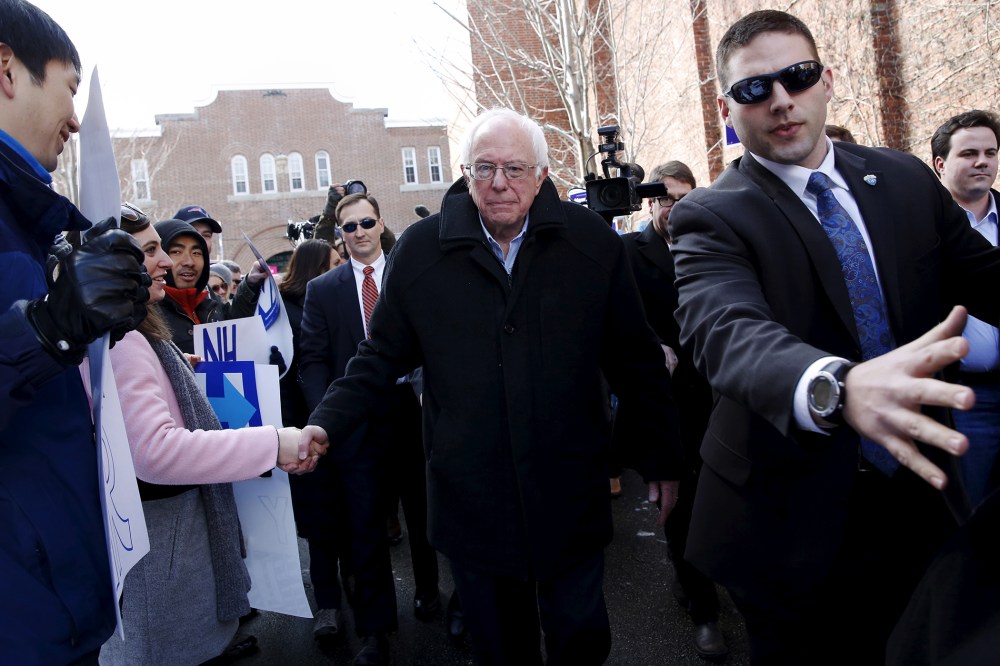
Bernie Sanders’ foreign policy — or apparent lack thereof — is not an oversight that’s unique to the presidential candidate. It’s representative of a pervasive problem within the progressive movement.
Progressive elected officials in America are more often raised on domestic issues: lobbying on healthcare, labor rights, comprehensive immigration reform, education, gun control, criminal justice, LGTBQIA, or pay equity. Many of the members of the Congressional Progressive Caucus, for example, cut their policy teeth locally, as city council member, county supervisor, or state legislator. Rarely did they have to legislate on foreign wars.
That deficit becomes a serious liability for progressives when contesting U.S. military action in Afghanistan, Pakistan, Yemen, Somalia, Libya, Iraq and more. Progressives appear reactive and uninformed, rarely speaking with the on-the-ground clarity and conviction of a Pentagon employee who’s been there and done that.
RELATED: Sanders supporters shrug off lack of foreign policy experience
This dynamic was ever apparent when I was a congressional staffer and why I, and others, spent as much analytical and actual time as we could in the Middle East, Central, South and Southeast Asia, Horn of Africa and Latin America. If we were to propose alternatives to Pentagon policy, we had to know the reality and rhetoric on the ground.
It’s this deficiency that’s now a liability for Sanders. He is appearing ill prepared when suggesting, for example, that Muslims be on the front lines of the fight in the Middle East. (To be fair, Clinton’s tokenistic rejoinder about Muslim-Americans as the “best defense” against homegrown terrorism in the U.S. wasn’t much better.)
But Sanders could easily turn this liability into an asset using the current principles and policy parameters that he’s applying to domestic politics. Campaign finance reform and income inequality — two of his favorite talking points — have obvious application to foreign affairs, foreign aid and foreign trade.
Consider the campaign finance reform implications of the defense industry, which is perpetually culpable for waste, fraud and abuse of taxpayer dollars. The hundreds of millions that the defense industry spends annually lobbying Congress — forcing America to commission war machinery to the tune of $35 billion that we don’t need and often store, for instance, in Arizona graveyards or pawn off to U.S. police forces — would finally be held accountable.
The now-infamous and ubiquitous profiteering and price-gauging that happens all the time in the war zone might see better monitoring and oversight in a Sanders administration. (For Sanders to walk the walk on defense spending, however, he’ll need to clean up his Vermont act quick as there’s no justification for trillion-dollar stealth fighters.)
Just examine any Special Inspector General for Afghanistan or Iraq Reconstruction audits to witness the egregious nature of the military misspending. Never mind the fact that the Department of Defense is the only government agency* that has never been audited by the Government Accountability Office. We know the problem exists, there’s just no sheriff in town willing to crack down on the corruption. The Pentagon can’t keep getting a free pass for losing billions of taxpayer dollars in the war zone.
RELATED: Clinton questions whether Sanders has a foreign policy network
Nor can the defense industry, which is only answerable to its shareholders and relies on America going into new wars and using new equipment. Cleaning up the industry’s stranglehold on Washington is low hanging fruit, bipartisan and a foreign policy issue Sanders should seize. It’d keep us out of a good chunk of the existing wars, of which there are too many, and appeal to the non-interventionist nature of independent voters, too. While doing so, Sanders should also use the rubric of campaign finance reform to weaken the private sector’s powerful purview over the future of Pacific and Transatlantic trade agreements. Similarly shareholder-driven, they have way too much control over the text.
Income inequality has even more foreign policy relevance that Sanders should seize. It’s not an American phenomenon (though it’s rampant here and reaching record levels); it’s a global trend. When we’ve got 62 of the richest individuals internationally coveting as much wealth as the bottom half of the world’s population, we’ve got a problem. And many of those poor — living in every war zone that we’ve initiated (i.e. Afghanistan, Pakistan, Yemen, Somalia, Libya, or Iraq) could do with some serious socioeconomic assistance, something the U.S. has never prioritized during, before or after military action. In every war-torn country’s case, we have not left that nation’s water, power, roads and bridges, housing, food systems or sanitation better off. I’ve been to Yemen, Somalia, Afghanistan, Pakistan, Syria and more. This was never our priority and it was palpable. If or when it ever was, via state-sanctioned foreign aid, it’s often been top-down, using foreign contractors versus local leaders, and leaving little in terms of legitimacy, credibility and capacity inside the country. If we truly want to prevent violence and win hearts and minds on the ground, it’s not going to be with more military interventions, which recent presidents have increasingly ramped up. It’s going to require a laser-like focus on the very inequality that Sanders summons — making sure low-income communities everywhere, from Flint to Fallujah, are getting fair and equitable representation in Washington. RELATED: Clinton struggles on Iraq war legacy This could be Sanders’ foreign policy, upsetting the status quo in Washington and using his existing talking points and policy frameworks to prioritize ground-up economic development, social inclusion and even environmental sustainability — not only in our traditional foreign policy dealings with adversaries but also in our trade policy. Done smartly, Sanders could execute a seamless, non-contrived transition from his preferred income inequality and campaign finance reform talking points to a legitimate foreign policy platform. Done strategically, Sanders could easily grow his appeal among progressives across the domestic and foreign policy audiences. And done with sensitivity, Sanders might even gain support from the war zones and war-ridden populations that once entertained the notion that an Obama administration might be different. It’s time for genuine progressives to stand up — on every policy. Michael Shank, Ph.D., is adjunct professor at George Mason University’s School for Conflict Analysis and Resolution and NYU’s Center for Global Affairs, and writes in his personal capacity. *CORRECTION: An earlier version of this article incorrectly stated that the Department of Homeland Security had never been audited by the Government Accountability Office. It was audited in 2013 and given a “clean opinion.”
Michael Shank Recommended


