








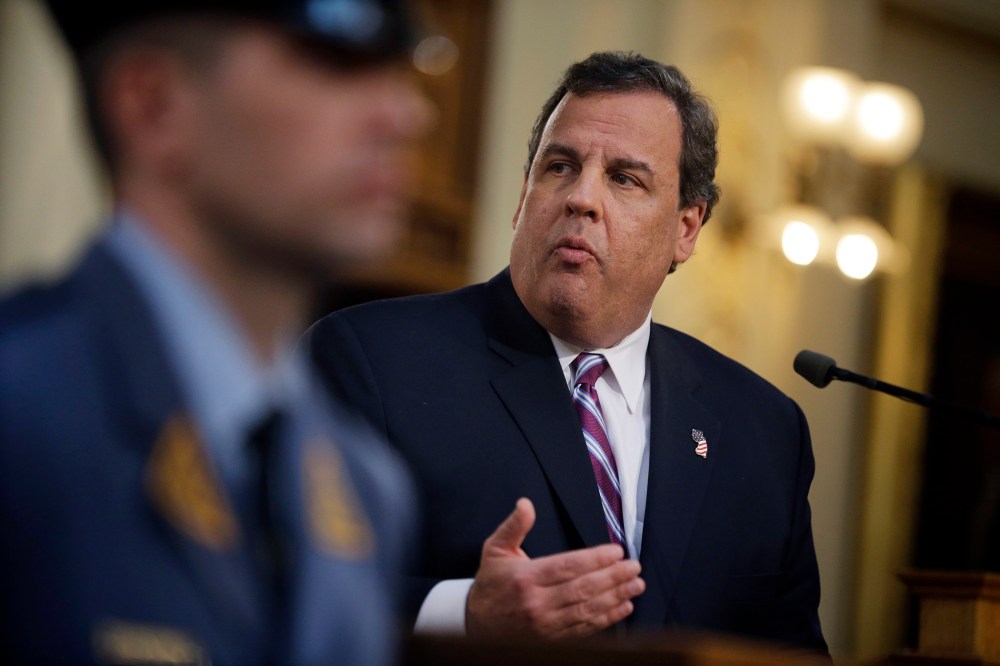
Despite being waist-deep in scandals that are threatening to derail his political career, New Jersey Gov. Chris Christie is forging ahead. He’ll hold a town hall meeting – his second of the year – on Wednesday in Long Hill. On Thursday, Christie plans to fundraise in Boston on behalf of the Republican Governors Association, which he chairs, alongside failed GOP presidential nominee Mitt Romney.
Christie on Tuesday attempted to shift focus to his financial priorities during his annual state budget address, presenting his balanced (as required by law) $34.4 billion spending plan to the Democratic-controlled legislature, calling for no tax increases and offered a $2.25 billion payment to the public worker pension fund.
Christie touted the $2.25 billion pension payment as a record amount during his speech. It’s likely to please Democrats, some of whom previously said they’d be willing to shut down the government if Christie doesn’t fulfill the state’s pension obligations.
Christie’s pension payment plan is still approximately $150 million less than the $2.4 billion required under a reform deal he signed in 2011. Three years ago, Christie raised the retirement age to 65 and required public workers to pay more for their retirement benefits. In turn, the state promised to increase pension payments each year for seven years.

Senate President Steve Sweeney, a Democrat, has said the $2.4 billion pension payment is “not negotiable.”
Democratic Assemblyman John Burzichelli, who sits on the budget committee, told msnbc that “$150 million short is not the number we need. There’s no alternative. It has to be met. It has to come at the expense of something else.”
During his address, Christie lamented that little is left over for additional spending on programs like K-12 education, drug rehabilitation and public safety. The governor said that even though the budget represents an increase of 3.5% over what the state spent last year, 94% of that increase is taken up by pensions, health benefits and debt.
“Due to our pension, health benefit and debt obligations, only 6% of new spending can be focused on the areas where we really want to dedicate our resources – education, tax relief, public safety, higher education, drug rehabilitation, heath care and critical services for the most in need.” The governor also laid the groundwork for even greater pension reforms, which may not go over well with public workers.
“Though the historic 2011 reforms we enacted together immediately reduced New Jersey’s state and local unfunded pension liabilities by 32 percent, it just doesn’t go far enough,” said Christie. “Without additional reforms, New Jersey taxpayers still owe $52 billion to fully fund the pension system.” Christie did not go into detail about what the pension changes may entail. The governor did not address his recent troubles, including the seemingly political-motivated lane closures ordered by his staffers on the George Washington Bridge. Christie has argued he had no prior knowledge of the scheme and has since fired one of his top aides. He’s also under investigation for alleged misuse of Hurricane Sandy relief funds. Democratic Hoboken Mayor Dawn Zimmer has also claimed her storm-torn city was denied relief funds from Gov. Christie’s office because she refused to support a prime real estate development project. How the swirling scandals will affect Christie’s ability to push his economic agenda is yet to be seen. Brigid Harrison, a political science professor at Montclair State University, said there’s likely to be more acrimony and tension than in previous years as the governor faces criticism for a shortage of state revenue, underfunding pension obligations, and cuts to the state’s Earned Income Tax Credit for low-income residents. Combined with allegations that his office abused its power, Christie has an “uphill struggle on his hands.” Meanwhile, a new Monmouth University/Asbury Park Press poll shows Christie’s approval rating has dropped by 20 points to 49% among registered New Jersey voters since the scandal became public. The survey also showed that just 45% gave Christie an above-average grade on Hurricane Sandy recovery, a big dip from five months ago when 72% of those polled gave the governor an above-average grade.Recommended


