








By Alex P. Kellogg
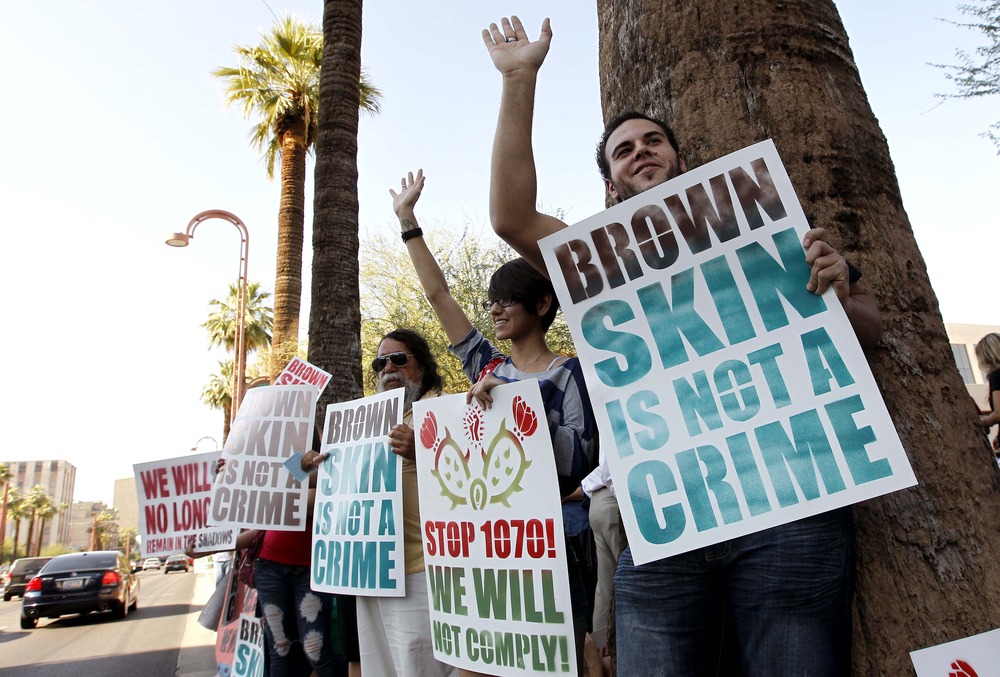
Civil rights and immigration advocacy groups have vowed to ensure that not a single element of Arizona’s controversial immigration law takes effect in the coming weeks as anticipated.
The groups, which represent the plaintiffs in a class-action lawsuit challenging the law, named Arizona SB 1070, plan to argue in court that the law is unconstitutional.
“We will fight to see that this law never takes effect, whatever that takes,” said Linton Joaquin, general counsel for the National Immigration Law Center (NILC) and a lawyer for the plaintiffs.
NILC is one of roughly half a dozen organizations, including the Mexican American Legal Defense and Educational Fund (MALDEF) and the American Civil Liberties Union (ACLU) that began challenging Arizona SB 1070 immediately after it was signed into law in 2010.
The 65-page motion, filed last week, requests an injunction that will prevent the law from taking effect following a Supreme Court ruling in June that upheld portions of it while striking down other elements.
Filed in federal district court in Phoenix, Ariz., the motion argues that the law should be struck down for two reasons: it would allow individuals to be detained by local and state authorities for immigration violations, which they say would violate federal law; and it would allow for discriminatory racial profiling of Latinos.
The lawsuit the Supreme Court ruled on in June was brought by the Justice Department.
In its ruling on the case the Court struck down key provisions of Arizona’s tough law, aimed at curbing the influx of illegal immigrants. But it left in place a controversial provision requiring police to check the immigration status of people they detain and suspect to be in the country illegally.
That portion of the law, Section 2B, is nicknamed the “show me your papers” provision, and is the linchpin of the law.
“We’ve always thought that SB 1070 had a whole host of constitutional problems,” Victor Viramontes, National Senior Counsel for MALDEF and a lawyer in the case, said Monday. “The Supreme Court decision basically vindicated us in many ways already.”
Viramontes and other lawyers for the plaintiffs say they are prepared to take their case all the way to the Supreme Court, if necessary. The Court cautioned in June that it would track how the law is implemented.
Lawyers argue that law enforcement authorities, elected officials and other local and state employees in Arizona have repeatedly made plain in public comments that the law will be applied in a discriminatory fashion.
In their motion they point to the statements of local authorities in Arizona, such as Sheriff Joe Arpaio of Maricopa County, who they say has made no secret of the fact that even in the absence of SB 1070 he has inquired about the immigration status of individuals in the past. A separate class-action lawsuit against Sheriff Arpaio claims he has engaged in a pattern of discriminatory policing practices in recent years. “Law enforcement officers are telling us that they will be violating core constitutional rights,” said Viramontes. The motion also delineates numerous examples of what lawyers argue is harassment and discrimination already taking place in Arizona. They say such issues will only worsen if any portion of Arizona SB 1070 becomes law. The portions of the law upheld by the Supreme Court are expected to take effect soon, following the completion of routine federal court procedures. Arizona Governor Jan Brewer declared victory after the Supreme Court’s 5 to 3 ruling. Gov. Brewer has said repeatedly that the law can be enforced without resorting to racial profiling. The ACLU of Arizona released thousands of emails in the motion filed last week, saying it offered clear-cut evidence that Arizona’s immigration law was racially motivated. The emails were sent, received and forwarded by ex-Sen. Russell Pearce and other supporters of the law. Chris Newman, legal director at the National Day Laborer Organizing Network and a lawyer on the case, said the implementation of the law would lead to “rampant discrimination.” “When the civil rights claims are finally litigated, courts will strike down the entirety of SB 1070,” he told Lean Forward. Plaintiffs in the case include U.S. citizens and legal and illegal immigrants who claim they were racially profiled and illegally detained by local and state authorities in the past.
The Cycle Staff Recommended


