








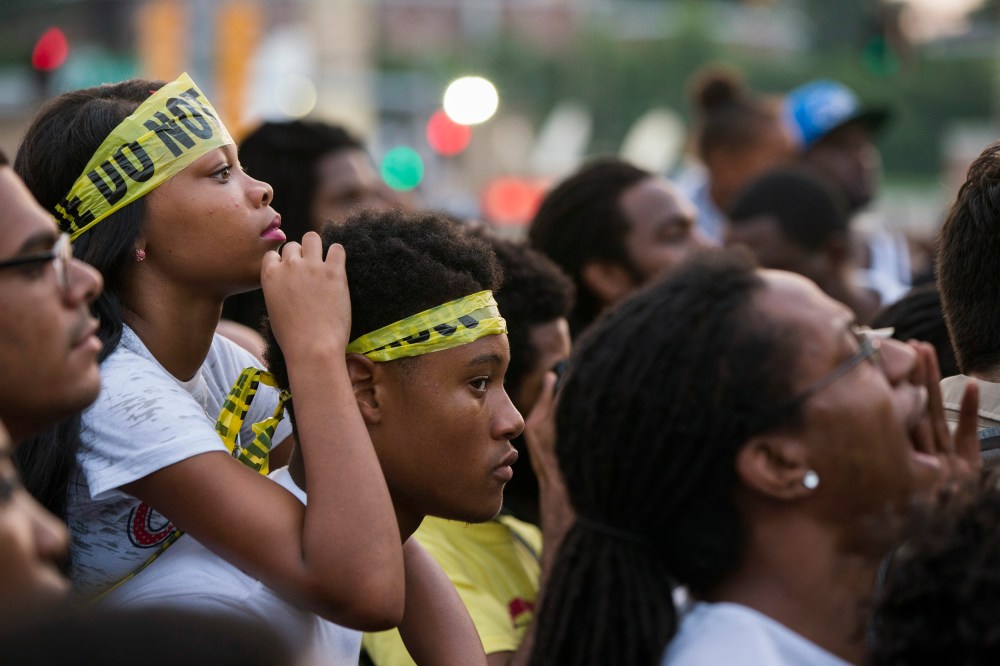
Police in Ferguson, Mo., on Monday began telling protesters – who have been gathered for days demanding justice for the death of an unarmed teenager at the hands of police — that they were no longer allowed to stand in place for more than five seconds, but had to keep moving.
“When inquiries were made to law enforcement officers regarding which law prohibits gathering or standing for more than five seconds on public sidewalks,” the ACLU of Missouri wrote in its emergency federal court filing to block the apparent policy, “the officers indicated that they did not know and that it did not matter. The officers further indicated that they were following the orders of their supervisors, whom they refused to name.” The ACLU argued the policy was a prior restraint on speech and asked for a temporary restraining order.
No standing allowed. So everyone is marching along and up and down W.Florissant. https://t.co/cOo1a9BriF
— Trymaine Lee (@trymainelee) August 18, 2014“The attorney general came to court via phone and announced that there was an alternative speech zone that was being set up,” Tony Rothert, the legal director of the ACLU of Missouri, told msnbc. That satisfied the judge, who agreed it was a close call but denied the ACLU’s request to block the policy.
So where and what was that free speech zone? “It’s supposed to be at the intersection of Ferguson and Florissant,” Rothert said. “There is a field there, but it is padlocked and no one can get in.”
At 6:45 p.m. CT on Monday, Guardian reporter Jon Swaine tweeted that a man was arrested for briefly failing to keep moving. On Tuesday, NBC News reported that a total of 78 people had been arrested, all but three for “failure to disperse.”
Man arrested for briefly failing to keep moving #Ferguson pic.twitter.com/HlcUgZv5JM
— Jon Swaine (@jonswaine) August 18, 2014Even as civil rights groups have demanded more transparency in the investigation of Michael Brown’s death, they have been struggling to keep up with the ever-changing policies on protest and the press – and what they are concerned are serious constitutional violations.
“In many ways,” Rothert told msnbc, “the First Amendment has been suspended in Ferguson.”
In an unprecedented move, global group Amnesty International deployed 10 observers on American soil to investigate human rights abuses against the protesters, like tear gas and smoke bombs being used. Steven Hawkins, Executive Director of Amnesty International USA, said in an interview Monday on MSNBC’s “The Daily Rundown” that the group saw some “troubling signs in Ferguson that violated international human rights standards.”
“We have had conversations with law enforcement to be part of the patrol when the curfew was in place … we were denied,” Hawkins told guest host Craig Melvin, saying “We plan to stay for the duration.” Four more observers have been deployed.
On Monday afternoon, President Barack Obama called for order, but also said, “Let me also be clear that our constitutional rights to speak freely, to assemble, and to report in the press must be vigilantly safeguarded,” he said, “especially in moments like these. There’s no excuse for excessive force by police or any action that denies people the right to protest peacefully.”
Just hours later, Getty Images photographer Scott Olson was arrested because, he said in a video taken as it happened, “media are required to be in a certain area.” He was released a couple of hours later. And Ryan Devereaux, a reporter for the Intercept, was arrested along with a German reporter.
The arrests of journalists came despite the fact that on August 15, the city, St. Louis County, and the Missouri Highway Patrol chief had signed a court agreement saying “the media and members of the public have a right to record public events without abridgment unless it obstructs the activity or threatens the safety of others, or physically interferes with the ability of law enforcement officers to perform their duties.” The agreement followed a First Amendment complaint filed by the ACLU on behalf of a radio reporter, Mustafa Hussein, whom police had ordered to stop recording.
“I’m going to tell you in the midst of chaos, when officers are running around, we’re not sure who’s a journalist and who’s not,” Captain Ron Johnson said in a late-night press conference Monday, according to a transcript from Politico. He added. “So yes, we may take some of you into custody,” he continued. “But when we do take you into custody, and we have found out you’re a journalist, we’ve taken the proper action.” The Intercept’s editor, John Cook, disputed that “proper action” had been taken, because Devereaux spent the night in jail even after identifying himself as press. Devereaux has not been charged. “Members of the public should be extraordinarily concerned when these repeat incidents occur,” Lee Rowland, staff attorney at the national ACLU’s Speech, Privacy & Technology Project, told msnbc of reporters being arrested. “We cannot evaluate what’s happening in Ferguson if the press doesn’t have the ability to document or report on whether other constitutional rights are being violated.” Civil liberties groups have also raised concerns about the broad restrictions on protesters, including a curfew that has subsequently been lifted, and the use of tear gas to disperse crowds that, according to authorities themselves, contain only a few bad actors. “When there are peaceful protesters and one bad apple,” said Rowland, “that seems like a disproportionate response, when targeted arrests are possible.” This 'no standing' protest policy makes it virtually impossible for elderly/disabled people to participate outside of a holding pen The fast-changing and internally conflicting nature of police instructions cause their own problems. “One police officer will tell someone they must stand in a location,” said Rothert, “and the next police officer will tell them they’ll arrest them if they stand there.” For both protesters and the press, Rothert said, “the biggest First Amendment issue right now is that no one knows the rules, and when I say no one, that includes the police.” The most recent Supreme Court case affirming the primacy of protesting on public sidewalks — even if a state claims that public safety is at stake — was McCullen v. Coakley. In June, the Court struck down a Massachusetts law creating a buffer zone around abortion clinics. “Consistent with the traditionally open character of public streets and sidewalks, we have held that the government’s ability to restrict speech in such locations is ‘very limited,’” wrote Chief Justice John Roberts. But courts are a slow mechanism for addressing rights violations, particularly ones that aren’t written down in law. As Rowland put it, “In most of the cases, years after tumultuous times in a city’s history, a court finally rules on whether its actions were problems.”
Irin Carmon Recommended


