








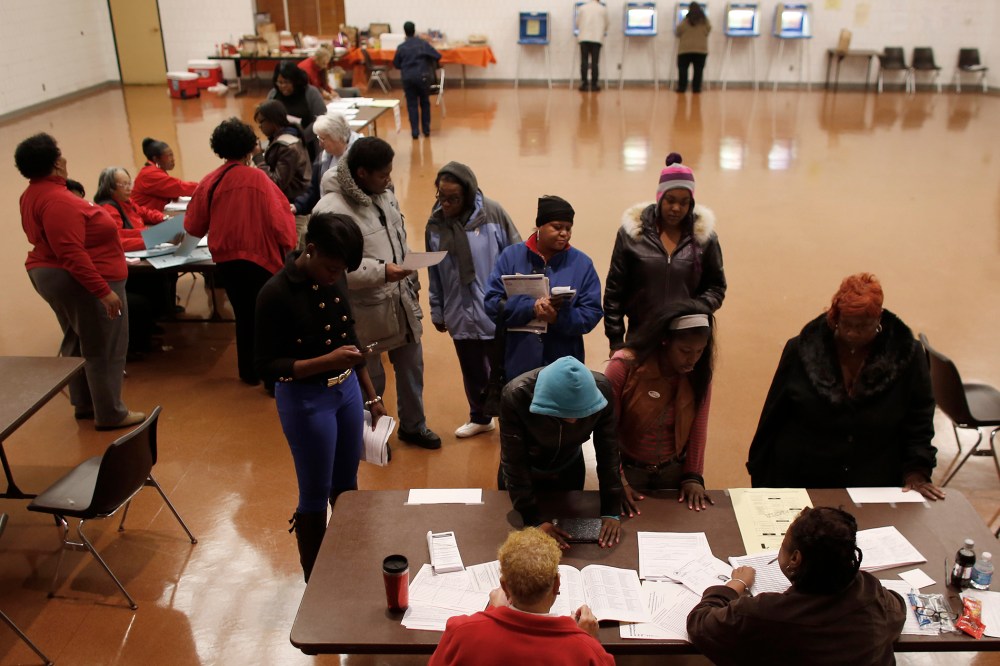
Wisconsin’s voter ID law was on, then off, and now back on again—for now. A similar Texas law was blocked by a federal court before going into force last year, and could now be nixed once more. North Carolina’s sweeping and restrictive voting law looks likely to be in effect this November, but there’s no guarantee. Ohio’s cuts to early voting were put on hold recently, but that decision too could be reversed. And no one seems to know what’s going to happen with Arkansas’ ID law.
In a slew of states with crucial races this fall, access to the polls is in the hands of the courts. That reality underlines how last year’s U.S. Supreme Court ruling that weakened the Voting Rights Act has transformed the legal landscape on the issue — but also how the conservative push to restrict voting is now a national, not a regional, campaign.
It’s a situation that is likely to cause confusion for voters no matter the legal outcomes. And looming at the end of the road is the Supreme Court led by Chief Justice John Roberts, no friend of voting rights, which could upend everything if it decides to clear things up by weighing in.
“That is the big question right now,” said Myrna Perez, a top voting rights lawyer with the Brennan Center for Justice, who has been arguing the Texas case. “Is this going to get before the court before the 2014 election? It’s certainly something that folks are pondering.”
In 2008, the Supreme Court justices upheld Indiana’s ID law, in Crawford v. Marion. But that measure was far more lenient than those passed by Wisconsin, Texas and North Carolina. And the plaintiffs’ lawyers in that case did little to show that real voters would be disenfranchised by it —a reality that’s at the heart of the more recent challenges.
If the Supreme Court does weigh in, it might be bad news for voting rights supporters: Roberts has made clear that rolling back civil rights law that he sees as too far-reaching is his top priority on the court. A ruling decisively affirming voter ID laws could make it next to impossible to use the VRA to tackle all but the most blatant examples of race bias in voting.
But that’s all down the road. This week, voting-rights groups challenging the Wisconsin ID measure filed court documents asking that the full 7th Circuit Court of Appeals take a second look at a ruling last Friday by a three-judge panel. In that decision, the three Republican-appointed judges overturned an injunction blocking the law that was issued in April by a district court judge, who found that it violated the Voting Rights Act’s ban on racial discrimination. Unless the full appeals court agrees to rehear the case and then restores the injunction, or the Supreme Court gets involved, voters will have to show photo ID at the polls this fall, when Gov. Scott Walker, a staunch supporter of the law, faces a tough fight for re-election.
Advocates are warning of chaos if that happens. Because of legal challenges, the law had been on hold since shortly after being passed in 2012, and voters will have little time to learn about it. In fact, the election is already underway: Absentee ballots have been mailed out and hundreds returned, election administrators said this week. Those voters will be disenfranchised unless they show up at election offices with acceptable ID.
Perez brought up the example of Pennsylvania, whose voter ID law was struck down by a court just weeks before the 2012 election. On their websites, several large counties continued on their websites to tell voters that the law was in effect.
Things have scarcely been simpler in Texas. On Monday, the trial wraps up in the challenge to that state’s voter ID law, which is being brought by some of the same voting and civil rights groups. The measure was passed by Republicans in 2011, then blocked the following year under the pre-clearance provision of the Voting Rights Act, known as Section 5. But last year the Supreme Court, in Shelby County v. Holder, neutered Section 5, and Texas immediately announced that the ID measure was in effect. It’s now being challenged under a different part of the VRA that was unaffected by Shelby.
U.S. District Court Judge Nelva Gonzales Ramos is expected to rule on the law’s fate in the coming weeks. But that decision is all but certain to be appealed, meaning Texans might not know for sure until just weeks before Election Day whether they’ll need ID. An estimated 1.2 million eligible Texas voters don’t have acceptable ID. And a high-profile governor’s race, in which Democrat Wendy Davis’s campaign has worked to register and mobilize large numbers of new voters, could drive up turnout. North Carolina, which hosts a crucial Senate race this fall, is also a muddle. A full trial over that state’s sweeping voting law won’t happen until next year. But a court recently rejected a bid by voting rights advocates to have the law put on hold for this fall. This week, an appeals court will hear an effort to overturn that ruling. Like Texas, much of North Carolina, was covered under Section 5 of the VRA, and it moved forward with the law after the Shelby ruling last year. Adding to the confusion in the Tar Heel State: Most of the law’s restrictive provisions are in force immediately—among them, cuts to early voting, the elimination of same-day registration and the disqualification of votes cast mistakenly in the wrong precinct. The law’s ID requirement won’t take effect until 2016, but poll workers have still been instructed to ask voters whether they have ID. Perhaps not surprisingly, in primaries early this year there were reports of would-be voters without ID being prevented from casting a ballot. As for Ohio, that state’s cuts to early voting, passed earlier this year, were blocked by a federal judge this month. Now the state is appealing that ruling. Gov. John Kasich looks likely to win re-election this year, but the outcome of the early vote fight will likely help determine the rules for the 2016 presidential election, when the state figures to once again be pivotal. And in Arkansas—where another hotly contested Senate race is playing out—two separate challenges to the state’s ID law are currently underway. In May, a county judge barred the law’s enforcement, finding it violates the state constitution, but stayed his own order. That means the law is still in effect, though the state is challenging the ruling anyway. Confused? Be glad you’re not a voter trying to figure out the rules.
Zachary Roth Recommended


