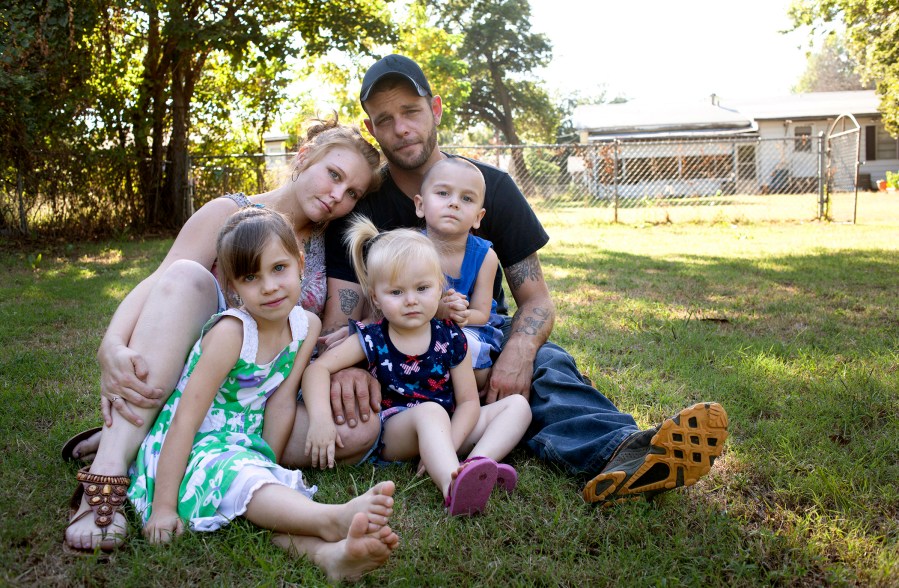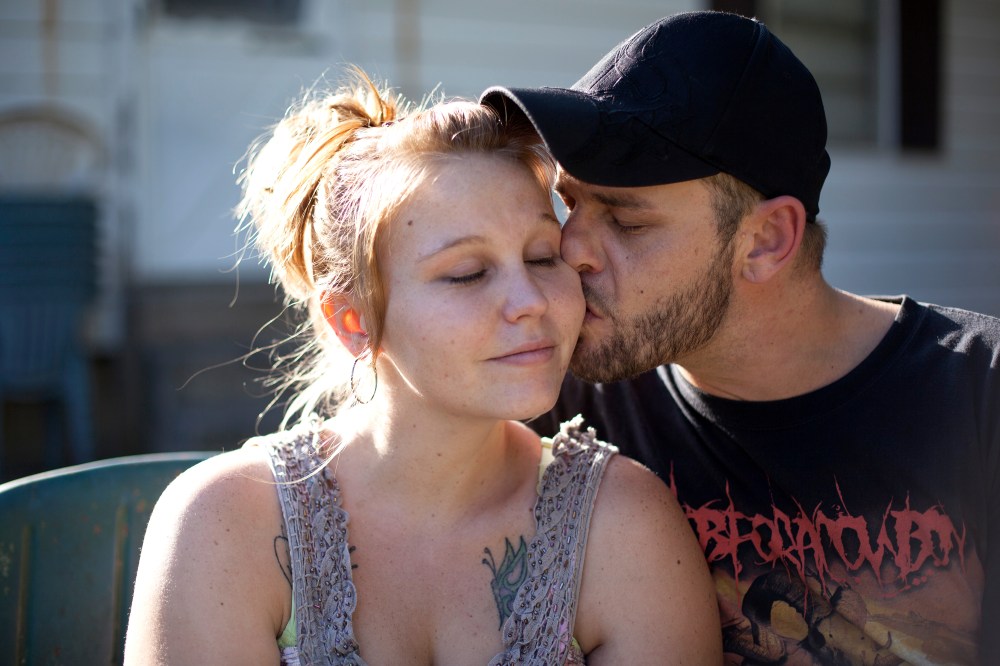
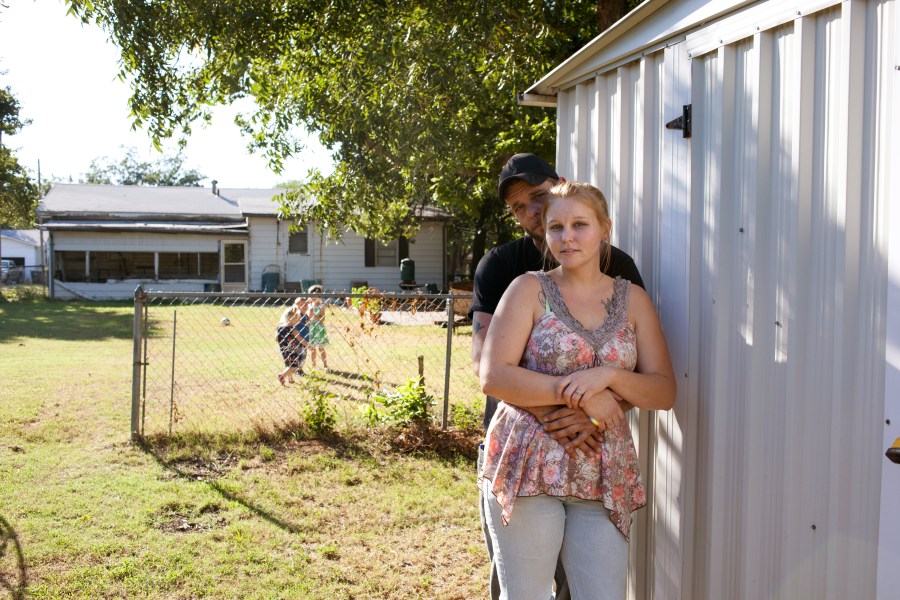
On their last night in Dallas, the ramen noodles and microwave popcorn were finished. The money for the motel had run out too. So on a hot August night Jessica and Erick Davis and their three young kids slept in the Mazda rented for the trip.
It had only been a few hours since Jessica’s abortion. Because the procedure needed to be performed later in her pregnancy, it stretched over three days.
“I cried until I could fall asleep,” she said.
Earlier that month, at home in Oklahoma City, the Davises were told that the boy she was carrying had a severe brain malformation known as holoprosencephaly. It is rare, though possible, for such a fetus to survive to birth, but doctors told them that he would not reach his first birthday. “He would never walk, lift his head,” Jessica, 23, recalled in an interview.
“I could let my son go on and suffer,” she said. Or she could accept a word she didn’t like – abortion – “and do the best thing for my baby.”
%22It%20took%20everything%20we%20had%20so%20that%20our%20son%20would%20not%20suffer%22′
The Davises’ ordeal was always going to be painful. But the grim path that led them to a night in the car was determined, nearly every step of the way, by a state that has scrambled to be the most “pro-life” in the nation. There are no exceptions for families like the Davises.
Oklahomans brag that theirs has become the reddest state. Republicans hold super majorities in both chambers and every single seat in the U.S. Congress. Republican Mary Fallin is governor. Every single Oklahoma county rejected Barack Obama–twice. The changed political landscape allowed Oklahoma to become a staging ground for the anti-choice movement’s strategy to undermine Roe v. Wade, one seemingly narrow restriction at a time.
“We are the guinea pigs,” said Ryan Kiesel, a former state lawmaker who is executive director of the American Civil Liberties Union of Oklahoma.
Since the consolidation of Republican control in 2010, the state legislature has passed at least sixteen laws relating to abortion, often with “no” votes in the single digits. It’s no coincidence that two of the cases involving women’s health currently hurtling towards the Supreme Court originated in Oklahoma.
“It’s sickened me about the state of Oklahoma, period,” Erick told MSNBC of his family’s experience. “I don’t even want to be in this state.”

On a sunny August morning in Grove, Oklahoma, Republican state representative Steve Martin recalled the day, more than 40 years earlier, when he took his girlfriend to have an illegal abortion.
“We got a number. We called the number,” he said, leaning back in his chair. “We set up a meeting under the tallest pine tree behind the parking lot of the Penn Square Mall in Oklahoma City.”
It was 1970, three years before Roe v. Wade, and Martin, then 21, had offered to marry his girlfriend and have the baby. She refused on both counts. “We wouldn’t have stayed married,” Martin conceded.
At a private home, the abortion provider “used some kind of a method that involved packing with gauze or some cotton, and having this girl walk around until she started miscarrying,” Martin remembered. “It was very painful.”
Martin told his story on the spacious lakeside dock of Representative Doug Cox. Cox is an emergency room physician and the lone Republican voice against restrictions on reproductive rights. In May, fed up with the endless stream of laws targeting reproductive rights, Cox had unleashed his frustration in a column for The Oklahoman.
“All of the new Oklahoma laws aimed at limiting abortion and contraception are great for the Republican family that lives in a gingerbread house with a two-car garage, two planned kids and a dog. In the real world, they are less than perfect,” he wrote. “What happened to the Republican Party that I joined?” In the same paper, he urged Gov. Fallin to accept Obamacare’s Medicaid expansion. She didn’t.
Cox doesn’t consider himself pro-choice. And yet that morning at his lakeside home, shirtless and with a fishing line dangling in the water, he said: “Like it or not, abortion has always been available to people whether it’s legal or not.” He added, “As a physician, I don’t want to go back to seeing women coming in with a perforated uterus or a coat hanger or somebody doing an abortion who doesn’t know how to do it.”
%22The%20battle%20is%20here%20to%20stay%2C%20and%20it%20will%20be%20in%20all%20fifty%20states%22′
That was when Martin started talking. He recalled his girlfriend’s experience as “hideous.” And yet in his eight years in the House he has, unlike Cox, repeatedly voted for laws that threatened to bring back those days. In a candidate survey, Martin answered 11 of 12 questions in agreement with Oklahomans for Life. Even so, the last time he ran for office in 2012, his opponent accused him of not being 100% pro-life.
Rep. Paul Wesselhoft has also been a reliable vote for abortion restrictions. But late the night before, at an annual party Cox holds for legislators, Wesselhoft had openly wished that the Oklahoma legislature would spend less time on abortion.
Wesselhoft, an ordained Southern baptist minister, is no stranger to the culture wars. He ran an anti-pornography organization, and for seven years, was the state coordinator for abstinence-only education. Still, he said of abortion, “I can’t think of anything more divisive than this issue. And I hate it for that reason.”
Not every Republican legislator is conflicted.
At the same party, Rep. Mike Ritze claimed that Margaret Sanger, the founder of what would become Planned Parenthood, got the idea from Adolf Hitler. The fact that Sanger opened her first clinic in 1916 seemed of little interest to Ritze. Asked what he thought of the term “war on women,” he said: “I’ve heard about it and I’ve heard some of the feminists talk about it. But I really don’t think there is a war on women unless you go to an Arab country.”
The University of Oklahoma Health Sciences Center, where the Davises were diagnosed, once provided later abortions for women whose fetuses had been diagnosed with lethal anomalies. It is now forbidden from doing so by a 2007 law banning abortions in public hospitals.
A second law, passed in 2011, banned abortions statewide after the 20-week mark of a pregnancy on the theory that fetuses could feel pain at that point. In Oklahoma, that law has no exceptions for fetal anomaly.
“Whether you’re pro-life or pro-abortion, we should all agree that gratuitous suffering by an unborn child is incompatible with our society,” state representative Pam Peterson, a Tulsa Republican, said at the time.
Most of the laws that forced the Davises across state lines can be traced back to Tony Lauinger, a tireless lobbyist who is chairman of Oklahomans for Life.
Asked about the Davis family, he said: “Women in that situation certainly would have been free to go get an abortion somewhere else. The thought that the pro-life taxpayers of Oklahoma ought to be required to be complicit in the killing of a child with a disability is abhorrent.”
The options to go “somewhere else” are dwindling. Oklahoma women diagnosed later in pregnancy with serious conditions were sometimes referred to Dr. George Tiller in Wichita. An abortion opponent murdered Tiller in 2009. Kansas then banned abortions 20 weeks post-fertilization, right around the time that serious fetal anomalies are diagnosed, as was the case for the Davises. Such bans are now in place in Arkansas, Alabama, Arizona, Georgia, Idaho, Indiana, Louisiana and Nebraska. A similar ban passed the U.S. House of Representatives earlier this year.
%22As%20a%20physician%2C%20I%20don%27t%20want%20to%20go%20back%20to%20seeing%20women%20coming%20in%20with%20a%20perforated%20uterus%20or%20a%20coat%20hanger%22′
That string of successes has meant happy years for Lauinger, whose anti-abortion activism began just after Roe v. Wade. While that landmark decision still significantly limits what he can do, his job has gotten much easier.
For decades, under Democratic control, legislative committee chairs would block abortion restrictions from a hearing. But new term limits, alongside rising conservatism, helped rapidly drain the legislature’s long tradition of Democratic control. Republicans took over the House in 2004, the Senate in 2008, and the governor’s mansion in 2010.
Not that the movement wants to stop in Oklahoma. “The battle is here to stay,” said Lauinger, “and it will be in all fifty states.”
The last hope for pro-choice advocates in Oklahoma is the state judiciary, where many of the laws have been successfully challenged, often on technical grounds. “We are growing weary of admonishing the Legislature for so flagrantly violating the terms of the Oklahoma Constitution,” the state Supreme Court wrote in 2010, after striking down a law that required women seeking an abortion to undergo an ultrasound and hear a description of the images. “It is a waste of time for the Legislature and the Court, and a waste of the taxpayer’s money.” Lauinger blamed the losses on the fact that “eight of the nine members were appointed by pro-abortion Democrat governors.” Rep. Ritze agreed. “Maybe as we see more Republicans, there will be fewer and fewer liberal judges appointed,” he said hopefully. “More of what we call the original intent-type of judge. Your Anton [sic] Scalias and your judge — the black judge, the Supreme Court judge.” In August, women in pink shirts, some with scrawled slogans about women’s rights, gathered at a state district courtroom. After years of wrangling, the federal government had finally made it easier to buy emergency contraception, but Oklahoma had raced to make it harder by restoring the ID and age requirements. Now the state was defending the rule in court. The judge ruled that the way the law had been passed violated the Oklahoma constitution. The women, members of the Oklahoma Coalition for Reproductive Justice which had brought the case, gathered in a café afterward to celebrate. The Coalition is also the plaintiff in a medication abortion case that is expected to go before the Supreme Court this term. The Oklahoman, a right-leaning daily, had just run a series of editorials condemning their work. “The editorial called me a ‘self-proclaimed feminist,’” said the Coalition’s president, Martha Skeeters, “which is like being called a Communist here.” When her group began lobbying against a Personhood bill by saying it would restrict in-vitro fertilization, or IVF, a legislator who planned to vote for it, said: “Sorry, what’s IVF?” Another legislator slammed the door in the face of an activist, calling her a baby killer. Pro-choice Oklahomans–scrappy, outnumbered, unfunded–are trying to build infrastructure with Take Root, an annual conference on reproductive justice in red states. Though there are stalwart exceptions, they get little support from the dwindling number of elected state Democrats, many of whom believe that pushing back against anti-abortion laws will hurt their careers. In his six years in the House, the ACLU’s Kiesel was repeatedly told by Democratic leadership to leave the chamber during abortion votes. Or, “hold my nose and vote for that bad legislation hoping that the courts would defeat it rather than torpedo your career over a single issue.” He wound up voting his conscience, and kept his seat anyway. Rep. Doug Cox also has paid no electoral price for his outspoken opposition to nearly all anti-abortion and anti-contraception legislation, despite being a Republican. Despite the drama over Personhood in the legislature, Cox says he didn’t get “a single question from any of my district and any of my meetings about it.” Cox said there are colleagues who share his views but fear a backlash. “As a physician,” he said, “I rotated through Planned Parenthood clinics, doing pap smears and breast exams, and yet the people who are standing up saying, ‘we’re going to cut off all this state money,’ I ask them: How many abortions did Planned Parenthood do in Oklahoma? The truth is they don’t do any. They looked at me like I was making it up.” The Davises know he isn’t. The lack of options sent them to Dallas, where protesters outside the clinic tried to hand Jessica a pair of baby socks. She told them to go to hell. She left the clinic with a death certificate, which she and Eric had asked for, and a footprint of the son they named Mark Gordon Scott Davis. The funeral homes Jessica called for a “proper burial” laughed at her, or hung up “because I mentioned the word ‘termination,’” she said. The funeral homes told her she had an abortion. “I don’t look at it like that,” Jessica said. “I’m showing my son mercy.’” The Davises, who are both unemployed and live on Jessica’s $700 a month in disability payments and food stamps, came home to unpaid bills. The electricity was slated to be turned off the next day. Eric sold off scrap metal he found to pay the bill, but there was no money left for gas and water. Oklahoma law had barred Jessica from using state Medicaid to cover the cost, so the couple had borrowed some money from relatives to cover the $2,800 procedure. In total, the trip set them back $3,500. “It took everything we had so that our son would not suffer,” Jessica said. “It was never something that I had to worry about–the politics,” she said. “I just let women make their own decisions. But I would hate for another woman to have to be in my position.”
Irin Carmon Recommended