








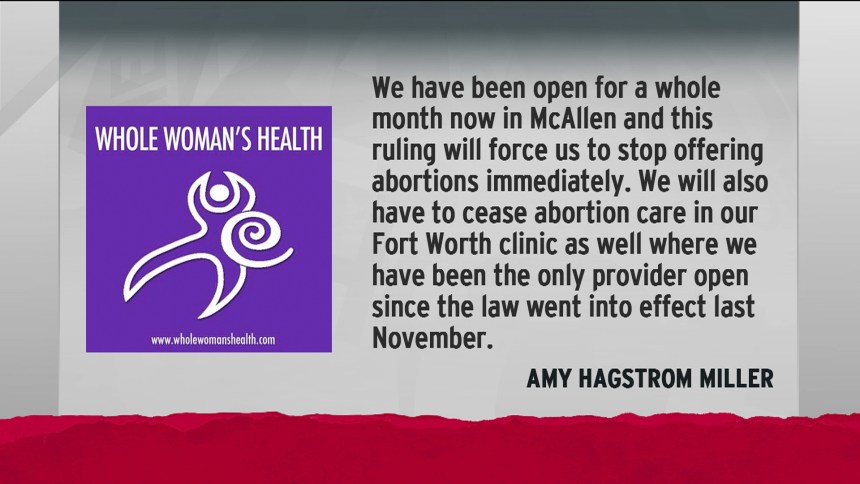
The 5th Circuit Court of Appeals Thursday allowed Texas to begin enforcing tough new abortion restrictions that will effectively close all but eight abortion facilities in the nation’s second-largest state. Unless the Supreme Court steps in, the law is poised to have the most devastating impact on abortion access of any such restriction across the country.
Under the law’s force, which will close 13 clinics, one out of six Texan women seeking an abortion will now live more than 150 miles from the nearest clinic. A lower court judge had previously ruled on August 28 that the law was unconstitutional, because it “would operate for a significant number of women in Texas just as drastically as a complete ban on abortion.” But in Thursday’s ruling, the three-judge panel in New Orleans said the law would not impose an “undue burden,” staying the district court decision as the state appeals.
In the past year, about half of Texas’s clinics that provide abortion have already closed, since a separate portion of the law was allowed to go into effect by the Fifth Circuit and then the Supreme Court. The provision at issue in the most recent ruling requires all abortions to take place in ambulatory surgical centers, or expensive mini-hospitals that cost over $1 million to construct.
%22Today%E2%80%99s%20ruling%20has%20gutted%20Texas%20women%E2%80%99s%20constitutional%20rights%20and%20access%20to%20critical%20reproductive%20health%20care%20and%20stands%20to%20make%20safe%2C%20legal%20abortion%20essentially%20disappear%20overnight.%22′
George W. Bush appointee Judge Jennifer Elrod, writing for the Fifth Circuit, wrote that the district court judge had overreached because “in our circuit, we do not balance the wisdom or effectiveness of a law against the burdens the law imposes.” She conceded, “We do not doubt that women in poverty face greater difficulties.” But Elrod argued the court was required to find that a “large fraction” of women would be affected by the law, even as she noted that the number of affected women in rural Texas was 900,000. In a partial dissent, Obama appointee Stephen A. Higginson pointed out that the existing clinics would now have to “increase by at least fourfold the number of abortions they perform annually.”
Lauren Bean, spokeswoman for the Texas Attorney General’s Office, said in a statement, “This decision is a vindication of the careful deliberation by the Texas Legislature to craft a law to protect the health and safety of Texas women.”
District court judge Lee Yeakel, had also allowed two clinics that had closed under the earlier provision, requiring abortion providers to have admitting privileges at local hospitals. That part of the decision was also blocked by the appeals court, and one clinic that reopened because of Yeakel’s decision, Whole Woman’s Health in McAllen, Texas, will close again.
The law in question was famously filibustered by Wendy Davis in June 2013, but Texas Gov. Rick Perry subsequently convened another special session to pass it anyway. It also includes an unconstitutional ban on abortion after 20 weeks (which has not been challenged in court) and restrictions on medication abortion (which the 9th Circuit Court of Appeals, ruling on an Arizona version of the law, said defied medical evidence and was an undue burden on women).
All eight of the clinics that can comply with the ambulatory surgical requirements are in major cities, leaving rural women with few options, and none south of San Antonio. In recent months, Planned Parenthood has announced new ambulatory surgical centers in Dallas and San Antonio.
The Texas abortion law’s most anodyne-sounding regulations are also the most sweeping in impact, and they are echoed by laws in states across the country, most of which have been blocked by courts from taking effect. Many red-state hospitals, including in Texas and Mississippi, have refused admitting privileges to abortion providers, making them unable to comply. Ambulatory surgical centers are prohibitively expensive to construct, though Planned Parenthood has been able to gather the resources to build two more in Texas. Neither clinic regulation is considered necessary by major medical organizations like the American Medical Association, which argues that they actually make women less safe by making legal abortion more inaccessible.
The admitting privilege requirement has already halved Texas’s abortion clinics. In May 2013, Texas had 41 facilities that provided abortion. By November 2013, there were 22, though the number has since fluctuated slightly based on individual doctors’ statuses.
The decision from the most conservative court in the country does not come as a surprise; only its timing does. When Yeakel issued his ruling in favor of the clinics on the Friday before Labor Day weekend, many observers expected an immediate reversal from the 5th Circuit Court of Appeals. But there was a surprise twist: Texas’s attorneys waited until the last minute to file its appeal brief, irritating the judges, who put off their ruling until after an oral argument. That was good news to the abortion patients in the Rio Grande Valley, who suddenly had a several-week window without having to travel hundreds of miles. At that argument on September 12, Judge Jerry Smith chided Texas for filing its motion at the last minute. “I’m a little bit perplexed by the way that that was handled by the state. It may appear that I’m just trying to give you a hard time, but I think it really goes to the seriousness of the state’s claim of irreparable harm.” But things looked bleak for the clinics once the argument was underway. “We have to look for evidence that women face an undue burden. Just the decrease in the number of clinics doesn’t tell us that women face an undue burden, does it?” said Judge Jennifer Elrod, a George W. Bush appointee, in oral argument. The attorney for the clinics, Stephanie Toti pointed to a patient advocate in the Rio Grande Valley, Lucy Felix, who testified at trial that “the obstacles caused by the closure of the two clinics in the Rio Grande Valley were substantial for the women who lived there.” “Well, did she say that women were actually not getting abortions?” Elrod persisted. “I think she said she talked to different providers, and to some women, and that there were obstacles … Did she give evidence that they were undue burdens that kept the person from getting an abortion?” Toti said Felix had, in fact, testified that she has “personally observed an increase in the number of women turning to illegal, self-induced abortion because of an inability to reach the legal abortion clinics.”
Irin Carmon Recommended


