








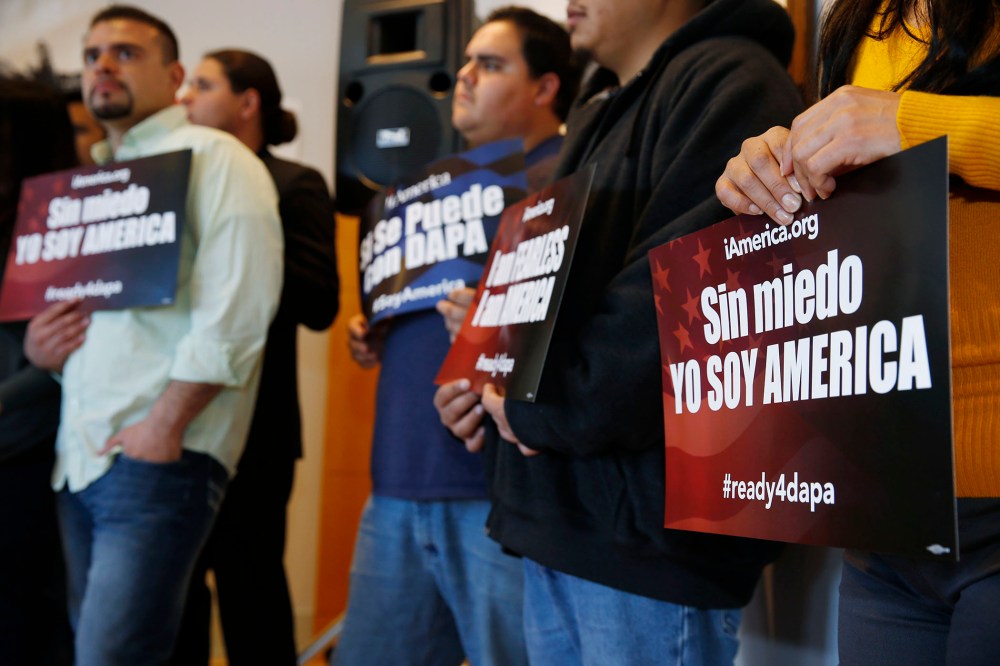
Late Monday night, U.S. District Judge Andrew Hanen temporarily blocked President Obama’s executive actions on deportations, which were challenged in federal court by Texas and 25 other states.
The immigration actions, which were set to begin going into effect today, expand DACA to undocumented immigrants over the age of 30 who arrived in the U.S. as children and create DAPA, a discretionary temporary deportation reprieve for undocumented parents of U.S. citizens and lawful residents. For now, both initiatives are on hold while the administration files its appeal with the court of appeals.
Here’s what else you need to know.
What is the Texas lawsuit about?
At bottom, the states claim that President Obama unconstitutionally bypassed Congress last year by offering deportation reprieves through executive action. The administration — with the support of 12 states, the District of Columbia, 33 cities, 27 police chiefs, highly respected legal scholars and nonprofit organizations — counters that DACA expansion and DAPA are solidly legal and that presidents of both parties have used their executive authority to grant similar deportation reprieves.
Why did the judge block the executive actions?
Judge Hanen focused on Texas’ claim that it would suffer financial loss by having to issue driver’s licenses to DACA and DAPA recipients. As he has done in previous cases, the judge used his 150 page order as a bully pulpit to excoriate the administration’s immigration enforcement policies. (The DACA program, which went into effect in 2012, was not affected by the judge’s order.)
Yet despite halting the immigration initiatives, Hanen did not rule that Obama in anyway exceeded his lawful authority or violated the constitution. Instead he ruled on very narrow, highly technical legal grounds: That the executive actions did not comply with the rule making requirements of the Administrative Procedures Act. The administration argues that the deportation reprieves are solidly legal and well within the president’s authority to focus limited immigration enforcement resources on the deportation of terrorists, felons and gang members — not DREAMers, and mothers and fathers of U.S. citizens and lawful permanent residents.
What happens now?
Judge Hanen’s order is of course an unwelcome setback for supporters of the president’s executive actions, but it’s hardly a fatal blow to DACA expansion or DAPA. The final decision — which most legal experts are confident will uphold the president’s immigration actions — will come from a much higher court; probably the U.S. Supreme Court.
%22Judge%20Hanen%E2%80%99s%20order%20is%20of%20course%20an%20unwelcome%20setback%20for%20supporters%20of%20the%20president%E2%80%99s%20executive%20actions%2C%20but%20it%E2%80%99s%20hardly%20a%20fatal%20blow.%22′
Here’s how it will work: The Obama administration will appeal Judge Hanen’s decision to the Fifth Circuit Appeals Court. The higher court will likely take several weeks or months to decide the case. In the meantime, both the DACA expansion and DAPA will remain on hold. The government will not accept applications for either program, but potential applicants would be well advised to continue to collect documents so they are ready to apply when the injunction is eventually lifted.
If the Fifth Circuit reverses Judge Hanen’s order — as many experts expect it will do — the DACA expansion and DAPA processes will go forward as planned. If not, the president’s executive actions could be delayed for many more months while the administration asks the U.S. Supreme Court to review the case.
Importantly, Judge Hanen’s order is hardly the final word. It’s just the first act in what could be a very drawn out play that may conclude in the U.S. Supreme Court.
In the meantime, what happens to the DREAMers and parents who qualify for DACA plus and DAPA?
The law requires Obama to set immigration enforcement priorities — to decide, in effect, which undocumented immigrants should be deported first. Last November, when he announced his immigration executive actions, the president said he’ll prioritize the deportation of “felons, not families. Criminals, not children. Gang members, not a Mom who’s working hard to provide for her kids.” What that means for immigrants who would qualify for the DACA expansion and DAPA is that, as long as they are not a deportation priority, their cases will remain at the bottom of the enforcement barrel while the Department of Homeland Security focuses on getting rid of those who threaten the safety of American communities. How does the judge’s decision affect the larger battle over comprehensive immigration reform? At the time Judge Hanen ruled on Monday, congressional Republicans were trying to figure out how to break a stalemate that threatens to shut down the Department of Homeland Security over GOP opposition to the president’s executive actions on immigration. %22Judge%20Hanen%E2%80%99s%20order%20is%20hardly%20the%20final%20word.%20It%E2%80%99s%20just%20the%20first%20act%20in%20what%20could%20be%20a%20very%20drawn%20out%20play%20that%20may%20conclude%20in%20the%20U.S.%20Supreme%20Court.%22′ Hanen’s injunction clearly complicates things for the GOP. Conservative Republicans may harden their position against compromise with Democrats and the administration on homeland security funding. On the other hand, Hanen’s order temporarily halting the implementation of DACA expansion and DAPA arguably takes the issue off the table — at least for now — undercutting those in Congress intent on using homeland security funding to kill the president’s immigration initiatives. Yet despite the GOP’s apparent obsession with creating an immigration system characterized by chaos and mass deportation, one thing is crystal clear — the DREAMERs and undocumented parents the Republicans long to deport are not going anywhere. They are already home. Stay tuned. David Leopold practices immigration law in Cleveland, Ohio and is the former President of the American Immigration Lawyers Association.
David Leopold Recommended


