








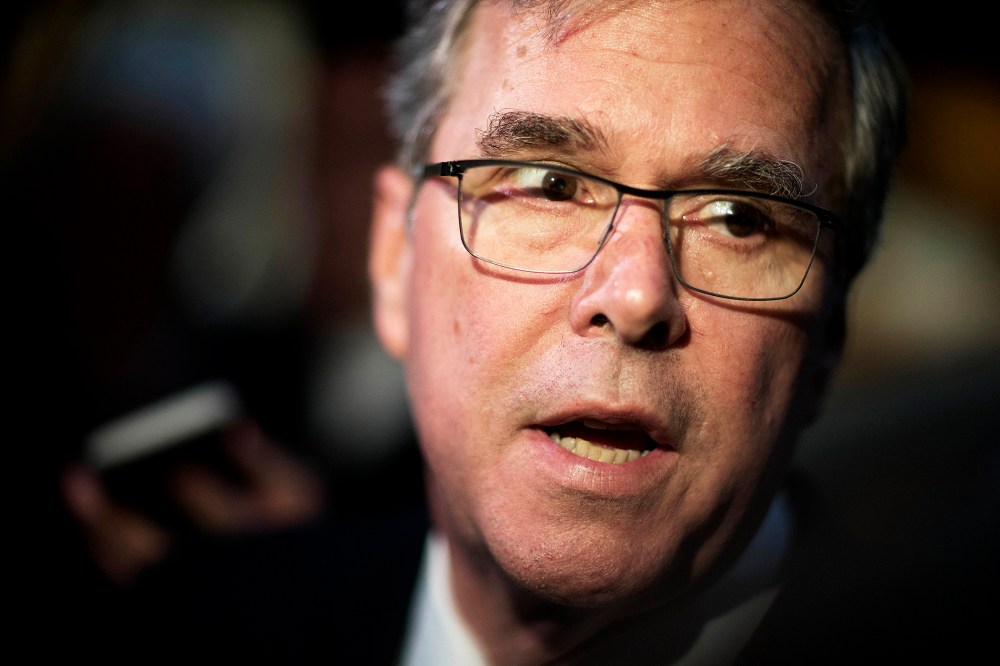
Republican Sen. Ted Cruz announced via Twitter early on Monday that he’s making a bid for the nation’s highest office. Fellow Senator Rand Paul is set to follow with his own campaign announcement on April 7, which would make them the first major 2016 contenders in either party to officially enter the race. But other big names, including former Florida Gov. Jeb Bush and current Wisconsin Gov. Scott Walker, both Republicans, could be months away from declaring.
RELATED: Why no one has declared a run for president in 2016 yet
Candidates are freer to take their time in 2016, election experts say, because this cycle’s particular set of election laws and party rules makes it far easier to hold off on an official announcement. There are concrete legal and financial advantages to waiting, along with a few obvious downsides for the top contenders.
The slow start is a far cry from the last open contest, in 2008, where many of the major contenders launched official exploratory committees immediately after the 2006 midterms and announced their campaign early the next year. Eventual winner Barack Obama formally announced plans to seek the Democratic nomination in February 2007.
Things have ticked forward since then, with presidential hopefuls jumping in slightly later in 2012 and now looking even later for the 2016 cycle.
Bush has been traveling to early voting states and raising money for a potential run, but told reporters this week that he needed a “few months time” before an announcement either way. Walker, who polls suggest is an early front-runner for the GOP nomination, is waiting for the legislative session in Wisconsin to end, which could be as late as summer as well.
Other likely GOP candidates, including Senator Marco Rubio, New Jersey Gov. Chris Christie, and former Texas Gov. Rick Perry are still tight-lipped about their plans. Sen. Lindsey Graham told msnbc he’s looking at a May decision and is one of the only 2016 prospects to launch an actual exploratory committee, along with neurosurgeon Ben Carson and Donald Trump. On the Democratic side, there are signs Hillary Clinton might jump in in April, but it’s only rumors at this point.
RELATED: Barbara Bush changes her mind about Jeb
The most pressing factor that could push Republican hopefuls to enter the race by a certain point may be the televised debate schedule, which often require candidates to have at least launched an exploratory committee to qualify. The first GOP debate of the 2012 cycle was in May 2011 and the first to include all the main candidates occurred in June. This year, the Republican National Committee – as part of an effort to rein in the overall number of debates – has set August for the first sanctioned forum.
The financial picture has changed since 2008 as well. Since the Supreme Court in 2010 declared limits on outside political spending unconstitutional in Citizens United and related cases, big money super PACs and non-profits have become a must-have for candidates to back up their official campaigns. While the campaigns themselves must observe strict federal limits on the amount individual donors can give, outside groups can raise and spend money in unlimited quantities. Such groups are now the primary vehicles for prospective candidates to fund their pre-campaign activities – Scott Walker has Our American Revival, for example, while Jeb Bush has his Right to Rise PAC. While the organizations can’t pass on the money they raise to candidates once an official campaign is launched, they can raise and spend money to advertise on behalf of a candidate.
Meanwhile, groups like Ready For Hillary, an independent group supporting Clinton’s eventual candidacy, will be able to transfer valuable email lists by trading them for older (and thus less useful) lists from previous campaigns.
The new system has mostly replaced the old exploratory committees, which were tightly regulated and allowed donors to give a paltry $2,700 max per person in the primaries –the same limits the official campaigns face. Given that Bush has reportedly asked donors to voluntarily limit their contributions to a humble $1 million or less, you can see why candidates would prefer the newer way.
RELATED: Walker’s hiring disaster The only catch for big dollar entities like PACs and 527s is that they can’t coordinate with the candidates’ official campaigns in any way once they enter the race. Since those contenders typically leave longtime trusted advisers in charge of outside groups, the longer they put off an exploratory committee or official announcement, the longer they can rely on their direct counsel. “If you hold off, you actually have fundraising advantages,” Larry Sabato, director of the University of Virginia’s Center for Politics, told msnbc. “You can coordinate more easily with your own super PAC and you’re able to raise money larger increments because you’re testing the waters as opposed to actually running.” Sabato added, “You are under stricter FEC rules as an official candidate and you have to be more careful about your staff associating with the super PAC organization.” There remains a big downside for candidates who put off declaring: people might question whether they are actually running or not. That’s why those who have formed exploratory committees so far are largely the back of the pack candidates who need an extra boost to get noticed by the press and donors. The more prominent hopefuls in each party are treated as candidates whether they’ve declared or not. Clinton’s every move is dissected as a 2016 story, while Bush, Walker, Rubio, Paul, Cruz, and other GOP prospects make headlines every time they visit Iowa or New Hampshire or hire a new aide at their PAC. RELATED: Where exactly are the 2016 candidates? It can be hard to keep up the dance sometimes – Perry accidentally referred to himself as a “candidate” in Iowa this week, for example. Paul tweeted the other day that he was “the only candidate” to support shutting down an NSA phone surveillance program. Did he mean he’s the only candidate for Senate in Kentucky? Sure, why not. Clinton’s pre-campaign infrastructure has grown so massive that Saturday Night Live’s Kate McKinnon impersonates her by peppering arch caveats like “… if I decide to run – who knows?” at the end of her sentences. This winking Schrödinger’s candidate status has upset some campaign finance watchdogs. Paul S. Ryan of the Campaign Legal Center, for example, has doggedly tracked each 2016ers’ actions and argued that many of them are skirting the line, if not crossing overtly into official candidate territory. The Federal Election Commission, which enforces the rules, is deadlocked between Republicans and Democrats and rarely reaches the majority needed to clamp down on alleged excesses, giving the field broad latitude to test the limits with consequence. “It used to be there were two stages, an exploratory stage and then the actual candidacy,” Rick Hasen, a Professor of Law and Political Science at the University of California, Irvine, told msnbc. “It’s now clear we have a third stage, the pre-testing the waters phase, which we might call the ‘dissembling’ or the ‘lying’ portion.”
Benjy Sarlin Recommended


