









I moved to New York in 2019. Unlike many single women who move to New York City with ambition to build a big new career or even find love, I moved there as a single woman to escape. Specifically, I was escaping the pain of walking down the streets in my old Washington, D.C. neighborhood ― the streets that my husband Jeff and I used to walk together.
My move to New York was quick ― my old apartment was packed up in a day. I was more than ready to get out of D.C. where just six months before, Jeff was killed when he was struck by a semi-truck while riding his bike.
The apartment in my West Village walk up ― the first apartment I lived in alone ― was tiny. My queen-sized mattress practically touched every wall in my bedroom. Every morning and night, I tiptoed around the corners of my bed. Taking full steps wasn’t possible ― there just wasn’t enough space. I knew it would be crowded, so I calculated what to donate before moving from my two-bedroom, Washington, D.C. condo. The extra chair from my old bedroom would have to go. The standing lamp, too. But the bed, though now bigger than I needed, would stay.
There were so many reasons why I decided to leave D.C. I moved so my dog wouldn’t try and lead me to the park where Jeff tried to teach her to play fetch. I moved to get far away from the possibility of seeing the same semi-truck that hit him. And I moved so I would never have to be in a taxi that could accidently take the wrong route past the hospital where he and I spent the last hours of his life together. The hospital where he died at 36 years old.
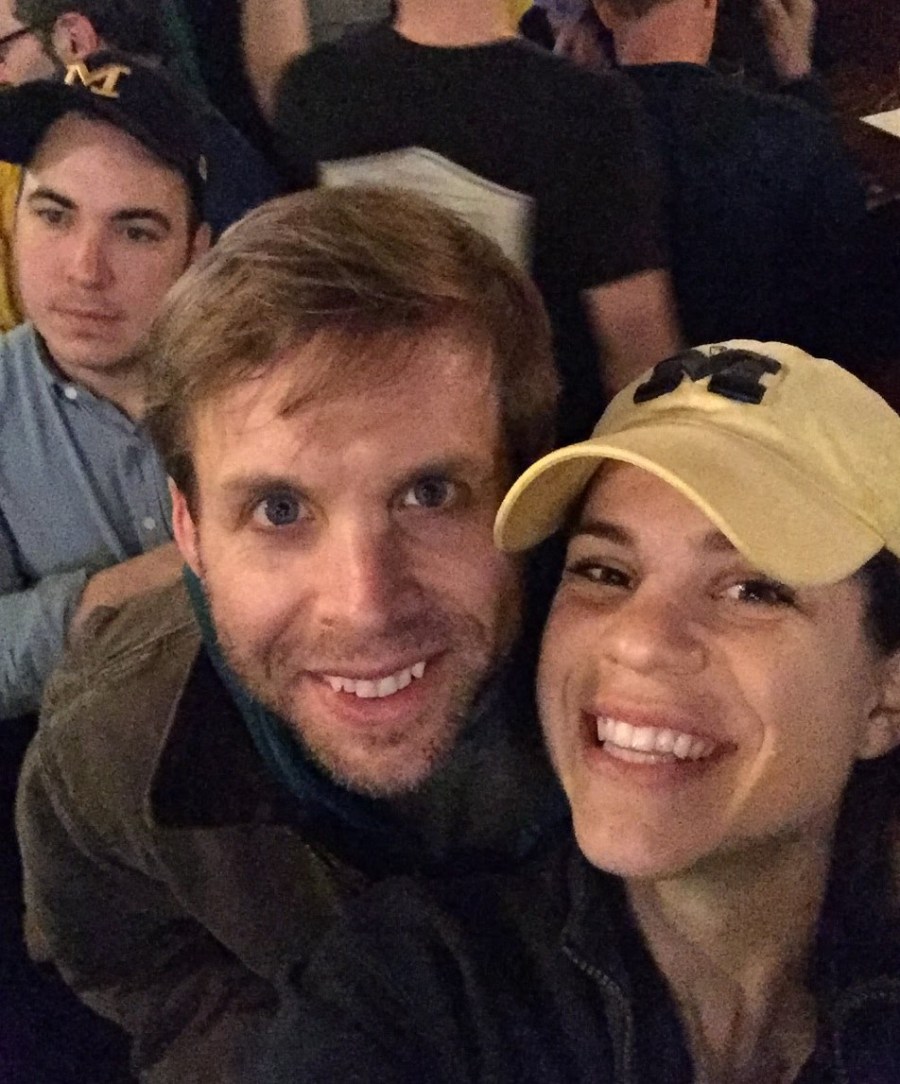
Three years before my move to New York, Jeff and I planned our wedding. Two hundred and fifty guests in black ties and gowns danced under a salmon pink sky, celebrating a relationship that had begun six years earlier, when I was 22. Jeff spun me around the dance floor and even as friends lifted us above their heads during the band’s final verses of “Shout,” we held hands tightly.
Our wedding was the first mile-marker on the roadmap of our life together. Kids? Yes. How many? Two if you asked him, three if you asked me. Live in D.C.? For a little longer, but let’s also consider Chicago or Santa Monica before we grow our family in our home state of Connecticut.
I first became aware of Jeff when I was an awkward sixth-grader, sitting in the stands with my little brother at the high school basketball game. As we watched the team run up and down the court, we heard the crowd chant: “We Want Jeff Long! We Want Jeff Long!” The cheers were followed by Jeff himself ― blonde hair flowing, a foot shorter than the rest of the team, his heart clearly in the sport even though the final minutes of the game were all the time on the court he’d get. As quite literally every person in the stands rose to their feet to cheer for Jeff, their school president, my little brother and I exchanged looks ― whoever Jeff Long was, he seemed worth knowing.
Jeff and I officially met more than a decade later, on day one of my first job after college. I was in my corner of a campaign office, tottering in high heels and a pencil skirt, trying to look as professional as possible, but likely coming off awkward and inexperienced as others buzzed around in T-shirts and jeans.
Jeff said hello as he filled his water glass, and I reverted from being a 22-year-old woman in coordinated business casuals to the admiring 12-year-old girl in the stands. “You’ll never guess who is working in my new office,” I texted my brother as soon as Jeff left.
The Jeff Long, I was pleasantly surprised to learn as we fell in love, was more complicated than my middle school version of him. He was softer, tearing up as we ate breakfast while watching human interest segments on the weekend morning news. He was a serial, innocent prankster who’d call our favorite pizza place in a terrible Italian accent to make dinner reservations. He was well liked, not because he was cool by traditional high-school-jock standards, but because he made it cool to be nice.
A few months before we got married, I started a job at a progressive political advocacy organization. One of my tasks was to arrange a discussion with feminist author Rebecca Traister about her book “All The Single Ladies,” The book was about the power of single women and the impact we can have on society when offered choices beyond heterosexual marriage. The story Traister told is a complicated one – single life is not all Bali trips and brunches. As I read, I ticked through the list of all the single lady things I hadn’t done. There was the fun stuff: living alone in a big city, traveling solo, having a social life that revolved primarily around other women, bedding gorgeous men just for fun. And there was the more mundane – I had barely even paid my bills without the advice of a partner.
To me, the book described an independent lifestyle defined by a certain kind of strength I was sure I didn’t have by virtue of being in relationships since I was 18 years old. There was no question I wanted to be with Jeff ― I loved him more than anything. But each night, as I lay in our bed, reading by the light of my iPhone and mentally preparing to walk down the aisle, I also wondered if the door to an independent life was closing behind me.
To be fair, I had also spent most of my life pulling that door closed myself. Growing up as a good girl in Greenwich, Connecticut meant plaid private school uniforms and high expectations, and I dutifully lived up to them: good grades, a good college, a good job on Capitol Hill. Hewing to this well-worn path, I believed at the time, also meant attaching myself to a nearly unbroken string of good, reliable boyfriends.
Whether I fully realized it or not, I was following the path of traditional Fairfield County, where eventually, husbands bring in the money and wives (at times) put their own dreams on the shelf. While I was confident that my relationship with Jeff would be full of joy and likely even void of the confining gender roles that defined our community ― he also questioned them. And I knew that after “I do,” the suffocating societal pressure of marriage then babies, then no job and just babies, could be a lot.
When I finally confessed the anxiety that sprouted from my late-night reading, Jeff sat opposite me with his coffee, cross-legged on the couch, and listened. He didn’t pretend to fully understand ― for men, after all, marriage has never meant the folding of one’s identity into a partner as it has for women. He asked questions: did I want to do a trip on my own, so I could see the world from a new perspective? Was it something about him that brought on these feelings? As hard as he tried, he understandably didn’t quite get it. He spoke calmly but he was anxious, too, gripping the sides of his mug, wondering out loud if my fears would jeopardize our future. They didn’t: a few months later we got married, happily, under that pink Connecticut sky, looking forward to our forever.
It was a beautiful Saturday morning in July 2018, two years after our wedding, when I got the call that Jeff had been struck by a semi-truck on his bike. Just 30 minutes earlier, he had thrown on a black tank top, a pair of flip flops and a backwards hat, and kissed me goodbye on his way out the door to the yoga class he was sneaking in before our friends’ housewarming party.
When my phone rang and his number appeared, I assumed he forgot something. But the voice on the other end was a nurse at George Washington University Hospital. He was still alive, she said, but I should come quickly.
For the 36 hours after the call, I remained by his side. I stayed as the doctors administered pain medication that made him nauseous. I stayed as he asked through the night for water and while trying to explain to him over and over again through the haziness of his pain medication that, sweetie, having liquids would prevent the doctors from performing critical surgery the next day. I held his hand and quietly sang to him, choosing songs about strength, while holding back my own tears. I grilled every nurse and doctor that came into Jeff’s room, asking uneducated but firm questions. From some I got compassion, and occasionally real answers; from others I got irritation and assurances of, “Ma’am, your husband is young and healthy, he will survive this, please don’t worry so much.” I tried to be strong, speaking confidently in Jeff’s presence, then wailing like a child in the privacy of the hospital bathroom. Jeff did not survive. Instead, he exited the supposedly simple surgery in a coma due to blood loss that was ultimately the cause of his death. At 30 years old, I became a widow. The weeks after Jeff died were dark. The road we had followed in tandem was suddenly split, and I was alone, frozen, facing a tangled path no one I knew had ever walked. I suddenly found myself in a world of forced independence. Whether I liked it or not, I would have to start living as a single lady, learning about myself in the absence of my partner, the person who was essential to the definition of “me” for most of my entire adult life. Some, understandably, didn’t believe I’d be able to go on, and some days, you could count me among those doubters. I’d scream at a wall, sob into a pillow, or make 3 a.m. calls to crisis hotlines when no one else would answer the phone. A common refrain from older women in my life who grew up in a world where connection to a man equaled worth and security was, “Kaylie, you’ll never get over this.” While true in many ways, I heard the part they didn’t say out loud: now that my husband was dead, my life was over, too. I was more surprised than anyone when it wasn’t. My younger female peers ― current and former single ladies themselves ― assured me that yes, I could navigate life on my own. We were living in the era of the Women’s March, when we felt more empowered than ever to do anything, especially the hardest things. I trudged through the aisles of the grocery store on my own, selecting items I liked ― cookie dough ice cream ― and leaving his favorites ― coffee flavored frozen yogurt. I made my mom’s lasagna for one, freezing the rest. I took steps forward as a single lady while gritting through intense flashbacks to the hospital scene that came spontaneously in cars, at parties, on airplanes, at work. A few months after losing my husband, when the initial shock of grief had worn off, I decided it was time to stop treading water and pick a shore to swim to. In the place of our old plans was a void, and a command: You don’t have forever. So, six months after the accident, I left my steady, respectable job to work for myself. I went apartment-hunting in New York City, where I would build a new home, and signed my first solo lease. I booked my first solo international trip. I explored unexpected feelings of lust and love with new men. While none of the experiences were seamless (I forgot bug spray in Costa Rica, clung to an unhealthy relationship for too long, and paid far too much each month for my West Village apartment) they were all mine. Letting myself be independent was one of the most terrifying choices I ever made. I chose to embrace the independence forced upon me, even if guiltily due to how I’d gained it. Because truthfully, if I wanted to keep living, there wasn’t another option. Since Jeff was killed, I’ve paid my own bills, bought my own furniture, cultivated an incredible group of friends, traveled where I wanted, and lived on my own. Without him, I often feel like an orphaned animal in an unforgiving wilderness. But I’ve survived the worst of a long winter. There’s no guide for young women who have lost husbands. There’s no “Dear Abby” column that advises you on how to clean out a dead beloved’s closet, or when to move a wedding band from your left ring finger to your right, or when it’s OK to feel your own stopped heart expand in your chest again. There is no playbook for how to be an appropriate 30-something widow. So, I made my own. Kaylie Hanson Long is a writer and communications professional dedicated to advancing gender equality. She is a dog mom to her sweet hound, Layla. You can follow her on Twitter at @KaylieEHanson and Instagram at @KaylieEHanson_.
Kaylie Hanson Long Recommended


