








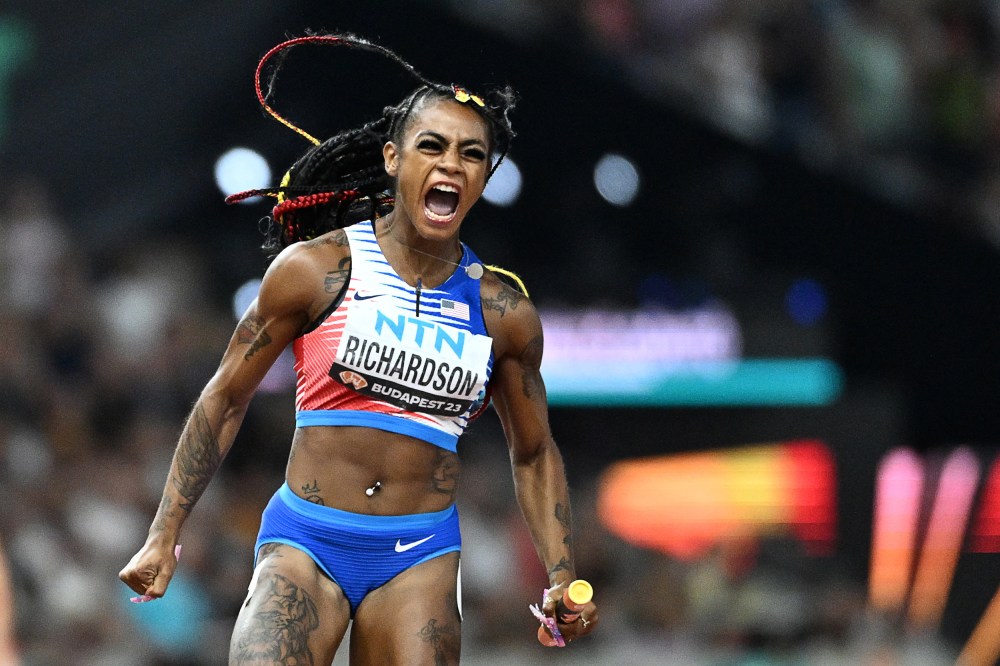
From sprinter Sha’Carri Richardson, to hurdler Sydney McLaughlin, to marathoner Fiona O’Keefe — there’s no lack of star power when it comes to American women runners who will likely take the world’s largest stage at the upcoming Paris Olympics.

Their path to success, however, was paved by many women before them.
It’s a story journalist Maggie Mertens tells in her new book “Better Faster Farther: How Running Changed Everything We Know About Women.”
As Mertens writes, throughout history, despite women proving their running capabilities time and time again, men in the medical establishment, media and athletic associations have fought to keep women out of competitive racing. Take, for example Kathrine Switzer who was literally pushed off the Boston Marathon course in 1967.
In the book, Mertens looks into the often over-looked narrative of how women defied limitations and propelled themselves to the forefront of competitive running.

Know Your Value recently chatted with Mertens about the book.
Below is the conversation, which has been edited for brevity and clarity:
Know Your Value: Tell us about the genesis of the book. Why did you decide to write a book shattering misconceptions about women’s running and athleticism?
Maggie Mertens: I’ve been writing about women athletes for a decade and I was constantly surprised by the misconceptions and myths that continue today about women, our bodies, and our physical capabilities. Many times these misconceptions were used as excuses for why women athletes are still underpaid, undervalued, and underappreciated. Running, to me, is one of the most human forms of movement so it made sense to look at the history of the myths and misconceptions told about women runners as a way to explore human physical capability and how we’ve structured our society to emphasize physical difference and women’s incapability.
Know Your Value: In your research, what was the most surprising thing you learned? Is there a particular story or interview that jumped out to you?
Maggie Mertens: I was shocked to find out that, although women were considered physically incapable of running a marathon well into the 20th century, in fact, a woman ran the very first Olympic marathon in 1896. Stamata Revithi, a Greek woman ran the Olympic marathon, albeit the day after the men’s race (she was told, incorrectly, that there would be a women’s race the following day) with no training or experience. Sadly, her story wasn’t covered for the major feat it was at the time, but was nearly lost to time.
Know Your Value: In the book, you write about the untold stories about groundbreaking female runners. Who was your favorite woman to write about — and why? Maggie Mertens: Florence MacDonald, the only American woman who made the 1928 800-meter Olympic Final was my favorite person to write about. This was a race that was highly controversial and led to many decades of women not being allowed to run middle or long distance races officially. Not much had been written about Florence at all before, so I got to dig through old newspaper archives and piece together her story, as well as find her son, who was still alive. By a major stroke of luck, I also tracked down an interview she’d given in her 90’s about the race, which she’d never commented on before publicly. Know Your Value: What can women today learn from the women runners you write about — especially in terms of taking on sexist workplace environments or men who simply don’t think they are qualified? Maggie Mertens: I hope anyone who reads the book realizes that despite what we’ve been told about defining gender through physical capability, women have consistently been doing things that men have claimed we can’t do. The women runners in the book proved again and again that gender is far more expansive than a little box to constrain us. We’d all be a lot better off if we stopped trying to strictly define how men and women are so different and just embraced the vast diverse spectrum of humanity and all of our strengths. Know Your Value: While the environment for women runners has certainly changed for the better, there are still obstacles, including (as you write) the relentless attention to women’s bodies. What do you think the biggest challenges are? Maggie Mertens: For sure women runners are still existing in a world where their body size is often associated (incorrectly) with their success. Coaches and trainers need to be better trained in spotting disordered eating, and the very dangerous signs of under-fueling, like a lost period, multiple bone injuries, or neurological, or cardiovascular issues. As a society, women runners need to be seen as strong and capable and valued the same way that we value male athletes, in sponsorships, in advertising, in media coverage, and in the way we gush over and are inspired by their physical accomplishments. I truly don’t think we will achieve gender equality in this world until we can achieve that.Recommended


