








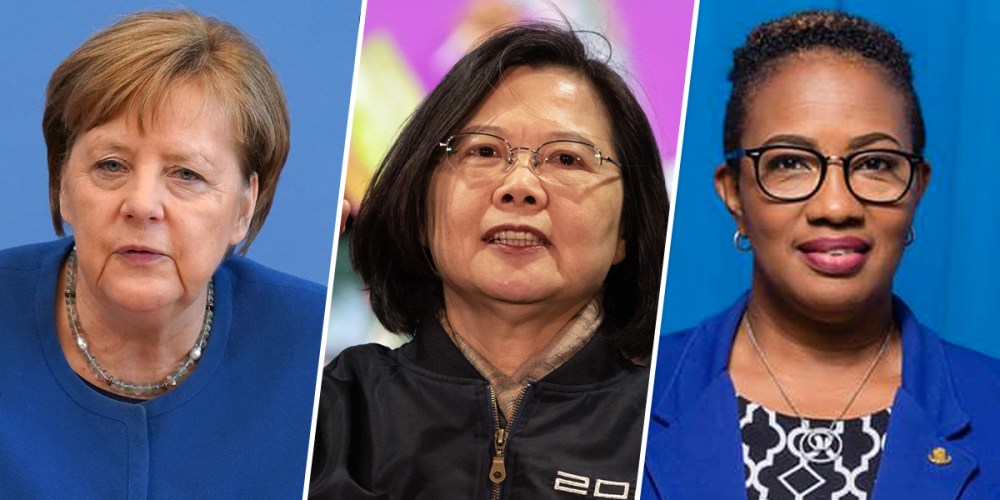
When we look at the global response to COVID-19, female leaders are shining. In many cases, it was women who acted before anyone else. This typically comes naturally to us: We are nurturers and communicators, we put the collective good before our own self-interest and we know how to be empathetic and decisive in equal measure. The oft-overlooked skills that women bring to the table are becoming very visible — in fact, they’re emerging as the greatest strengths for leadership today.
The traits we typically associate with leadership — being assertive, competitive, confident, dominant, independent — are stereotypically associated with men. But do these traits really make the best leaders? Just look to female heads of state like New Zealand’s Jacinda Ardern, Taiwan’s Tsai Ing-wen, Sint Maarten’s Silveria Jacobs, Denmark’s Mette Frederiksen, and Germany’s Angela Merkel. These women have received global acclaim for their responses to the pandemic — and, at the same time, challenged our traditional assumptions of leadership.
The qualities that make women great leaders through times of crisis are also what make them great leaders every day. Here are just a few of the traditionally feminine leadership traits that the pandemic has brought into focus:
Compassion
Social psychologist Alice Eagly notes that women place a greater value on positions that they view as “helping people, making the world a better place, getting rid of suffering, and serving humanity.”
During trying times, this compassionate leadership style is especially effective. Take Norway’s Prime Minister, Erna Solberg, who appeared on a popular television program to speak directly to her country’s children about COVID-19, answered their questions, and allayed their fears. As the pandemic took hold across Europe, German chancellor Angela Merkel was praised for her direct, empathetic address in which she underscored the role that every person has to play in preventing casualties: “These are not simply abstract numbers in statistics, but that is a father or grandfather, a mother or grandmother, a partner. And we are a community in which every life and every person counts.”
Humility
Numerous research examines gender differences in humility — and they find it to be a definitively feminine trait. It is also a critical driver of effective leadership. In her article exploring why women-led nations were doing better with COVID-19, Times’ The New York Amanda Taub pointed to the principle of humility, referencing an op-ed by Devi Sridhar, the Chair of Global Health at the University of Edinburgh Medical School: “No discipline has all the answers, and the only way to avoid ‘groupthink’ and blind spots is to ensure representatives with diverse backgrounds and expertise are at the table when major decisions are made.” Female leaders are able to leave their ego at the door and encourage different ways of thinking.
It’s a well-documented fact that women prefer to work in teams, while men prefer to work alone. A recent study by Peter Kuhn and Marie Claire Villeval suggests that women tend to avoid competition, while men are more averse to cooperation. Given the global scale of COVID-19, a collaborative approach is key, as demonstrated by two countries who swiftly flattened the curve: Before the virus had even taken hold in Iceland, Prime Minister Katrín Jakobsdóttir took proactive steps, partnering with the scientific community to launch an extensive contact-tracing team and make free virus tests readily available. “It was very clear from the beginning that this was something that should be led by experts—by scientific and medical experts,” Jakobsdóttir said. New Zealand Prime Minister Jacinda Ardern has also received universal acclaim for her handling of the pandemic. It is worth noting that her approach was nonpartisan; the liberal politician worked with Scott Morrison, the conservative prime minister of Australia, to create a joint effort that has effectively eliminated the virus from their island nations. Perhaps COVID-19 has shown the world what should have been obvious all along: The qualities that make women excellent caregivers are also what make them great leaders. “I don’t see any contradiction in being empathetic and compassionate and being a strong leader. That’s not weakness. That’s strength,” said Ellen Johnson Sirleaf, former president of Liberia and recipient of the Nobel Peace Prize. She knows a thing or two about leading through a crisis, as she navigated Liberia through the Ebola virus outbreak of 2014. It feels fitting to conclude with her words, which I echo wholeheartedly: “The power of women has not yet been fully tested or tapped. We need to build towards using it more often.” Shelley Zalis is CEO of The Female Quotient and founder of The Equality Lounge. She is a champion of equality and has devoted her career to advancing women in the workplace
Shelley Zalis Recommended


Collaboration
