








For President Obama, the Affordable Care Act was always about the long game, creating a lasting legacy by achieving what generations of presidents before him could not: universal health care.
But over the last four years, both he and his party have paid an enormous price for the signature legislation. And if the Obama administration can’t quickly repair the website that allows Americans to sign up for health insurance, the rest of his presidency could be imperiled.
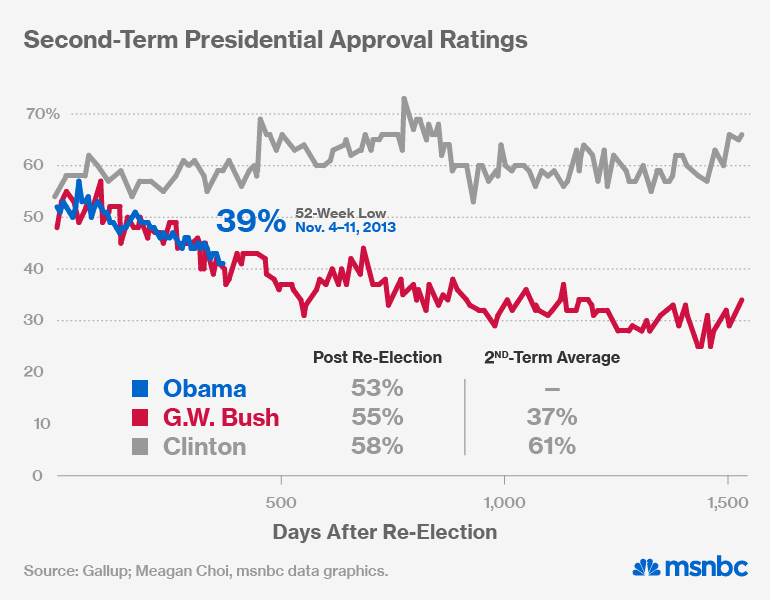
On Tuesday, Quinnipiac University released a survey showing Obama’s approval rating bottoming out at 39%, with 54% disapproving of his performance. Recent polls from NBC/WSJ (42% approval), Pew Research (41% approval), and Gallup (42%) have also found his popularity sinking to a low point.
It’s no mystery what’s driving the sudden downturn. The health care exchanges are still not fully functional, leading to the weak enrollment numbers announced Wednesday. And the administration is taking heat for its misleading assurances that Americans on the individual market would be able to retain their existing plans.
For Obama, this marks a turning point.
“What’s happened recently is a dagger aimed at the heart of the Obama presidency,” William Galston, a Brookings Institute fellow and former policy aide to President Clinton, told msnbc. “For the first time, the bonds of trust and confidence that have linked him to the American people are showing signs of fraying–and that’s the foundation of any administration.”
Obama has gone through rough patches before–the 2010 midterms, the 2011 debt ceiling fight, the recent Syria conflict. But most of his toughest battles have been fought over broad ideological disagreements: whether to tax the rich instead of cutting public benefits, whether marginalized groups deserve equal rights, whether the government should play a role in ensuring access to health care. Obama was able to win fights like these–politically, at least–by presenting a stronger argument to the public than his opposition.
This time the challenge is much more tangible. Either the exchange works or it doesn’t. Either people getting cancellation notices can find acceptable, affordable coverage or they can’t. There’s no messaging substitute for success on either front.
Taken together, the website and cancellation issues have eroded two of Obama’s most lasting advantages with the public: his perceived credibility and effectiveness. Quinnipiac’s latest poll found that only 44% of Americans found the president “honest and trustworthy,” a new low and a 10-point drop from six weeks ago. Only 43% said he had proven competent in running the government.
It’s not just average Americans who are getting fed up. With their signature law struggling, the White House is losing another one of its biggest assets: Democratic unity.
During the shutdown, Obama’s rock solid support from Democrats in the Senate and House helped fend off attacks from a divided Republican party, leading to a resounding victory. This time around, Democrats are increasingly tuning out the White House and looking for their own plan–or worse, a Republican one.
Several Democrats have signed on to a bill by Senator Mary Landrieu of Louisiana, who faces a tough re-election fight next year, that would require insurance companies to continue to offer existing plans to individuals facing cancellation, even if they don’t comply with new Obamacare regulations. Rather than just attracting other endangered red-state Democrats, however, Landrieu has also convinced Jeff Merkley of Oregon and Dianne Feinstein of California to co-sponsor the effort. Bill Clinton, a staunch defender of the law overall, has called for a legislative fix as well.
In the House, Democrats grumbled after a meeting with White House officials that they need decisive action from Obama to keep Democrats from defecting to a similar bill by Republican Congressman Fred Upton that would allow insurance companies to extend old policies.
“We need something to support; they need to come up with something or many of us will support the Upton bill,” Congressman Steve Cohen of Tennessee told reporters, adding that the latest rollout troubles were “the last straw for many of us.”
Health care experts warn that bills like Landrieu’s and Upton’s would undermine the law in a variety of ways, most notably by keeping healthy (and cheaper to insure) consumers out of the exchanges. The White House is struggling to come up with an alternative that doesn’t trade long-term policy damage for brief political gain.
But it’s easy to appreciate why Democrats are so nervous. After putting Republicans on the defensive in the wake of the shutdown, early polling suggests Democrats are in danger of an Obamacare backlash of their own. Quinnipiac found the two parties tied in the generic Congressional ballot 39-39 in their most recent poll, erasing a 9-point Democratic lead last month. Failing to make gains in the House would be bad enough, but if Democrats lose the Senate, Obama will also lose one of the last mechanisms for advancing his agenda, especially on presidential appointments and judicial nominations. Presidential approval ratings for second term incumbents, which often predict a party’s midterm performance, tend to be sticky. Without a looming campaign to rally partisans behind the White House, it’s hard to make up ground. An alarming feature noted by The Fix is that Obama’s trend line is starting to look like that of President George W. Bush, whose approval rating tumbled early in his second term, worsened later, and finally bottomed out at 25% in his waning months. It would be–to put it mildly–simplistic to look at charts of recent presidents’ polling and conclude Obama is doomed to follow the same course. After all, Bush’s collapse didn’t happen in a vacuum, it was the result of a string of disasters. The core drivers of Bush’s decline were Iraq and Katrina, but there was also an unpopular attempt to privatize Social Security, his intervention in the Terri Schiavo case, a failed Supreme Court nomination, and in Congress, a series of scandals that included the indictment of Majority Leader Tom DeLay and resignation of Mark Foley. Just when Iraq started to improve, another wave of scandals rolled in: Plamegate, which led to the conviction of Dick Cheney’s chief of staff Scooter Libby, and the US Attorneys scandal, which led to the resignation of Attorney General Alberto Gonzales. Right as those began to subside, the economy sputtered and then collapsed, leading to terrifying financial upheaval for many Americans and a wildly unpopular bailout. If Obama manages to fix the website, secure some kind of solution for cancelled plans, and then generally stay out of trouble, he should improve on that performance. But there are elements of 43’s experience that should disturb the White House. If you had to pinpoint the point-of-no-return politically for the Bush presidency, it would be Hurricane Katrina. The reason was more than just the the horror caused by the disaster and worsened by the federal government’s bumbling and disconnected response. It unraveled the core argument for his presidency: “He may not agree with you on everything, but he’ll do everything in his power to keep you safe.” Seeing his management style up close–and its devastating consequences–raised as many questions about what was happening in Iraq as it did about disaster preparedness at home. Questions that Democrats were eager to answer for disillusioned voters. For Obama, the health care law was central to his own re-election argument, which boiled down to: “He may not agree with you on everything, but he’s an honest, highly competent technocrat doing his best to improve your life– unlike his partisan opponents.” The administration’s inability to implement its most critical policy item as promised is sowing doubts among Americans about whether that argument still rings true. Republicans will be all too happy to offer their own explanation.
Benjy Sarlin Recommended


