








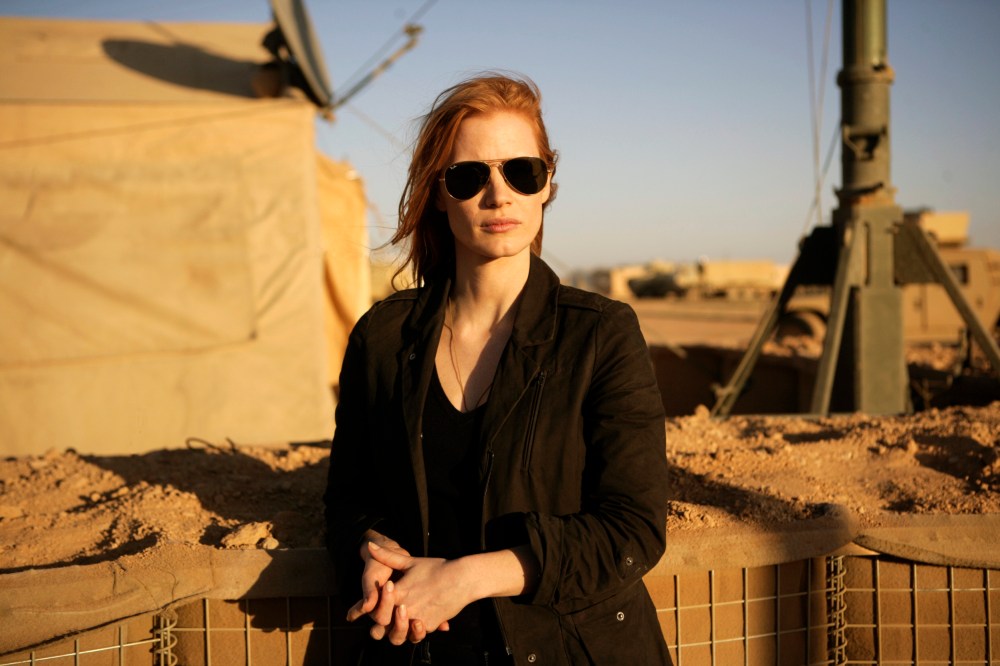
Zero Dark Thirty, a film about the decade-long CIA hunt for Osama bin Laden and the raid that killed him, is already one of the most talked about films of the season, and the movie doesn’t even come out for another week.
The film is the brainchild of screenwriter Mark Boal and director Kathryn Bigelow, whose earlier collaboration—The Hurt Locker—won six Oscars in 2010. Already, Zero Dark Thirty has been named Best Picture by the National Board of Review and by the New York Film Critic’s Circle, as well as one of the ten best films of the year by the American Film Institute.
But in addition to all that praise, Zero Dark Thirty has also netted a fair amount of criticism for what some feel is too strong a message that torture played a key role in locating Osama bin Laden in his Pakistan hideout.
The New York Times’s Frank Bruni, who voiced his moral reservations about the film in a recent piece entitled “Bin Laden, Torture and Hollywood,” said on Hardball Tuesday that the movie “does suggest very, very strongly that without the torture, we would never have been able to raid that compound; we would never have gotten there.”
There is no denying that brutal interrogation methods, otherwise known as enhanced interrogation techniques, took place between the years 2002 and 2005 as tactic to extract information from Al Qaeda operatives.
But did they work?
Senate Intelligence Committee chair Dianne Feinstein, D-Calif., and Senate Armed Services Committee chair Carl Levin, D-Mich., said no. They wrote in a joint statement that, “The suggestion that the operation was carried out based on information gained through the harsh treatment of CIA detainees is not only inaccurate, it trivializes the work of individuals across multiple U.S. agencies that led to UBL and the eventual operation.”
But some critics worry that Zero Dark Thirty sends a different message—that torture practices were essential to the CIA’s operation in finding bin Laden.
So how graphic are these scenes that depict enhanced interrogation techniques?
According to Vulture’s Mark Harris, within the first 20 minutes, the film confronts the audience “with an excruciating, sustained sequence of waterboarding, abuse, and humiliation.”
The Daily Beast’s Marlow Stern also described one of the interrogation scenes saying, “The detainee is stripped naked, has his face covered in a towel and doused with water repeatedly until he almost drowns, is beaten, subjected to a barrage of heavy-metal music, forced to crawl around in a dog collar, and then placed in a tiny box the size of a cupboard.”
And New York Magazine film critic David Edelstein wrote that, “As a moral statement, Zero Dark Thirty is borderline fascistic.”
“Kathryn Bigelow is kind of an amoral filmmaker,” said Edelstein on Hardball Tuesday. He went on to say that Bigelow “shoots those torture scenes in a very neutral way,” and that her message is that torture is “ugly but necessary.”
Others, however, saw it differently.
Though Marlow Stern does go into graphic detail about the brutality surrounding the interrogation scenes, his takeaway was that very little information actually came out of those methods. It is only when the interrogators adopt a more relaxed technique, offering the detainee food and a cigarette, that they are able to get the vital information about bin Laden’s courier that leads to his location. Both Bigelow and Boal insisted that their film has no agenda when it comes to torture practices. Their motive was to create an honest portrayal of the bin Laden manhunt, and as Bigelow stated on The Today Show, enhanced interrogation techniques are “part of the history.” Adding more fuel to the critics’ fire is the fact that the filmmakers pitched Zero Dark Thirty as what Boal described, a “hybrid of the filmic and the journalistic.” Boal, who is himself a former journalist, threw himself into his research and even gained the cooperation of the CIA to get as many accurate details about the raid and its backstory as possible. During production, Bigelow too went out of her way to capture the story the way it may have actually unfolded. She had her production team build a full-scale replica of the Abbottabad compound, as well as two helicopters, she never used what is called a “wild” wall that would have allowed her camera to capture an entire room, and she actually filmed parts of the raid through night-vision goggles, instead of adding the effect in post-production. Consequently, those who believe the film’s message is not just that torture happened, but that it needed to happen, are further concerned that the movie may project that message as fact. But again, that interpretation seems to vary depending on the viewer. As Adam Serwer of Mother Jones writes, “If you’re thinking of giving Bigelow an award, Zero Dark Thirty is ‘history;’ if you’re a journalist asking a question about a factual error in the film, it’s just a movie.” So does Zero Dark Thirty, as Frank Bruni said on Hardball, give the “impression that torture was a vital part in getting Osama bin Laden?” You can decide for yourself when the film is released on Dec. 19.
Emma Margolin
Emma Margolin is a reporter at MSNBC.com. Recommended


