








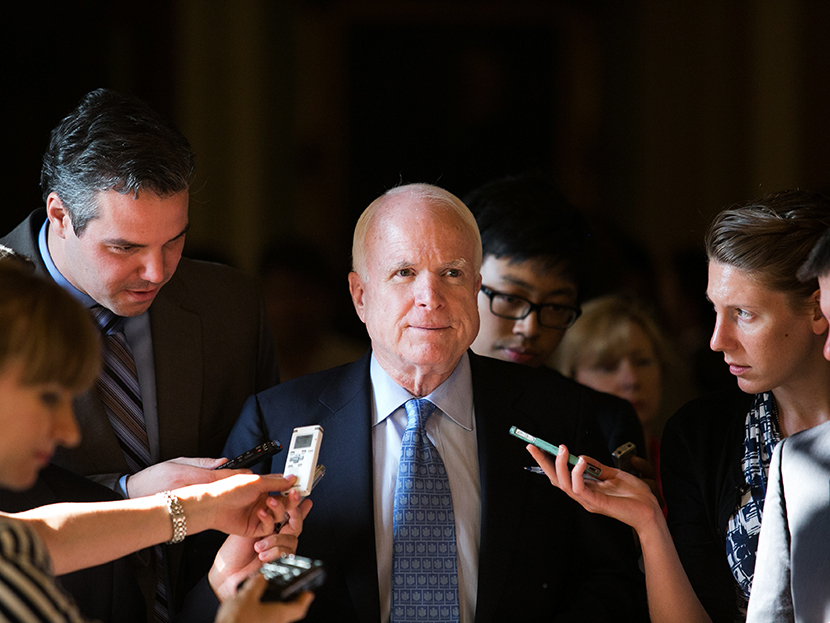
When it comes to defusing the “nuclear option,” John McCain is the Senate’s James Bond. On Tuesday, the Arizona Republican brokered a last-second deal with Democrats to preserve the filibuster in exchange for votes on several critical presidential appointees.
In 2005, McCain narrowly averted another procedural showdown after Republican leaders threatened to go nuclear to confirm conservative judges. This time it was Democrats with their finger on button demanding votes on cabinet nominees and board members. Under the deal McCain brokered with Senate Majority Leader Harry Reid, President Obama will get up-or-down votes on five disputed nominees and an agreement to hold votes on two open National Labor Relations Board positions so long as he picks new candidates.
From the outside, it’s easy to view the prolonged battle over arcane rules as another Washington sideshow. It wasn’t. The progressive core of President Obama’s second term agenda, from climate change to Wall Street reform, runs through those nominees and Democrats did not make their threats lightly.
The partisan standoff was the result of years of growing tensions over the GOP’s unprecedented levels of obstruction and Obama’s use of executive power, the latter of which is heavily influenced by the former.
In Obama’s first term, Senate Republicans stymied the president’s legislative priorities with record use of the filibuster, nearly derailing health care reform and preventing serious movement on either a climate or immigration bill. Because the House GOP today won’t pass even routine bills without apocalyptic threats of their own, the Senate GOP’s legislative roadblocks are no longer as relevant. But they’re still holding up judicial picks and presidential appointees at high rates, both of which become even more important in the absence of a functioning legislature. Democrats considered reforming the rules governing filibusters at the start of the new Senate, but ultimately backed off any major changes for fear of antagonizing the GOP. But as the situation grew more dire, Reid reopened the discussion and even apologized to colleagues for not doing so sooner.
Two things kicked the fight into overdrive. First, Senate Republicans decided to start blocking presidential nominees for key positions out of hand. That means they didn’t just filibuster individual appointees because they didn’t like their qualifications, they announced plans to block any nominee for their position, either because they thought the agencies shouldn’t exist or because they wanted to undermine their ability to function. This might have been tolerable until a federal appeals court ruled early this year that President Obama could not fill the positions with recess appointments. Democrats now had to either fix the Senate procedure or leave crucial agencies’ rudderless for an indefinite period.
“It’s the only way, in many cases, the president can have any impact on policies he cares deeply about,” Thomas Mann, a senior fellow at the Brookings Institute and prominent critic of GOP obstructionism, told msnbc.
Take one prominent nominee addressed by the McCain-Reid deal: Richard Cordray. Obama chose him to head the Consumer Financial Protection Bureau, the new agency long championed by Senator Elizabeth Warren. The CFPB was created by the Wall Street reform law that both the Senate and House passed in 2010. But Republicans announced they would block Cordray and anyone else unless Democrats agreed to revisit the law and weaken the bureau’s authority.
In another critical case, the court’s decision to void recess appointees threatened to leave the National Labor Relations Board without a quorum to make decisions. That’s an outcome many Republicans would likely prefer after tangling with the NLRB over a dispute (since resolved) over whether Boeing was retaliating against unions in Washington by opening an assembly line in South Carolina. The most important nominee included in the deal, however, is probably Obama’s choice to head the Environmental Protection Agency, Gina McCarthy. Climate change remains a growing threat, but Republicans are so united in denouncing the science behind it as a hoax that one Congressional staffer felt compelled to use a pseudonym just to argue the opposing view. With no hope for meaningful legislative action in the near future, environmentalists are counting on EPA regulations on power plants to help turn the tide, a process made easier by having an actual appointed leader at the agency. Adding to the urgency: if the EPA fails to act before the 2014 elections, a Republican-led Senate could block any new rules. And if you think labor, finance, and the environment are contentious topics, wait until the conversation turns to health care. Next year, Obama is set to make his first appointments to the Independent Payment Advisory Board—better known in right-wing chain e-mails as a “death panel”—that was created by the Affordable Care Act to control long-term Medicare costs. Already Republican leaders Mitch McConnell and John Boehner say they’ll refuse to submit a list of their preferred choices for the committee, instead reiterating their demand that the whole law be repealed. The topic was not addressed in the latest filibuster agreement, suggesting another nuclear standoff may be in the cards. It’s still not clear whether the filibuster fight will spread to judges, another area where the president has made it clear he’s frustrated with inaction. But both are symptoms of the same underlying issue: if Obama wants to leave a substantive legacy in his second term, it probably won’t be through Congress.
Benjy Sarlin Recommended


