








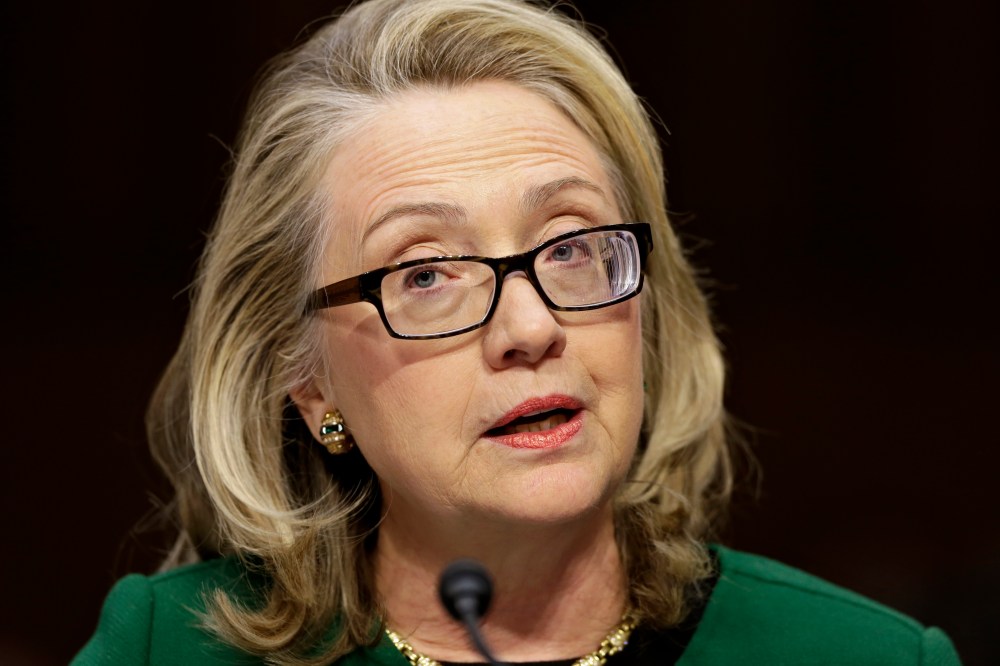
Outgoing Secretary of State Hillary Clinton faced off against the Senate Foreign Relations Committee Wednesday in a heated hearing regarding her role in the attack on the U.S. mission in Benghazi last September that left four Americans dead, including Ambassador Chris Stevens.
Republican senators pressed Clinton, who took full responsibility during her opening statement.
“As I have said many times since September 11, I take responsibility. Nobody is more committed to getting this right. I am determined to leave the State Department and our country safer, stronger, and more secure,” Clinton said. She also pointed to budget cuts that left the department with insufficient security as a result of inadequate funding.
Since the September 11, 2012 attack in Benghazi, Republicans have been up in arms over what they framed as a vulnerable U.S. mission in the region, a strengthened al Qaeda, and a cover-up by the Obama administration over whether the siege was an act of terror. Leading up to the 2012 election, they used the issue to galvanize the public and show a weakened U.S, soft on security under President Obama—but the issue largely fell flat with the American public at the voting booths.
Where the Republican case gained traction was in the fight against U.N. Ambassador Susan Rice’s chances to succeed Clinton as the next secretary of state. Republican lawmakers seized on Rice’s comments on Sunday talk shows following the attack, when—speaking from declassified talking points—she characterized the violent mob as a spontaneous reaction over an anti-Islamic film posted to YouTube. Later intelligence revealed the siege was a planned attack. Having never been nominated, Rice took her name out of consideration to be the nation’s top diplomat on December 13 under heavy pressure from congressional Republicans who vowed to block her nomination.
The argument against Rice having “misled the American public” was in full force during Clinton’s Senate hearing Wednesday. Republican Senator from Idaho James Risch asked Clinton whether she selected Ambassador Rice to deliver the message to the American people. “No, I did not, Senator,” Clinton replied. “I personally was not focused on talking points. I was committed on keeping our people safe.”
In the hearing’s most intense exchange, Senator Ron Johnson, R—Wis., charged, “We were misled that there were supposedly protests and then something sprang out, an assault sprang out of that and that was easily ascertained that that was not the fact and the American people could have known that within days.”
“With all due respect, the fact is we had four dead Americans,” an impassioned Clinton responded. “Was it because of a protest, or was it because of guys out for a walk one night who decided they’d go kill some Americans? What difference, at this point, does it make? It our job to figure out what happened and do everything we can to prevent it from ever happening again, senator. Now, honestly, I will do my best to answer your questions about this. The fact is that people were trying, in real time, to get to the best information.”
Senator John McCain, who led the charge against Rice’s nomination to lead the State Department, took his chief complaint against Rice before Clinton, “People don’t bring RPG’s and mortars to spontaneous demonstrations. That’s a fundamental…The President, as late as September 24th, two weeks later, didn’t acknowledge this was an act of terror.”
Clinton replied that she disagreed with McCain’s sequence of events.
President Obama did, in fact, refer to the attack as “an act of terror” in remarks in the White House rose garden the day after the attack. That same day, Clinton said that “heavily armed militants assaulted our compound.”
As to McCain’s complaint about aid being withheld from Libya, Clinton pointed out that the House of Representatives has “holds” on aid to the country, saying “we have got to get our act together between the administration and Congress if this is a priority… I hope we can have the kind of discussion where we can agree on approaches that will make a difference. I also hope we’re looking forward because right now Libya is still dangerous.”
Sen. Bob Corker, R-Tenn., also hammered Clinton over security failures in Benghazi, saying “these officials [in Benghazi] were screaming out for more security,” referencing memos sent to the State Department.
“I have thought about this almost constantly since that date because I do feel responsible. I feel responsible for the nearly 70,000 people who work for the State Department. I take it very seriously. The specific security requests were handled by the security officials. I didn’t see those requests 0r they didn’t come to me, I didn’t approve them. I didn’t deny them. That’s one of the findings of the report,” Clinton said, referencing the independent Accountability Review Board findings last month. “These requests don’t ordinarily come to the Secretary of State.” Many of the Senators thanked Clinton for her service and mentioned the record number of miles logged and countries visited as the nation’s top diplomat. Sen. Richard Durbin, D-Illinois, took his opportunity for questioning to defend both Rice and Clinton. “I also want to say a word on behalf of Ambassador Rice, an extraordinary individual who has served this country well. I think some of the criticism that was heaped on her was unfair and did not reflect the fact that she was reporting the best information she had available at the time. And as you have said, more information became available, and it was dutifully reported,” Durbin said. “I do want to make one point for the record here about whether the American people are told everything right away, in the right way, so that they can be fully informed. And I’d like to refer to five words for them to reflect on: Iraqi weapons of mass destruction.” Durbin voted against the joint resolution authorizing the Iraq War in 2002. One of the most inflammatory comments came from Kentucky Republican Senator Rand Paul, who compared the Benghazi attack to “the original 9/11,” when nearly 3,000 Americans were killed. Paul called the loss of life in Benghazi “a failure of leadership” on Clinton’s part. “Four lives were cost because of this. I’m glad you’re accepting responsibility—and I think with you leaving, you’re accepting culpability for the worst tragedy since 9/11. Had I been president at the time, and I found you didn’t read cables from Benghazi, the cables from Ambassador Stevens, I would have relieved you from your post.” In her opening statement, Clinton choked up over the lives lost in the attack. “I stood next to President Obama as the Marines carried those flag-draped caskets off the plane at Andrews. I put my arms around the mothers and fathers, sisters and brothers, sons and daughters and the wives left alone to raise their children,” Clinton said. Clinton’s testimony came more than a month after originally requested, after health issues kept her from testifying in December—amid criticism from a number of Republicans that she faked health problems to avoid testifying. A PPP poll conducted in December showed that 40% of Republicans said they believed Clinton was “faking her health problems so that she doesn’t have to testify to Congress about Benghazi.” Only 22% of respondents overall said they thought Clinton was faking illness. Clinton will testify before the House Foreign Affairs committee Wednesday afternoon. Senator John Kerry, D-Mass., has been nominated to succeed Clinton as secretary of state, and his confirmation hearing will be held Thursday.
Erin Delmore Recommended


