New federal employees are going to feel the sting from the federal budget deal unveiled on Tuesday. Of the proposed legislation’s nearly $1 trillion in savings, an estimated $6 billion comes out of the pensions of any federal workers hired after Dec. 31, 2013. Those newer workers would have to pay for 4.4% of their salary, more than five times what older employees would pay.
Shortly before the details of the budget plan were announced, National Treasury Employees Union president Colleen Kelly told msnbc that changing her members’ retirement benefits would be “unacceptable.”
“There are too many in Congress who do not value and respect federal employees and the work they do,” she said. Kelly’s union estimates that federal workers have already lost some $113 billion to deficit-reduction efforts, thanks in part to a multi-year pay freeze lasting from 2010 to the end of the 2013 government shutdown.
Many federal employees also lost money to unpaid furlough days as a result of the across-the-board budget cuts known as sequestration. In addition, federal employees hired after 2012 already contribute more to their own pensions than those hired before, thanks to a bill Congress passed in February of that year. Whereas older hires pay 0.8% of their salaries into the federal retirement system, those hired after the law went into effect contribute 3.1%.
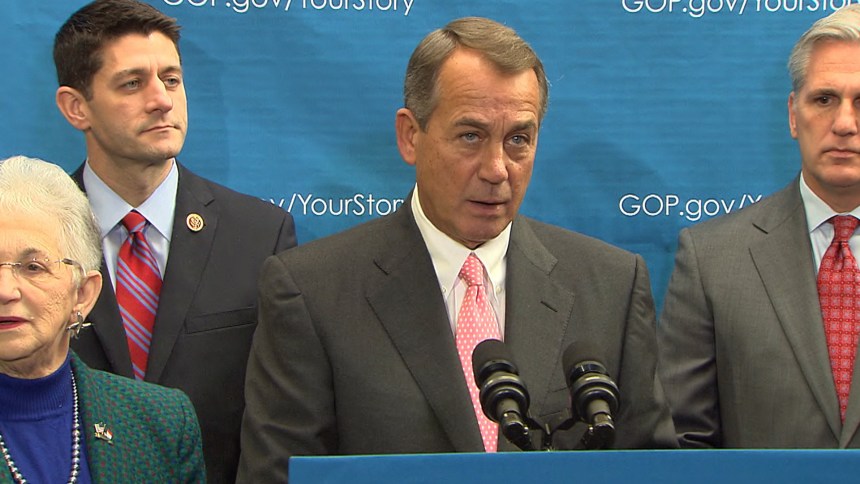
Early budget proposals from both major political parties have targeted federal employee pensions, though mostly at the expense of older workers who still contribute 0.8%. The proposed White House 2014 budget [PDF] would have slowly increased up to 2% between 2014 and 2017. Instead of that 1.2% increase, budget negotiator Rep. Ryan, R-Wisc., had proposed that federal employees contribute 5.5% more, for a grand total of 6.3%.
While the White House and the Republican Party disagreed only with regards to the size of the cut, one of the most powerful House Democrats has fought to contain the damage. House minority whip and former majority leader Steny Hoyer represents a district in the state of Maryland, where many voters are employed by the federal government.
“To continue targeting one group to carry the burden of fixing our deficits is absolutely unacceptable,” he said in a statement last week. “This denigration of our nation’s federal employees doesn’t just harm our ability to recruit and retain the top-notch workforce needed to serve the American people—it harms the American people who access the services of our government.”
Hoyer’s office did not respond to a request for comment on the pension details in the new budget deal.
If left unaltered, federal retirement systems appear to be financially sustainable in the long term. A June report [PDF] by the Congressional Research Service found “no point over the next 80 years at which the assets of the Civil Service Retirement and Disability Fund are projected to run out.” Outside the Beltway, most state and local public employees have seen recent changes to their pensions. Over the past three years, nearly every state in the country has somehow revised their retirement systems. In Detroit, a recent court ruling has paved the way for a municipal bankruptcy in which public sector workers expect to see significant cuts to their pension benefits. In addition to the $6 billion in pension cuts for civilian federal employees, the budget deal reduces military retirement benefits by another $6 billion, through adjustments to retirees’ cost-of-living adjustment. CORRECTION: An earlier version of this article said that newer workers would have to pay 4.4% of their retirement benefits once the budget went into effect. In fact, they will need to pay 4.4% of their salary.
Ned Resnikoff is an urban policy analyst, researcher, writer, and editor. His byline has appeared in a variety of publications, including the New York Times, San Francisco Chronicle, Dissent, and The Nation. He writes the newsletter Public Comment, which can be found at publiccomment.blog. Recommended