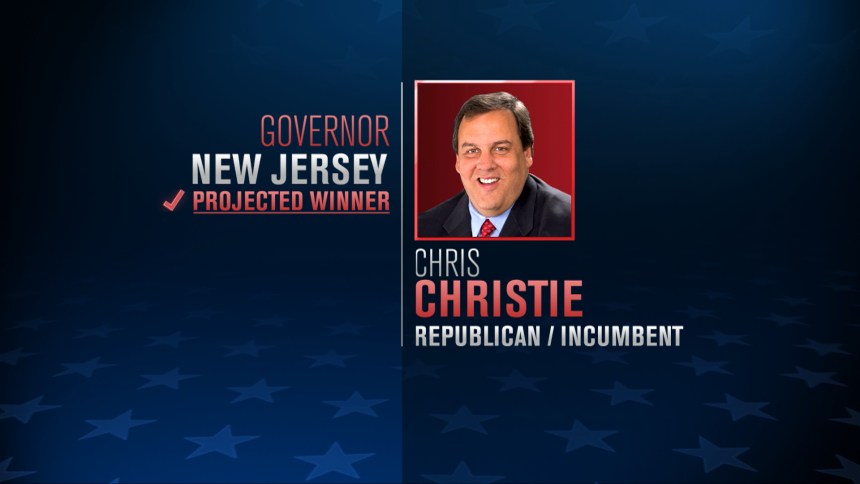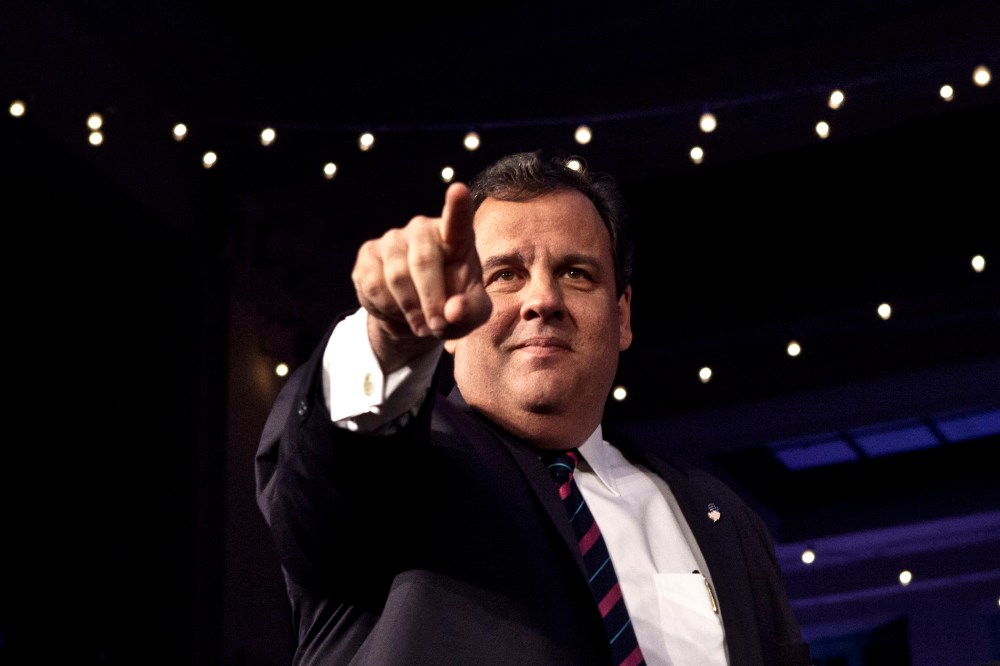
New Jersey Gov. Chris Christie sailed to re-election Tuesday — a victory that bolsters the possibility of a presidential run in two years. The Republican governor is widely perceived to be a moderate, national voice in his party thanks to his work with President Obama in the wake of Hurricane Sandy. NBC News projected Christie the winner just after polls closed at 8 p.m. ET.
Christie’s opponent, Democratic challenger Barbara Buono, spent nearly $2.5 million trying to unseat the New Jersey governor and win back control of what tends to be a solid blue state in national elections. But the Christie campaign was able to vastly outspend Buono, pouring almost $9.2 million into the race. The state Democratic Party all but abandoned Buono, as 50 state and local party officials announced their support for Christie’s reelection bid. While Buono tried to turn Christie’s presidential ambitions into a liability, New Jersey voters did not punish their governor for appearing to seek the national stage.
“What people have never understood about us is that I didn’t need the introduction to all of you,” Christie told New Jersey supporters during his Tuesday night victory speech. “I know you, because I’m one of you.”
Christie also dropped what may have been an oblique hint to his rumored national ambitions, saying that people in Washington, D.C. could take a lesson from how things are done in New Jersey.
Women, white voters and independents put Christie over the top on Tuesday. But in a hypothetical matchup against Hillary Clinton, Christie would clearly lose some of that support. Exit polls indicated that Clinton would win against Christie by 7 points, 50% to 43%. Still, 49% of New Jersey voters said Christie would be a good president.
Exit polls also indicated that a solid majority in New Jersey backs same-sex marriage, 60% to 36%, despite Christie’s opposition to it.
Christie’s win occurred on the same night that Virginia voters rejected Republican gubernatorial candidate Ken Cuccinelli, a far-right evangelical. Christie’s victory and Cuccinelli’s defeat took place during a pivotal moment for the Republican Party — it is trying to determine whether it will become a home for moderate conservatives or chart a course even further to the right.
But political scientist Jonathan Bernstein was skeptical that Cuccinelli’s loss and Christie’s victory indicated much about changing dynamics within the party.
“I would be careful about drawing strong conclusions from specific elections,” he said. “It certainly is very true that generally candidates that are perceived as moderates tend to do better in general elections than candidates who are perceived as extremists.”
Even though Christie opposes abortion rights and same-sex marriage, he is viewed as a moderate both within his party and by the national press — a perception partly to due with his handling of Hurricane Sandy’s aftermath. After the storm devastated regions of his state, Christie sought billions in federal disaster relief, bucking conservative members of the national Republican Party who opposed spending large amounts to aid states affected by the storm. Christie even praised President Obama’s handling of the federal disaster relief effort, infuriating conservatives who believed that the applause would support Obama’s re-election campaign against Republican challenger Mitt Romney.
Christie also strayed from the official Republican position on the government shutdown, arguing that Democrats were only partially to blame and that there was also “blame to go around for the Republicans in the House for not coming to consensus even amongst themselves.”
Yet Christie, possibly with an eye towards the 2016 primaries, has rejected the “moderate” label. And on paper, his policy positions make him appear to be a fairly orthodox conservative.
“I don’t know that there are issue positions that Christie has taken that go against Republican conservative orthodoxy,” Bernstein told msnbc. “Compared to Rudy Giuliani who was pro-choice on abortion and who was in favor of gay and lesbian rights, I’m not aware of Christie having any particular differences on issues.”
Christie’s reputation for being a moderate comes more from his personal style, according to MSNBC’s Steve Kornacki, a long-time observer of New Jersey politics.
“The biggest thing with Christie is just embracing Obama, and I think that has stamped him with some of the Tea Party as a RINO [Republican In Name Only],” Kornacki told msnbc.
Yet Kornacki also speculated that Christie’s victory and Cuccinelli’s loss could compel Republican elites to try to moderate the party’s tone in time for the 2014 and 2016 elections.
“It really crystallizes to them the urgency of pulling the party away from the Cruz-DeMint style, trying to play heavily in the primaries in 2014, and trying to avoid nominating Cucinelli-style candidates in 2016,” he said.
But while the “billionaire class” of Republicans might try to drag the party toward the center, “the real question is whether it’s a lesson that will trickle down to the Republican primary voters,” said Kornacki. In his victory speech, Christie seemed to tell the national Republican party what it takes to win. Leadership, he said, is about “bringing people around the table, listening to each other, [and] showing them respect.” “While we may not always agree, we show up,” he said. “We show up everywhere. We don’t just show up in the places that vote for us a lot, we show up in the places that vote for us a little. We don’t just show up in the places where we’re comfortable, we show up in the places where we’re uncomfortable. Because when you lead, you need to be there. You need to show up, you need to listen, and then you need to act.” Less than three weeks before Christie’s win, another election was held in the state of New Jersey. Newark Mayor Cory Booker, widely considered to be a rising star within the Democratic Party, scored a landslide victory in the Oct.16 special election to replace the late Sen. Frank Lautenberg. As Christie easily won re-election, Booker was already sworn in as a U.S. Senator. By scheduling an Oct.16 special election for the open Senate seat, Christie avoided having to share an election day with Booker, whose star power likely would have turned out more Democratic voters. Christie has denied that his own electoral prospects factored into his decision to hold the Senate election on a separate day. “I’m not going to play politics with this,” he told reporters in June, soon after issuing the decision. Not long after Booker was sworn into office, a new book came out that suggested Christie had almost entered national politics himself during the 2012 election. In Double Down, an in-depth account of the 2012 presidential election, journalists John Heilemann and Mark Halperin (both MSNBC contributors) report that Mitt Romney’s advisers seriously considered picking Christie to be the campaign’s vice presidential candidate. Romney himself evidently wanted Christie to be his running mate, according to a separate report from POLITICO. But Christie was ultimately passed over because his “background was littered with potential land mines,” according to Heilemann and Halperin. Among those landmines: Christie’s brother, Todd Christie, was at one point embroiled in an SEC stock fraud investigation. Christie called the leaks reported in the book “very disappointing” in an interview with CNN’s Jake Tapper. “I think it’s a complete violation of trust of me and the spirit within which I entered that process,” he said. One other bit of bad press has troubled Christie in the last week of the campaign, though it is unlikely to effect his poll numbers significantly. Last week, the famously cantankerous governor attracted some negative press when he was photographed yelling at a public school teacher during a campaign event. On the same day that they re-elected Christie, New Jersey voters approved a ballot measure that would amend the constitution and raise the state’s minimum wage from $7.25 to $8.25 per hour. Christie opposed the amendment, saying that changing the constitution just to raise the minimum wage is “a stupid way to do it.”
Ned Resnikoff is an urban policy analyst, researcher, writer, and editor. His byline has appeared in a variety of publications, including the New York Times, San Francisco Chronicle, Dissent, and The Nation. He writes the newsletter Public Comment, which can be found at publiccomment.blog. Recommended