








Movements don’t hold still; they either keep pushing forward or they decline. American labor has been doing the latter for the better part of a century.
When organized labor peaked in the mid-fifties, roughly one-third of all American workers were union members. Now only 11.3% are enrolled in unions, including 6.6% of private sector employees. Should the trend of de-unionization continue, it is not unreasonable to wonder whether there will be any American labor movement to speak of in twenty years or so.
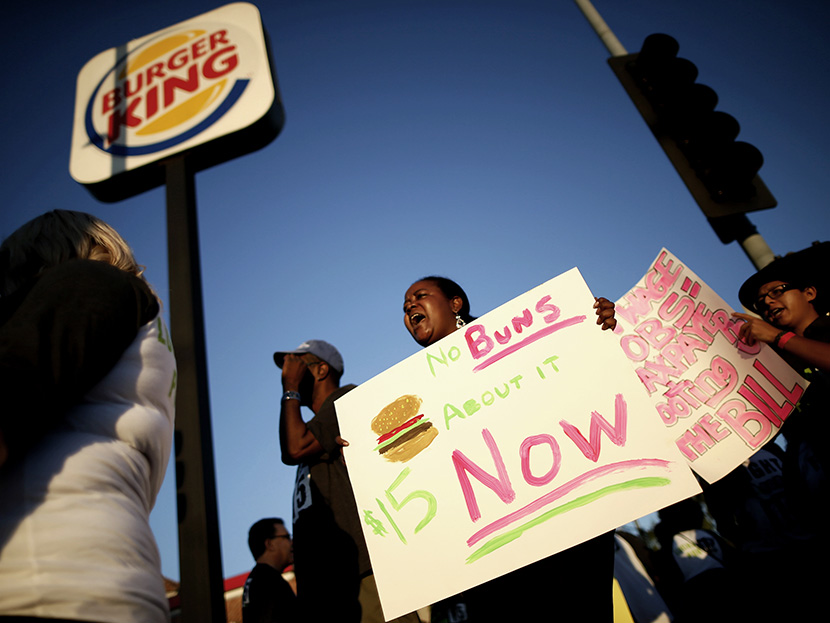
But that may change. Over the past several months, a new kind of labor activism has emerged from some of America’s poorest-paying and least-unionized industries. Fast food workers have stood near the forefront of the movement, waging a nationwide strike campaign which began in December with about 200 New York-based fast food employees and now encompasses thousands of workers spread across 58 cities.
The affected cities range from New York to Seattle, and from Detroit to Memphis. The strikers come from a variety of different backgrounds, but the majority of them are poor people of color, forced to scrape by on what they can earn from one or two low-wage jobs and a bit of public assistance. When they walk the picket line, many of these striker carry signs with expressions like, “I AM A MAN,” a reference to the 1968 sanitation workers’ strike and a sign that many workers consider this campaign to be as much about human dignity as it is about wages.
Few would deny that something significant is happening at the bottom rungs of the fast food industry. What remains unclear is whether those workers can save organized labor, let alone themselves.
One of America’s biggest unions is staking millions of dollars on the answer. The Service Employees International Union (SEIU), which lays claim to over two million members worldwide, has poured its substantial resources and manpower into growing the spontaneous fast food strikes from a local phenomenon to a national campaign. Hundreds of other unions and political organizations have also pledged support, but SEIU remains the nascent movement’s most prominent institutional benefactor.
If the fast food workers achieve tangible results, it could transform low-wage fast food and retail in the same way that the United Auto Workers (UAW) and other unions helped to transform manufacturing during the 1930s. Their efforts, combined with the stimulative impact of World War II, helped birth a new American middle class and an organized labor Golden Age.
Organizing in a different era, the fast food movement could lead to transformative change on a similarly grand scale.
Fast food workers are demanding a new base wage of $15 per hour and the right to form a union. If the appeal for higher pay were granted, it would effectively wipe out a substantial chunk of what is now called the low-wage economy. Fast food would likely shed some jobs, but it would also become an industry which pays a living wage to all of its employees, potentially driving up wages across the whole economy in the process. Many current union members, while not the primary beneficiaries, would likely feel the wage hike’s positive effects when bargaining for a salary increase. The results would be similarly dramatic if the fast food industry became a union stronghold on par with the post-war automotive industry. The ailing labor movement would receive a sudden influx of new members, and even non-union service and retail outlets might be forced to raise wages if they hoped to retain employees—or keep those employees from joining a picket line. But of the fast workers’ two goals, unionization is the one less likely to be realized on any significant level. The industry’s franchising model takes much of the responsibility for workplace conditions away from fast food corporations and places it in the hands of local managers. Building meaningful union density through thousands of small-bore, franchise-by-franchise organizing drives would be all but impossible; if unions are to establish a stable foothold within the industry, their best bet is to somehow legally circumvent the franchise structure and make national corporations into the primary bargaining entities. While raising fast food wages to $15 per hour would also be a difficult feat, the path to doing so is at least more apparent. Fast food strikes might help create the momentum for state-by-state minimum wage increases; after a certain tipping point, federal minimum wage legislation could very well follow. Political scientist Dorian Warren refers to this model as “progressive federalism,” and argues that it was effective in largely wiping out legal child labor. But regardless of whether the fast food workers’ movement achieves either of its stated goals, it has already accomplished something important for the labor movement. Thousands of workers have been activated and politicized in the last industry where such a thing seemed possible. The resulting strikes have done more than draw attention to class and inequality; they have also helped to revive a long-dormant model for how democratic societies deal with such issues. Instead of treating these issues like purely electoral or legislative problems, fast food workers are taking democratic engagement into the street and the workplace. What’s more, national media, corporations, and political institutions are paying attention. That may not be enough to have a lasting impact, but it’s certainly a start.
Ned Resnikoff is an urban policy analyst, researcher, writer, and editor. His byline has appeared in a variety of publications, including the New York Times, San Francisco Chronicle, Dissent, and The Nation. He writes the newsletter Public Comment, which can be found at publiccomment.blog. Recommended


