








A flight originating in the Ukrainian city of Kharkov, just 25 miles from the Russian border, was allegedly hijacked Friday by a Ukrainian citizen who declared he had a bomb and demanded the flight be diverted to Sochi, Russia – the site of this year’s Winter Olympics, which on Friday morning hosted an opening ceremony on the greatest international stage.
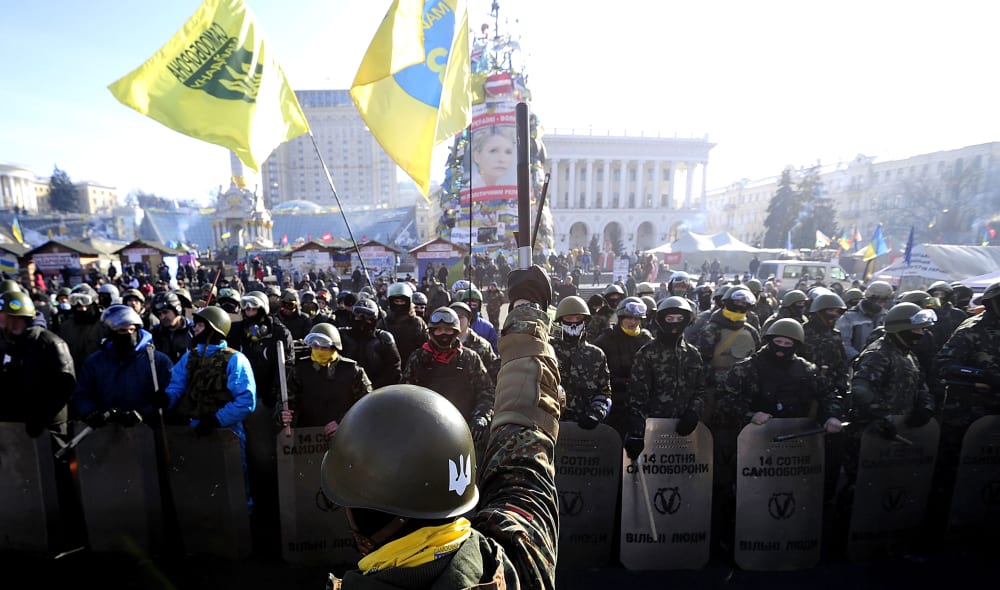
Neighboring Ukraine is locked in a battle for its future with citizens protesting their government’s decision to sidle up to Russia rather than forge a partnership with the European Union.
Here are five things you should know about the crisis in Ukraine:
1. Ukrainians are taking to the streets after their government chose to align with Russia
Ukraine, Europe’s second-largest nation, is caught in a tug-of-war between its European neighbors to the West and it’s ancestral roots in Russia to the East. The most recent flare-up has locked the country in months of violent protests over the government’s decision to pursue a pivotal trade deal with Russia, rather than the European Union.
Ukrainian President Viktor Yanukovich scuttled a sweeping trade and political agreement with the E.U. in November and opted instead to forge a partnership with former Soviet nations, after Russia threatened to impose crippling trade sanctions that would wreak havoc on Ukraine’s already-weak economy.
Yanukovich accepted a $15 billion loan offered by Russia. Putin withheld those payments to Kiev in January, saying Russia would wait for Ukrainians to form a new government before fully implementing the deal.
The move away from E.U. integration sparked outrage from Ukrainian citizens, especially in the western and central parts of the country where the European identity is stronger.
2. Yanukovich’s decision was a big blow to the E.U. – and a big win for Putin
“Nowhere is the fight for a democratic, European future more important today than in Ukraine,” Secretary of State John Kerry told a security conference in Munich last weekend. The deal offered by Europe and rejected by the Ukrainian government last fall, called the Eastern Partnership Program, is part of a sweeping E.U. effort to bring former Soviet Republics into the fold by encouraging and furthering western trade principles. As the second-largest European nation, Ukraine was set to be a cornerstone in that agenda.
Putin lobbied hard against the Eastern Partnership Program, exerting pressure against other former Soviet republics by threatening sanctions and banning exports. The Cold War-era strong-arming pointed to Putin’s belief that a strong European economic block could threaten Russia, in the same way the E.U. concentrated military power by forming NATO.
3. Ukraine has been here before
Created in 1991 after the collapse of the Soviet Union, Ukraine has always struggled with its identity as a former Soviet Republic. The Orange Revolution of 2004-2005 ushered in pro-Western President Viktor Yushchenko, but his attempts to align Ukraine with E.U. and NATO fell short due to divided public opinion in Ukraine. His opponent, Yanukovich, won the presidency in 2010 and turned Ukraine back toward Russia. The latest protests, which have drawn tens of thousands into Kiev’s Independence Square, are the largest since last decade’s Orange Revolution. 4. Russia is Ukraine’s biggest energy supplier and trade partner Russia is Ukraine’s largest individual trading partner and energy supplier, although combined, the E.U. nations overtake Moscow in trade. Ukraine and Russia are tied together by a pipeline that runs through Ukraine, delivering Russia’s oil to Europe. 5. The U.S. is trying to broker a diplomatic solution…with some hiccups U.S. Assistant Secretary of State Victoria Nuland landed in Kiev Thursday to meet with opposition leaders and with Yanukovich, who returned to work Monday after four days of sick leave. Yet the headline from Nuland’s first day in-country centered on recorded audio of her making a profane comment about her European counterparts on a call with U.S. Ambassador to Ukraine Geoffrey Pyatt. The U.S. accused Moscow of bugging the call and leaking the audio in which a woman’s voice says “F*** the E.U.” suggesting a disregard for the E.U.’s position.
Erin Delmore Recommended


