








The main takeaway from the Bureau of Labor Statistics’ April jobs numbers: Steady as she goes.
The unemployment rate dipped slightly to 7.5%, as the U.S. economy adds just enough jobs to keep up with population growth. The country’s staggeringly low labor force participation rate, the proportion of people who are either working or looking for work, hasn’t budged. The numbers aren’t terrible—in fact, they’re a little bit better than many economists predicted—but they’re not great, and they’re not significantly different from anything we’ve seen recently. A snail’s pace economic recovery has been the norm for quite some time now.
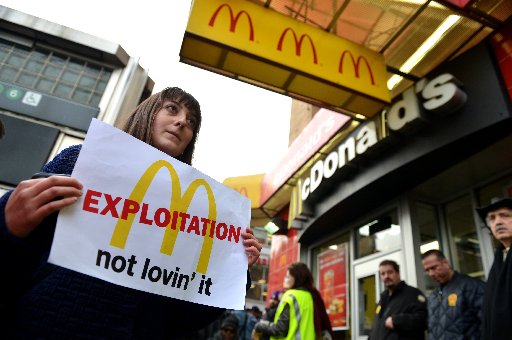
At the current rate of job growth, “it will take more than five years to return to the prerecession unemployment rate,” according to a note from the Economic Policy Institute’s Heidi Shierholz. But the shape of the recovery matters just as much as the pace, and that’s where BLS indicators become even more alarming. As the United States plods its way out of recession, it appears to be completing its transformation into a McJobs economy.
Take a look at this chart:
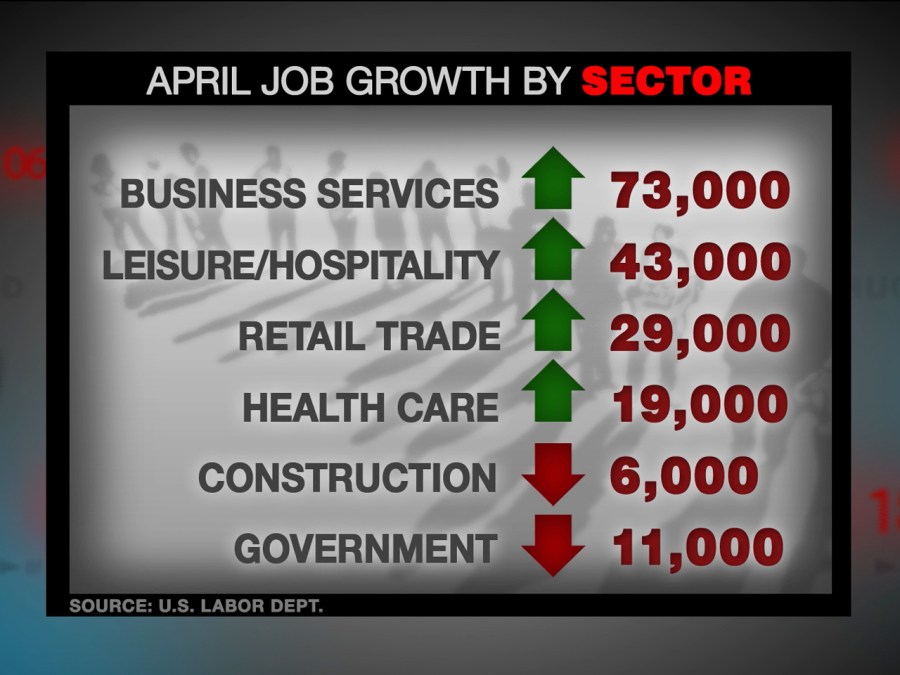
Roughly a third of all job growth over the past month was concentrated in the retail and hospitality industries, both notable for their markedly low earnings and poor union density rates. These are the industries which have come to replace manufacturing at the heart of American industry. “Business services,” the sector with the greatest job growth, is a hazy classification which includes everyone from lawyers to janitors.
The above chart also shows us that construction—an industry that still has relatively high wages and union membership rates—lost jobs, but that industry’s deterioration was far outstripped by the bleeding in the public sector. For the decline of government jobs, we can partly blame sequestration’s across-the-board government budget cuts, which have compelled state, local and federal agencies to reduce labor costs where they can. But sequestration-inspired layoffs are only part of a broader narrative about conservative efforts to starve public employment as much as possible. As we can see from this month’s jobs report, their efforts continue to pay dividends. So the overall trend appears to be away from employment in traditionally stable, relatively unionized, decently paying industries, and toward growth in precarious labor in “business services” like fast food work, retail, housekeeping, and janitorial services. As this trend develops, we’re seeing a commensurate drop in full-time work: While the number of people on non-farm payrolls rose by 165,000 last month, the number of involuntary part-time workers—that is, people who would prefer full-time employment but were only able to find part-time jobs—rose by 278,000. Meanwhile, the average work week decreased from 34.6 to 34.4 hours. If you want to understand the increasing labor unrest in the service and retail industries, this month’s jobs report provides a decent snapshot of its root causes. As low-wage, precarious work becomes the norm, we can expect to see yet more low-wage, precarious workers take to the streets. The big question is whether that will be enough to shape the direction of the economy’s evolution, or if the McJobs economy is here to stay.
Ned Resnikoff is an urban policy analyst, researcher, writer, and editor. His byline has appeared in a variety of publications, including the New York Times, San Francisco Chronicle, Dissent, and The Nation. He writes the newsletter Public Comment, which can be found at publiccomment.blog. Recommended


