








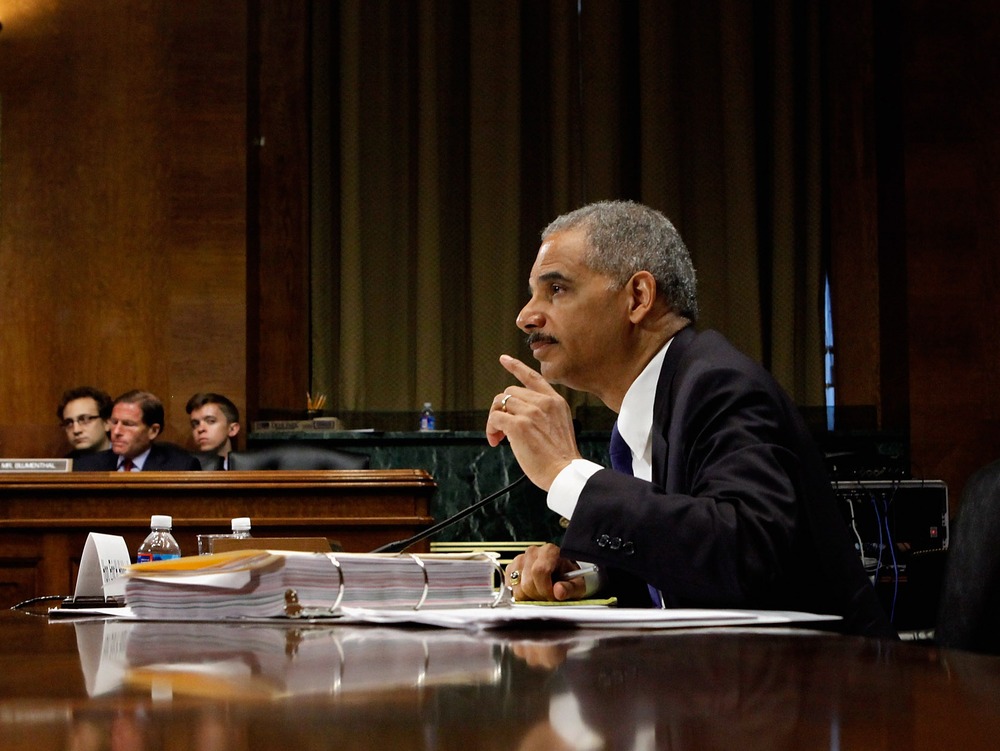
Until recently, the Republican investigation into Operation Fast and Furious had been churning along in the background of our political debate, mostly ignored by just about everyone but Fox News and its viewers. That changed in a hurry Wednesday, when a House committee, on a party-line vote, approved a measure to hold Attorney General Eric Holder in contempt of Congress for his refusal to turn over documents related to the probe.
Since the issue now looks like it could be with us for a while, it’s worth getting up to speed. Here’s what you need to know about Fast and Furious and the latest partisan skirmish that it’s triggered:
I thought The Fast and the Furious was a Vin Diesel movie about exploding cars which was later unwisely extended into a whole series of basically identical sequels. What does that have to do with Eric Holder?
That’s different. The Fast and Furious we’re concerned with was one of the operations conducted as part of Project Gunrunner, a program of the Bureau of Alcohol, Tobacco, and Firearms (ATF) that was begun in 2005 under the Bush administration. The idea behind Project Gunrunner was to deliberately allow traceable firearms to go to Mexican drug cartel members, with the hope that this would help lead law enforcement to higher-ranking criminals.
That sounds like a terrible idea? Did it work?
Of course it didn’t. In 2010, a U.S. Border Agent was killed in a firefight by a gun that had fallen into the hands of drug cartels as part of the program. That led an ATF whistleblower to reveal that the Fast and Furious operation, begun in 2009 as part of Operation Gunrunner, had lost track of many of the guns it had allowed criminals to obtain. And that in turn prompted Rep. Darrell Issa, the California Republican who chairs the House Oversight committee, to begin investigating Fast and Furious last year.
But some conservatives are treating Fast and Furious like a nefarious conspiracy, rather than just a botched program. The head of the NRA called it “just one part of Barack Obama’s agenda to attack gun owners and our Second Amendment rights.” And one conservative blogger called it “the Reichstag fire of the Second Amendment.” What are they talking about?
Great question. As Rachel Maddow explained Wednesday night, a conspiracy theory that originated in the far-right blogosphere argues that the program was designed to deliberately provoke an increase in gun violence, giving the administration a convenient excuse to then crack down on gun rights (just as the Nazis set fire to the Reichstag building soon after coming to power and blamed it on their political opponents, giving them an excuse to crack down on political dissent). It’s of a piece with the general idea pushed by among gun-rights supporter like NRA president Wayne LaPierre that the fact that the President Obama hasn’t yet done anything to limit gun rights only serves as evidence that he plans to limit gun rights. He’s lulling gun owners into a false sense of security, you see.
All pretty crazy, right? And yet, as Maddow made clear, the”Reichstag Fire of the Second Amendment” theory has been taken up by Republican lawmakers including Sen. Charles Grassley and Issa himself, and has informed the committee’s investigation.
Wow. So anyway, what’s the point of contention? Why is this blowing up now?
Holder’s Justice Department, which oversees ATF, has turned over 7,600 documents to Issa since the investigation began, by its count. But it refuses to turn over documents that relate to internal communication after February 4, 2011. Why that date? That’s the date of a Justice Department letter which claimed the ATF always tried to interdict illegally purchased guns—an assertion that DoJ was forced to walk back later that year, after an internal investigation into the matter. In other words, it appears that Holder’s concerns aren’t about documents covering the program itself, but rather are about documents that relate to the department’s response to the controversy.
Doesn’t Congress have a right to get whatever documents it asks for? How can the administration withhold them?
President Obama is citing executive privilege, arguing that the documents are covered under “presidential communications privilege,” which is intended to ensure that presidents can conduct a full and robust decision-making process without fear of internal deliberations being exposed. As it’s been used in the past, it can be applied even to communications in which the president himself was not personally involved. Holder wrote in a letter to Obama this week (pdf) that releasing the documents “would inhibit candor of such executive branch deliberations in the future and significantly impair the executive branch’s ability to respond independently and effectively to congressional oversight.” Holder added that the requests relate in part to ongoing criminal investigations and prosecutions, and so releasing the documents could compromise those efforts.
More generally, Democratic lawmakers agree that the whole thing—not just Fast and Furious, but Project Gunrunner in its entirety—was a major screw-up that needs to be probed. But they say the focus on Holder is misplaced, and shows that the investigation is a politically motivated effort to embarrass the administration. Nancy Pelosi argued further Thursday that the effort is payback for Holder’s bid to block state voter ID laws pushed by Republicans. I thought President Obama was all about open government. Is asserting this executive privilege common? More common than you might think. President Clinton invoked it 14 times, and President George W. Bush 6. This is the first time that President Obama has done it. So what happens now that the committee has voted to hold Holder in contempt? The vote will now go to the full House, likely as soon as next week. The committee vote was on party lines, with all Republicans voting yes and all Democrats no. A similar breakdown is expected in next week’s vote, for which Speaker John Boehner has voiced his support. If that happens, the House could then, in theory, initiate a criminal proceeding against Holder, with the potential of up to a year of jail time. Congress could even be empowered to arrest Holder and throw him in the Capitol jail (yes, there’s a Capitol jail). But that’s unlikely. Instead, the House will likely pursue a civil prosecution in federal courts, meaning a judge would ultimately decide—no doubt after a lengthy process of appeals by both sides—whether the documents have to be released. But by that time the Obama administration may no longer exist, and everyone will likely have forgotten about the kerfuffle. In other words, the important point isn’t really about what happens to the documents, it’s about the political impact of an Attorney General being held in contempt. When was the last time someone was held in contempt? Not too long ago, actually. In 2008, the Democratic House held Bush White House officials Josh Bolten and Harriet Miers in contempt for refusing to turn over documents relating to the Bush administration’s politicization of the Justice Department. The matter is still ongoing in the courts.
Zachary Roth Recommended


