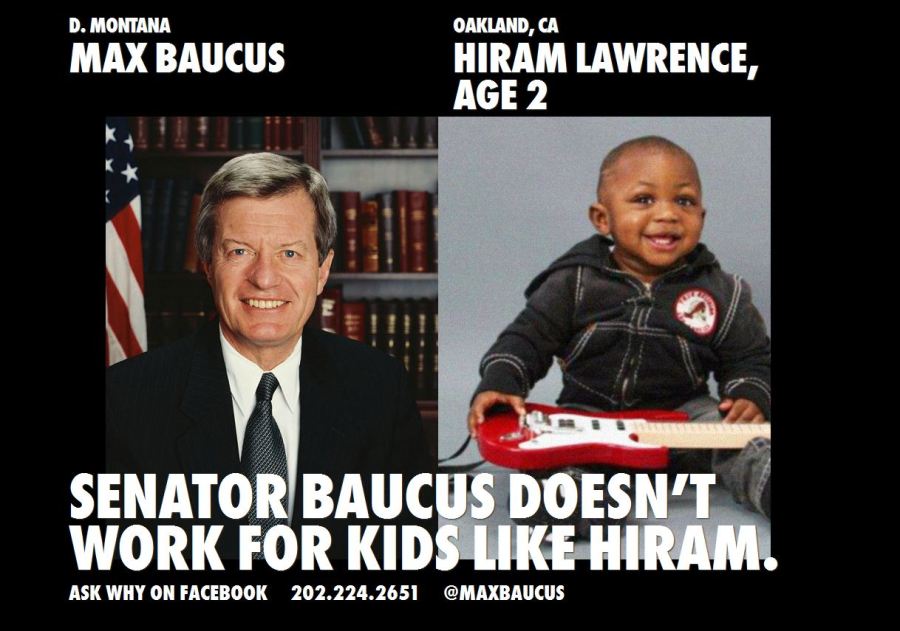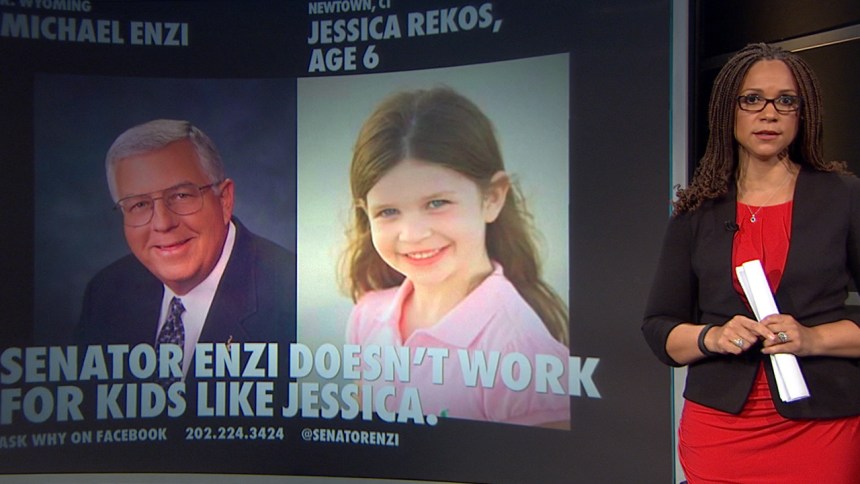
Last month, after 45 U.S. senators struck down gun reform legislation that 90% of Americans supported, two Brooklyn, New York, designers weren’t convinced those lawmakers were representing the people who elected them to their jobs.
Faun Chapin and Meg Paradise, founders of the Brooklyn creative collaborative design firm Guts & Glory, decided to campaign against those 45 senators to fight for the Manchin-Toomey bill on background checks. I spoke with Chapin earlier this week to find out more about their campaign that has gone viral, They Don’t Work for You, that shows pictures of senators who voted against the bill next to pictures of gun violence victims.
What is the story behind the They Don’t Work For You campaign?
While driving back to our studio in the Catskills from NYC on Thursday April 18, we got an email from a friend named Judy, a 70-year-old grandmother in Berkeley. She was furious that the Manchin-Toomey bill had been struck down and wanted a way to express her outrage. She said “I want to make buttons with pictures of the senators that say ‘Child Killer’ on them.” We were equally as frustrated with the Senate’s inaction and agreed with Judy’s sentiment and while we didn’t think buttons were an effective way to get out our message, we wanted to do something.
Over the course of the two-hour car ride, we had the basic concept, messaging and structure worked out in our heads. We then needed to find someone to help us build this idea and turn it into a tool. We reached out to our longtime friend and collaborator, Marc Phu, to develop the site as well as a handful of friends to help with researching the senators and the victims of gun violence.
What was the process like for getting it up and running? How much time did it take?
The process was fast and furious. We worked non-stop, dropping everything else for the next four days. We started on Thursday afternoon and by Sunday afternoon we had a working prototype. It was intense and emotionally devastating but we knew that we wanted to get this tool for advocacy out as soon as humanly possible.
How did you pick which gun violence victims to show?
We wanted to include Sandy Hook victims because it was so recent and so devastating, but it was very, very important that we expand the conversation to all gun violence that is currently happening in the U.S. What happens almost daily in Chicago, Detroit, Philly and Oakland is just devastating and it doesn’t get any coverage. We wanted to make sure that the victims we showed were all in the last year, all children, and whose deaths might have been avoided if we had better gun control laws in place.
The research for this site was absolutely heart wrenching. We spent several days reading stories about the kids of Sandy Hook (as well as many other kids affected by gun violence). We looked at these kids’ faces so big on our screens and said to ourselves over and over, I’m so sorry this happened to you. This shouldn’t have happened. We can do better than this. And when we put the six images of the teachers from Sandy Hook together we looked at them and we said “My God, they’re all women. And half of them are our age.”
We read stories about the teachers who hid their kids in closets and whispered “I love you.” And read stories about kids who were found wrapped in the arms of the teachers who literally lost their lives trying to shield their students with their bodies. In this moment where they must have absolutely feared for their own lives, they were still thinking about how to protect their kids. And thought this is why we’re doing this. This should not happen. This has to change. This isn’t a lefty-liberal thing, this is a basic human thing. Far too many people are dying unnecessarily for something we have the power to change.
Meg comes from a family of teachers and grew up around educators her entire life, she knows what teachers will do in the best interests of their kids.
Have you been politically engaged before in your work? If not, what was the motivation this time around?
We are very politically informed as individuals, but this is the first time Guts & Glory has been politically engaged. We are excited at the possibility to do more with political groups in the future.
Things to note: this project has turned into an outlet for citizens to direct their frustration and anger.We wanted to create a constructive way to shape policy that is representative of the public. While part of Congress is clearly being obstructionist, it is our responsibility as citizens to remind senators who they work for. We wanted to create a project that would motivate people to act. And Marc’s clients include MoveOn.org and Credo Action, so he has had some idea of how online organizing works and was instrumental in turning this into a real tool.
What types of reactions have you gotten regarding the campaign?
We have received mostly positive responses. We would say about 99%. While we can’t track people who have called their senators, we’re seeing thousands of people tweet every single senator and raise the issue on senator’s Facebook pages as well as their own. While most of our visitors are from the US, we’ve also had a large amount of unexpected visitors from all around the world, most notably the UK, France, Canada, and Australia. On the second day of launch we had almost 30,000 organic hits, meaning no press, just individuals sharing the site. We are now at about 80,000 unique visitors since the launch. Have you heard from senators/their offices? Not yet! They know where to find us! I noticed aesthetic similarities between the gun victims and the senators. How much thought did you put into the look of it? As designers we are trained to find patterns and similarities in images. We quickly realized that there were some very eerie similarities that had a profound emotional effect on us. The pairings were very deliberate, a lot of them mirror each other in little ways, some of them look like they could be their children. We were very are of that. Most people probably do not realize it, but it subconsciously is a very powerful part of the piece. The thing that’s really interesting to us as designers is that we’re not using any of the usual tropes of activism or web language. There are no pictures of guns and we don’t even say that these kids have been killed by guns; you have to click on their names and go to an external site to find out what happened to them. There are no shiny buttons to click telling me what to do. And the site is really long! You have to scroll all the way to the bottom to get to the crux of our argument that they don’t work for you because they work for the NRA and the gun industry. And we’ve watched on twitter in real-time as people have scrolled through the site and clicked on every single one of the senators twitter pages. So something is really resonating. Do you have any advice for people who might want to get engaged like this but have never done anything? The most profound thing for all of us involved was that we had a simple idea (a tool really), we executed it quickly, and put it out there and it made a difference! We had never done anything like this before. We helped many different people, from very different walks of life, use our tool to make their voices heard. You as an individual, can help make a difference. You just have to actually act. Other things you can do include: To quote Dumbledore, the time has come to choose between what is right, and what is easy. This project wasn’t easy for us to research, create or continue, but it is absolutely the right thing to do. See an example of their work below.
Lorena Ruiz Recommended