








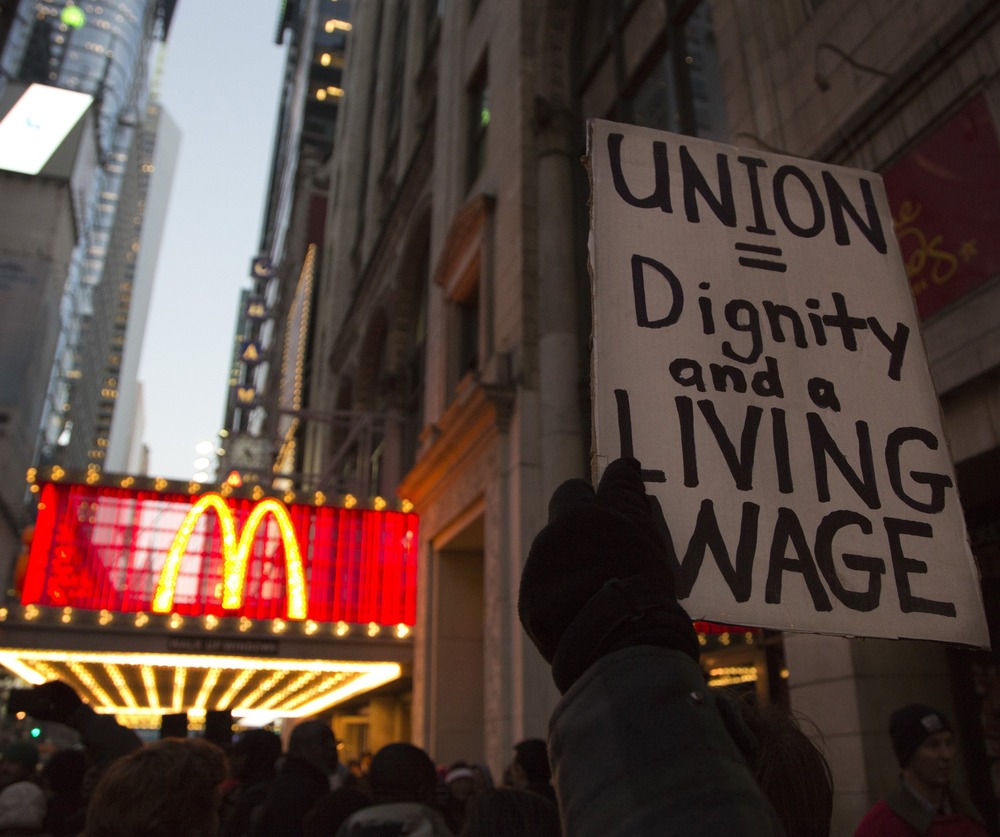
Hundreds of fast food and retail workers went on strike in Chicago Wednesday morning in a labor action consciously modeled on New York City’s fast food workers campaign and the nationwide Walmart strike which occurred last Thanksgiving. The Chicago strikers—who include workers from McDonald’s, Subway, Macy’s, Sears, and Victoria’s Secret—are demanding a wage floor of $15 an hour and the right to form a union.
“I think I’m doing more than what I should, and for $8.25, it’s not enough,” said Esly Hernandez, a striking Dunkin Donuts worker who makes $8.25 an hour. “They don’t even appreciate the work that I do. They don’t even say thank you. They treat you like you’re a robot.”
Hernandez, who said he lives “paycheck-to-paycheck,” joined the Workers Organizing Committee of Chicago (WOCC) after being approached by a coworker. That workers organization, with the support of other local workers groups and unions, is leading the Fight for 15 campaign to raise wages and form a union.
Hernandez said he joined the strike in large part because he wanted to be a good father to his four-year-old son. “I want to be able to go to school, to pay for school, and for him to be proud of me,” he said. Because his son—who does not live with him—is anemic, Hernandez said he is sometimes forced to choose between buying medically recommended nutrition for his son and paying his electricity bills.
“I don’t want my son to go through the struggles that I’ve been through,” said Hernandez.
Labor unrest in low-wage service and retail sector workplaces has become increasingly prevalent over the last few years, as those sectors have come to occupy increasingly central roles in the U.S. economy. Low-wage jobs in those industries have driven post-recession job growth to a great degree, leading observers such as labor reporter Andrew Kroll to refer to the American economy in its current form as “the McJobs economy.”
As service and retail work has come to replace manufacturing as the country’s bedrock industry, low-wage employees in those workplaces have become more and more restless. Last Thanksgiving, employees at Walmarts across the United States went on strike as part of a dramatic campaign to change conditions at the notoriously low-wage retail colossus. Just days later, workers in New York City staged the largest walkout in the fast food industry’s history, demanding higher wages and union recognition.
While no subsequent labor actions have garnered as much national attention as the Black Friday strike, low-wage workers across the country have been chipping away at retail and fast food companies with targeted, short-term walkouts and protests. Many of these actions have been organized by non-union “alt-labor” groups such as OUR Walmart and the community organizing group New York Communities for Change, which is organizing New York City fast food workers.
“In some ways this is something new,” Columbia professor Liza Featherstone told msnbc in late November. “This idea of organizing through community organizations, through worker organizations, that are more flexible and reflect the contemporary workplace, and the fact that people don’t necessarily have the same job for their whole lives.” However, she also sees low-level, militant, decentralized labor organizations as a throwback to 19th century industrial relations.
Organizations like OUR Walmart, historian Nelson Lichtenstein told In These Times in October, are “a kind of return to labor formations of the 1930s. It’s an association–they aren’t looking for legal certification, they don’t claim to represent everyone. They’re a minority that is willing to stick their necks out.” Wednesday’s strike in Chicago is remarkable because it shows just how contagious this kind of labor unrest has become. Until now, major fast food strikes have been confined to New York City, which recently held a second strike, even larger than its first. The strike in Chicago is the first major labor action to afflict the fast food industry in a city besides New York. Similarly, the Chicago strike demonstrates how the tactics which have given Walmart such a headache are spreading to other big department store brands. Workers from Macy’s and Sears are among those who walked off the job on Wednesday. New York’s fast food campaign is the “main model” for the Chicago strike, said Hernandez. WOCC members recently met with two New York fast food workers and some Argentinian guest workers who staged a surprise strike at a Pennsylvania McDonald’s in March. Hernandez said that the Chicago workers and New York workers were fundamentally engaged in the same struggle. “I’m going to keep on fighting for this, because I’m not the only one who’s going to suffer,” he said.
Ned Resnikoff is an urban policy analyst, researcher, writer, and editor. His byline has appeared in a variety of publications, including the New York Times, San Francisco Chronicle, Dissent, and The Nation. He writes the newsletter Public Comment, which can be found at publiccomment.blog. Recommended


