









Expressing confidence at work may be innate for many men, but for many women, it’s often a skill that must be learned.
That was the big takeaway during a Clubhouse discussion hosted Tuesday evening by Know Your Value founder and “Morning Joe” co-host Mika Brzezinski. She was joined by “her “Earn It” co-author and “Morning Joe” producer Daniela Pierre-Bravo, Columbia professor Alexandra Carter and former Cinnabon CEO Kat Cole and more.
“I was blessed to be educated, to learn different languages, to have all of these opportunities, and it was still hard for me” to find confidence, Brzezinski noted during the event. “…At a certain point in my career, my emotions were all over the place. I still don’t have a good poker face, but I’m happy with where I am. I’m confident about what I do…”

The panelists shared personal stories and tips they learned throughout their careers. They also took questions from the Clubhouse audience about how to handle delicate workplace issues as effectively as possible. Here’s what we learned:
1. Don’t harp on your weaknesses.
Women are 16 percent less likely than men to apply to a job after viewing it, according to LinkedIn. Often, women self-screen themselves out of applying because they don’t believe they qualify for the job.
To address this gap, Cole shared her story of becoming the CEO of Cinnabon in her 30s. Cole was the youngest candidate, and she also had quite a few holes in her resume. Many women may have been put off from applying, or they may have been too focused on the career pitfalls.
“Instead of doing what I have seen so many people do out of humility, which is listing the three, four, five things I wasn’t sure about or skilled in, instead what I asked was: ‘here are the areas where I have lighter experience. Are you prepared to give me the support and resources I need to be successful?’”

This approach gave Cole a way to acknowledge that she’s not perfect (no applicant is), and to reframe her supposed “weaknesses” as opportunities for growth and collaboration within the company.
Cole ultimately got the job. And now she pays it forward.
“I give opportunities to younger, less experienced or less obvious candidates. I’m prepared to give them the resources they need in exchange for the very real value they have,” Cole said.
2. Gather allies.
One Clubhouse attendee expressed concern that her boss doesn’t take her viewpoints seriously, and that he overlooks her in favor of male colleagues. The panelists responded that, while such work culture slowly—and hopefully—evolves, she can gather work allies to uplift her during those difficult moments.
“You’re going to recruit some amplifiers in the room,” Carter advised. “Let’s say [the attendee] raises her hand and gives an idea. Automatically, women in the room will say ‘I’d like to return us to [attendee’s] idea. In other words, they speak her name and give her credit.”

Carter, a professor at Columbia Law School, a world-renowned negotiation trainer for the United Nations, added,“Ladies, the more that we are in rooms and amplifying each other, the more our influence grows so that not only are we heard more, but also so that our sisters’ ideas cannot be appropriated.”
3. Build your mentoring network.
In the absence of consistent female mentors who can help build confidence, Cole recommended being proactive.
Instead of waiting for one permanent mentor to come along (which, if it happens, great!), mentees should reach out with specific questions for people they admire.
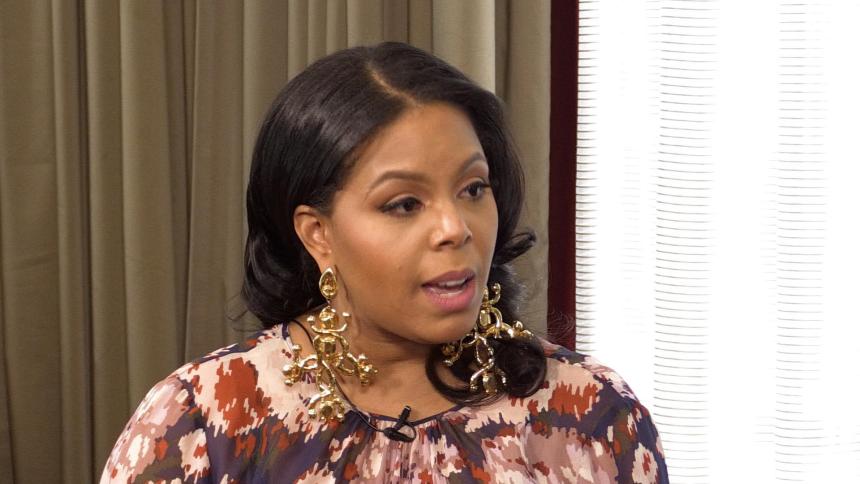
“If there was a new assistant, a customer in the business, an executive I admired, in writing or by voicemail or if I passed them in the hallway, I would simply say ‘I admire you for X, I know this about you…I would love to hear from you and grab your perspective over a 15 minute cup of coffee,” Cole said. “And I would end it in 14 minutes. Most people are flattered and try to find a way, especially if you’re just making a small time commitment.”
Cole said she always follows up with these mentors and tells them how she used their advice in her working life. The practice has served as a wonderful way to build knowledge as well as a supportive base, she said. For Brzezinski, a strong voice—as in a literal, physical voice—is critical in projecting confidence. “The voice, in my opinion, is one of the most powerful tools,” Brzezinski said. “We don’t think about it. We’re thinking about it in terms of you know, physical, the outfit and the face—but your voice can bring it home.” Brzezinski admitted this was something she struggled with. “Well into my career…I was always talking a little too fast and taking on too much responsibility for everybody’s feelings. And all if it showed through my voice,” she said. Over time, women who know their value and practice using their voice will be able to use the tool to their advantage. “It’s not something you can wing. If you’re not naturally knowing your value or comfortable communicating effectively, the voice is where the weakness will show,” Brzezinski said. “You need to get on a stage or stand on a street corner or have a party with the express purpose of standing on a chair and giving a toast, or have your friends pick you apart and give you critiques—but you’ve got to practice using that voice.” Many men want to be allies, the panelists said. Sometimes they don’t know how to be, or they take for granted that women have to work harder to be heard. Educating them and including them is critical to women’s success in the workplace. “It’s important that men are also cognizant of how difficult it is for women to have a seat at the table,” said MSNBC political analyst Elise Jordan, who made an appearance during the Clubhouse session. Other cameos included “Morning Joe” co-host Joe Scarborough and Forbes’ chief content editor Randall Lane, who acknowledged that men have a role to play in boosting women’s confidence at the workplace. “Men need to listen, and we get better by listening to all of these amazing women here today,” said Lane.
Halley Bondy Recommended


4. Hone the power of voice.

5. Include men.

