










When Donald Trump’s post-election attack on his own country’s democracy began in earnest, there was a school of thought that said his antics were dramatic, but ultimately hollow.
It was almost exactly a month ago when a senior Republican official told the Washington Post, “What is the downside for humoring him for this little bit of time? No one seriously thinks the results will change. He went golfing this weekend. It’s not like he’s plotting how to prevent Joe Biden from taking power on Jan. 20. He’s tweeting about filing some lawsuits, those lawsuits will fail, then he’ll tweet some more about how the election was stolen, and then he’ll leave.”
This made it sound like the outgoing president would simply go through the motions and stomp his feet for a while. Adults would pat him on the head, tell him what a shame it was that no one was listening to him, and the political world would largely ignore his tantrum.
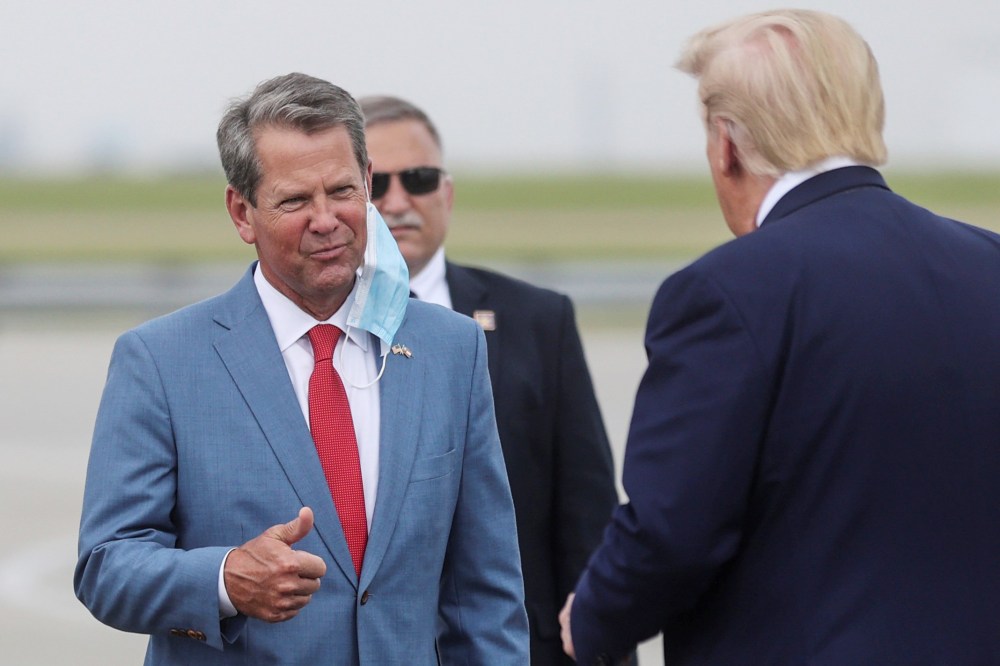
But as a practical matter, Trump actually appears to be intensifying his efforts to cling to power, election results be damned. On Saturday, he lashed out at Georgia Gov. Brian Kemp (R) via Twitter, accusing him of fighting harder against the president’s wishes than “the Radical Left Dems.” A day later, Trump called the Georgia Republican a “so-called” governor, saying Kemp could still deliver a “WIN” for the GOP ticket if he’d only follow the president’s instructions.
The efforts were not limited to Twitter. As the Washington Post reported over the weekend, Trump went so far as to call Kemp directly, urging him to take steps to overturn the election results the outgoing president doesn’t like.
Hours before he was scheduled to hold a rally in Georgia on behalf of the state’s two GOP senators, Trump pressed Kemp to call a special session of the state legislature for lawmakers to override the results and appoint electors who would back the president at the electoral college, according to two people familiar with the conversation, who spoke on the condition of anonymity to describe the private call. Trump also asked the governor to demand an audit of signatures on mail ballots, something Kemp has previously noted he has no power to do.
There was, incidentally, a different pretense for the call. A friend of the governor’s family died in a car crash on Friday, and Trump offered his condolences.
But as the Post‘s report added, “that was not the purpose of the president’s call.” According to a source familiar with the conversation, “This was not a condolence call.”
On the contrary, this was a phone meeting in which Trump tried to recruit the governor into participating in an anti-election scheme.
These efforts aren’t working. Last night, Kemp and Lt. Gov. Geoff Duncan (R) issued a written statement, explaining that calling a special legislative session to overturn election results and select a pro-Trump separate slate of presidential electors “is not an option that is allowed under state or federal law.” Georgia Secretary of State Brad Raffensperger (R) added yesterday that to approve such a move would be to “nullify the will of the people.” The problem, of course, is that Trump couldn’t care less. Legal options are irrelevant. Nullifying the will of Americans is the obvious next step when Americans’ will conflicts with Trump’s wishes. The senior Republican official said a month ago tomorrow, “It’s not like he’s plotting how to prevent Joe Biden from taking power on Jan. 20.” Except, that’s precisely what he’s doing. Trump went so far as to reach out directly to a governor, lobbying him to take steps to overturn the results of a free and fair election. There is some question as to whether such efforts are legal. On Saturday night, Andrew Weissman, a longtime Justice Department official who helped lead Special Counsel Robert Mueller’s investigation, wrote on Twitter that Attorney General Bill Barr should “make it clear it’s a crime to pressure public officials to undermine the election results. And then take action against those who participate in such conduct.” While questions of legality seek answers, the fact remains that there is no defense for the president’s anti-democracy efforts. Those inclined to “humor” Trump are failing to see just how far he’s willing to go to nullify his electoral defeat.
Steve Benen is a producer for "The Rachel Maddow Show," the editor of MaddowBlog and an MS NOW political contributor. He's also the bestselling author of "Ministry of Truth: Democracy, Reality, and the Republicans' War on the Recent Past."
Latest Post
Recommended


