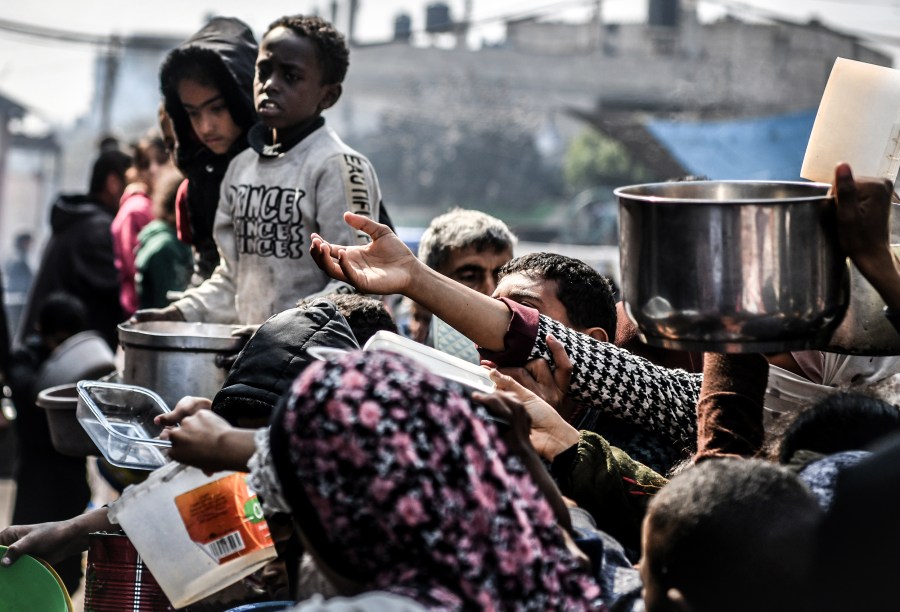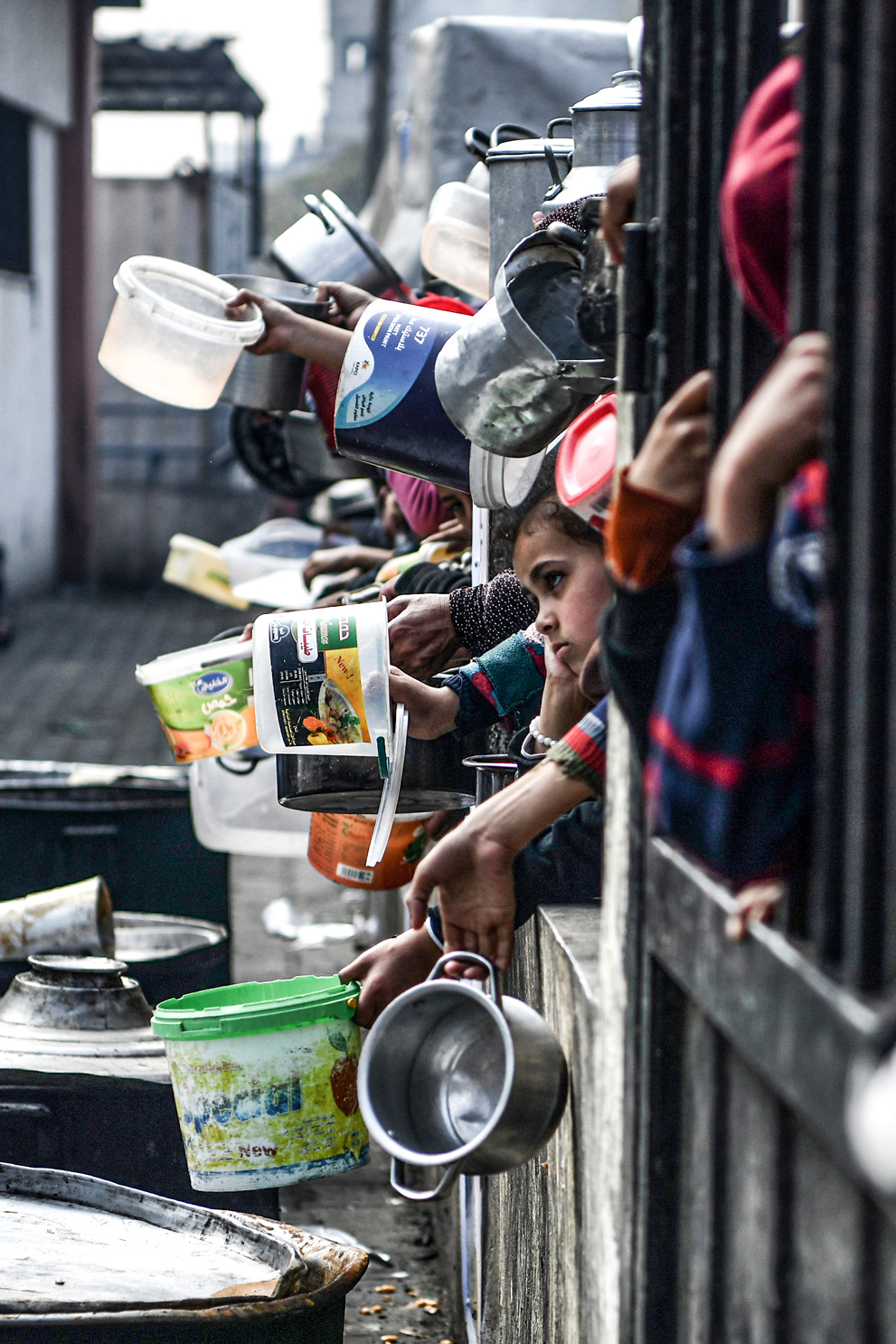
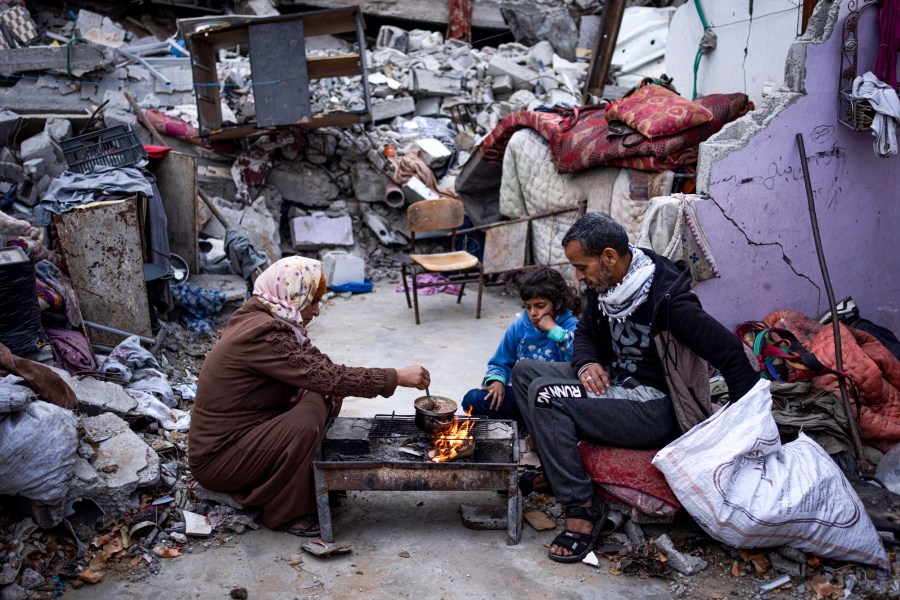
Palestinians in Gaza are starving. After five months of Israel’s war against Hamas, few households are able to easily obtain enough calories to survive. According to the international initiative that tracks such things, the entire northern half of the Gaza Strip is facing an imminent famine. It may have already begun by the time you are reading this. If the same conditions hold through mid-July, the same will be true for the south, where the vast majority of the Gaza Strip’s 2.2 million residents have been forced to flee under Israeli bombardment.
A famine in Gaza would be the first time that the Integrated Food Security Phase Classification mechanism, or IPC, has determined a famine exists since 2017. It would also be the first in the 21st century to be declared outside of Africa. But the Levant’s dry and mountainous terrain is no stranger to famine. The Torah and other books of the Hebrew Bible reference multiple instances of famine befalling the biblical land of Israel, often interpreted as “warning notices of God’s wrath aimed to bring the people to contrition and thus avert final destruction.”

It’s too easy to think of famine as a force of nature, an act of God, something unbidden and unstoppable. But as European Union foreign policy chief Josep Borrell told a meeting of European foreign ministers in Brussels on Monday, “This famine it is not a natural disaster, it is not a flood, it is not an earthquake; it is entirely man-made. By whom? Let’s dare to say it: by whom?” He then answered his question: “By the one that prevents humanitarian support [from] entering into Gaza; by the lack of access; by the acute insecurity inside Gaza.”
It’s too easy to think of famine as a force of nature, an act of God, something unbidden and unstoppable.
In other words, by Israel, which has been waging war against Hamas after the group’s brutal Oct. 7 attacks, which left over 1,000 Israelis dead. The imminent famine is the obvious result of a range of policies that Israeli Prime Minister Benjamin Netanyahu is carrying out to deprive the Palestinian people of resources that might also benefit Hamas, no matter how many children are malnourished in the process.
Gaza isn’t alone. Every modern famine since the dawn of the Industrial Age — whether it’s an act of subjugation against an obstinate population in an empire, an act of cruel indifference from a colonizer toward its colony, or the result of the decision to forge swords instead of plowshares in an untilled land soaked with blood — is a policy choice. It is irrefutable that the acute hunger that the Ministry of Health in Gaza says has killed at least 30 Palestinians, mostly children, since Oct. 7, is the result of choices that the Israeli government has made.
This is not to discount the role that weather patterns have played in the world’s famines. The shifts in long-standing patterns that climate change is provoking are likely to make severe hunger more common, the World Food Programme has predicted. But all too often from the 19th century onward, the severity of famines can be attributed to governments withholding — or even extracting — resources that could lessen the impact of natural disasters.
During the drought of 1873-74 in Bihar, India, then a British colony, Sir Richard Temple organized a massive relief effort that resulted in only 23 officially recorded starvation deaths. But Temple was excoriated by the British government and in broadsides from the press. The Economist, for example, scolded him for prompting Indians it deemed lazy to believe “it is the duty of the Government to keep them alive.” Moving forward, the cost in British pounds would outweigh the cost of human lives in the Raj’s famine response, historian Mike Davis argued in his book “Late Victorian Holocausts: El Niño Famines and the Making of the Third World.”
Cultural memories of the cool British response to the “potato famine” that left an estimated 1 million Irish people dead from malnutrition or hunger-related diseases (and displaced another 1 million) helped forge an affinity in Ireland toward the Palestinian people that lasts to this day. In 1845, most land in Ireland, then a British colony, was owned by English landlords who rented it out to Irish peasants, most of whom grew potatoes to feed their families. When a fungal blight struck the potato crop two years in a row, London opted for a policy of laissez-faire nonintervention.
As is the case in Gaza, historically, war and conflict have been the most common human causes of famine.
“Forced by economic necessity to sell [their] produce,” the Irish were “furiously resentful when food left the market towns under the eyes of the hungry populace, protected by a military escort of overwhelming strength,” historian Cecil Woodham-Smith wrote in her book “The Great Hunger.” “It was a sight which the Irish people found impossible to understand and impossible to forget.”
While the British cited Adam Smith’s invisible hand of capitalism to justify their hands-off approach, the Soviet regime quoted Karl Marx’s communist vision as it engineered a famine in 1930s Ukraine. Josef Stalin forced millions of former serfs to either work on collective farms or as laborers in newly constructed factories, as much of the grain harvested from Ukraine and other Soviet republics was sold overseas. Failure to meet the harvest quotas sometimes resulted in the seizure of any food peasants had for themselves, and many historians believe that Stalin used the resulting starvation as a tactic to help break Ukrainian nationalism. Nearly 4 million Ukrainians are estimated to have died during that human-caused famine, known today as the Holodomor after years of Soviet denial that such an event ever occurred.
As is the case in Gaza, historically, war and conflict have been the most common human causes of famine. Whether it’s burning crops to keep them from one’s enemies, waging battles that require workers to be pulled out of the fields to fight, or carrying out sieges and blockades that cut off areas from replenishing their supplies, the end result is the same: malnutrition and starvation. Violence in Yemen and Haiti has put millions of civilians on the brink of famine. South Sudan and Somalia, where the IPC most recently documented famine conditions, have experienced periodic surges of violence for years, exacerbating the effects of poor weather that led to fewer crops. “If you don’t feed people, you feed conflict,” United Nations Secretary-General António Guterres told the U.N. Security Council in 2021. “Conflict drives hunger and famine, and hunger and famine drive conflict.”
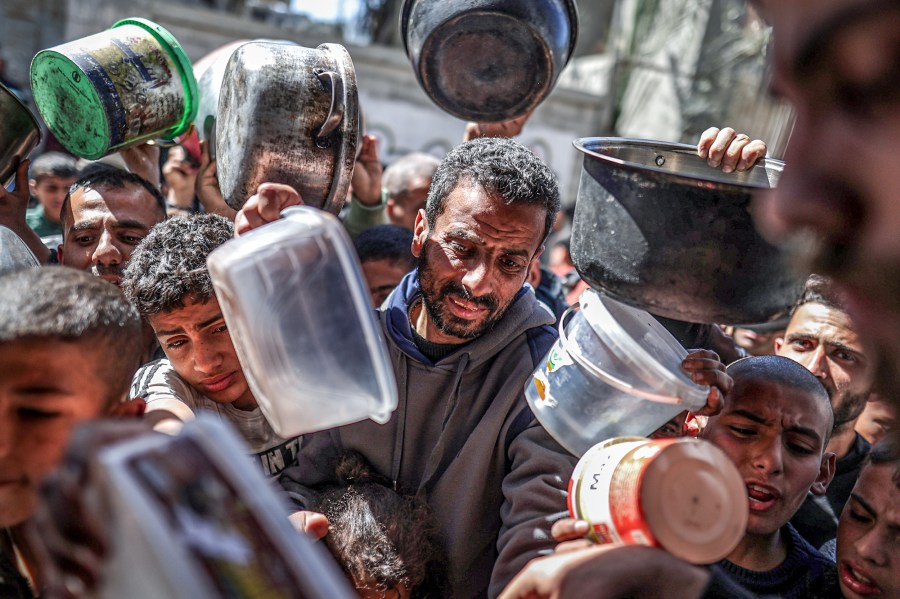
The hunger crisis we’re watching unfold in Gaza is striking in part for its sheer severity. “This is the highest number of people facing catastrophic hunger ever recorded by the Integrated Food Security Classification system — anywhere, anytime,” Guterres said during a Monday press briefing. We “are about to witness the most intense famine” since World War II, Alex de Waal, a professor at Tufts University and an expert on humanitarian issues, wrote in The Guardian on Thursday.
The IPC measures food insecurity on a five-level scale. Phase 1 denotes normal conditions. In Phase 5, there’s “an extreme lack of food and/or other basic needs even after full employment of coping strategies” and “starvation, death, destitution and extremely critical acute malnutrition levels are evident.” A famine exists when at least 20% of households in a given area have reached Phase 5. As of March 15, according to the IPC, 95% of Gazans were at Phase 3 or higher. Conditions are more dire in the north, where famine conditions are taking hold faster than in the south. The crisis in Gaza also stands out for the number of intentional decisions that have helped trigger these conditions. This is a foreseen consequence of Netanyahu’s stated goal of destroying Hamas. It is what happens when an entire population is collectively punished in an escalation of the effective siege that the Gaza Strip has been under since 2007. Because, shockingly, there’s no shortage of food on hand to feed the 2.2 million Palestinians who call the Gaza Strip home. The United Nations has said there’s plenty of aid at the ready, either at the border or in the region, to reverse the downward spiral toward famine. But Israel has instituted roadblocks — some procedural, some literal — that are hindering humanitarian groups’ ability to distribute supplies. The only two border crossings that are regularly operating are in southern Gaza, exacerbating the difficulty in providing aid to Gazans stuck in the north after the ground invasion Israel launched in late October. As The New York Times recently illustrated, the process to actually get aid loaded onto trucks in Egypt and into the Gaza Strip involves multiple Israeli checkpoints and waits in lines that stretch for miles. Drivers must navigate roads destroyed during airstrikes, avoid surging crowds desperate to obtain the supplies on board, and deal with a convoluted distribution network. An average of 140 trucks a day, not all of which have food, carry aid into Gaza, but the World Food Programme has estimated that at least 300 trucks a day, all of them carrying food, would be needed to make a dent in the crisis. Israel has said that it’s cooperating to allow aid into Gaza without hindering its efforts to dismantle Hamas. But Netanyahu has repeatedly threatened to launch a major military operation in Rafah, even though that’s where much of the aid being allowed into Gaza is arriving. The planned offensive also further imperils the nearly 1 million civilians pinned between the fighting further north and the Egyptian border. And the international aid group Oxfam recently documented that Israeli military strikes have targeted not just the Palestinian police officers guarding aid distribution but aid convoys themselves. The meager amounts of aid reaching Palestinians is unpopular even among Israeli citizens. A poll taken last month found that 68% of Jewish Israelis surveyed were opposed to aid flowing into Gaza under the current conditions. Meanwhile, Israeli demonstrators have protested at the border crossing at Kerem Shalom to further slow the trucks’ progress. In response to the Oct. 7 attack, Israel has killed nearly 32,000 Palestinians, according to the Gaza Health Ministry. Those casualties and the famine conditions that Israel’s decisions have made imminent are doing little to help achieve their war’s professed aims. Hamas has managed to regroup enough in the north to launch attacks against the Israeli military even as Netanyahu weighs an offensive against Rafah in the south. The U.S. has grown more and more vocally critical of the excessive casualties the Israeli campaign has produced. And a survey released Wednesday by the Palestinian Center for Policy and Survey Research showed that while support for Hamas itself among Palestinians has dipped since a surge in October, support for Hamas’ performance in the war against Israel remains high. History has shown us that the famines no longer simply happen as so many would still assume — they are caused or exacerbated. This is what makes this entirely man-made crisis all the more tragic. It is not merely that there is enough food to feed the millions who are affected. Nor that there is no drought that is causing people to starve in the desert. It is that with its choices and actions, Israel is helping cause a famine that will not help it win this war, but only amplify its suffering. The solution is clear: Let the people of Gaza eat.
Hayes Brown is a writer and editor for MS NOW Daily.