









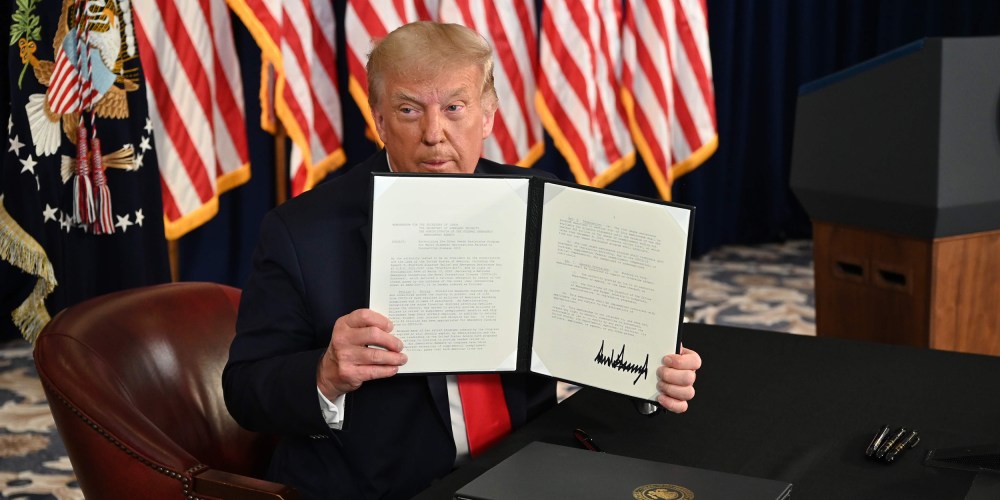

Unable to negotiate a deal with Congress, Donald Trump signed a series of executive actions over the weekend, most of which unraveled in the days that followed. The president said, for example, that he was reviving a “generous” unemployment-aid program, which is badly flawed and at odds with his own description.
Similarly, Trump said he was cutting the payroll tax through an executive action, but that’s not going according to plan, either.
And then, of course, there’s the president’s measure on evictions. He said over the weekend, “I’m protecting people from eviction.” Trump added on Tuesday, “We’re stopping evictions. We are stopping evictions. We’re not going to let that happen.”
For good measure, the Republican went on to tell reporters at a White House press briefing yesterday, “I want to make it unmistakably clear that I’m protecting people from evictions. They didn’t want to do that. The Democrats didn’t want to do a protection from evictions.”
There are two basic problems with this. The first is that the Democratic plan, which was approved in mid-May, included unambiguous eviction protections. Either Trump didn’t read the Democratic plan and he’s condemning something he knows nothing about, or he’s brazenly lying. Both seem equally plausible: the president routinely lacks a basic understanding of policy disputes and he’s uncontrollably dishonest.
But just as importantly, Trump’s chest-thumping boasts notwithstanding, he hasn’t actually protected anyone from evictions. In fact, the top voice on economics policy in his own White House made an on-air concession to this effect yesterday.
Larry Kudlow, director of the White House’s National Economic Council, said on Fox Business on Wednesday that the eviction order did not extend a moratorium that had been put in place by the March bill. “It’s not quite an eviction moratorium, but it’s certainly eviction protection,” he said.
Even that was overly generous. Trump’s new executive order doesn’t include an eviction moratorium, doesn’t include funds to help Americans pay mortgages or rent, and simply asks relevant agencies to “consider whether any measures temporarily halting residential evictions of any tenants for failure to pay rent are reasonably necessary.”
In other words, as we discussed earlier in the week, instead of actual protections, Trump issued an order asking administration officials to see if there’s something they can do.
A Politico report added this week, “[N]ot only would his action fail to halt evictions, it wouldn’t do much of anything to immediately help the 20 million or so Americans who face the loss of their homes in the next few months amid the coronavirus crisis.” The article added: Trump’s order does not extend the lapsed four-month eviction moratorium, which itself covered only about a quarter of the nation’s 44 million rental units…. It also provides no direct money to aid tenants in distress, who will eventually have to pay months of back rent. The departments of the Treasury and Housing and Urban Development were instructed to identify sources of funding. Neither could provide details Tuesday on how they would do that. House Financial Services Chair Maxine Waters (D-Calif.) explained, in reference to the executive order, “It means nothing.” And yet, there Trump stood, repeatedly declaring with pride that he’s “protecting people” from evictions and “stopping evictions.” We’ll probably never know for sure, but I’d love to know whether the president believes his own nonsense, or whether Trump is peddling a claim he knows to be false.
Steve Benen is a producer for "The Rachel Maddow Show," the editor of MaddowBlog and an MS NOW political contributor. He's also the bestselling author of "Ministry of Truth: Democracy, Reality, and the Republicans' War on the Recent Past."
Latest Post
Recommended


