








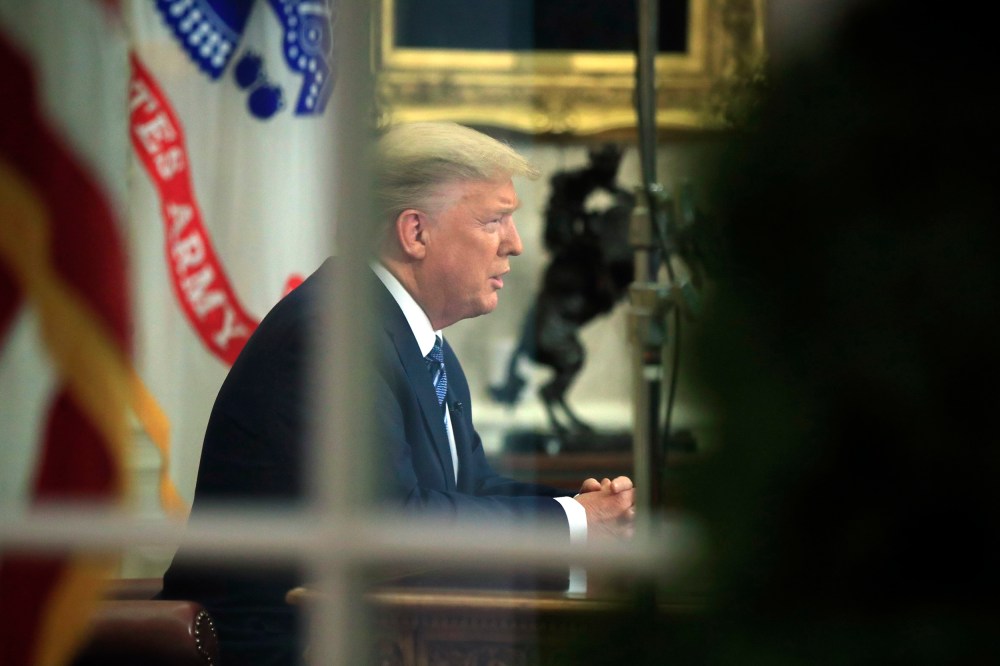

Three months ago today, as the scale of the coronavirus crisis was starting to take shape in the United States, the New York Times published a report that included a word to describe Donald Trump that stood out for me as significant: “bystander.”
While he presents himself as the nation’s commanding figure, Mr. Trump has essentially become a bystander as school superintendents, sports commissioners, college presidents, governors and business owners across the country take it upon themselves to shut down much of American life without clear guidance from the president.
The analysis was clearly accurate, and it was reinforced repeatedly in the weeks and months that followed. Trump occasionally seemed willing to acknowledge the crises unfolding around him, but the president nevertheless made it clear that he was willing — indeed, eager — to let others take the lead in doing actual work.
Some of this may have been driven by Trump’s desire to avoid blame in an election year: the more he put the onus on others to act, the more he could deny responsibility if their efforts fell short. It’s also likely that the president adopted the posture of a bystander because he didn’t have much of a choice: Trump still doesn’t know much of anything about governing, and even if he were determined to put down the remote control and act, he wouldn’t have any idea what to do.
But whatever the rationale, in March, the president was fairly labeled a bystander, and three months later, the description still applies.
Ezra Klein noted yesterday, “Donald Trump is now down by more than 8 points in polling averages. Coronavirus is resurgent. Expanded UI is set to expire on July 31st. The nation has exploded in protests over police brutality. And he’s doing … nothing. About any of it. He’s just rage tweeting.”
Specifically on the coronavirus crisis, Harvard’s Ashish K. Jha added earlier today, “It feels to me like the federal government has thrown in the towel on this pandemic.” Noting the administration’s passivity — the testing czar is gone and hasn’t been replaced, the task force has largely disappeared from view, etc. — Jha added that administration officials “don’t even appear to be trying anymore.” It was six years ago when some of then-President Barack Obama’s critics decided to deride him as a “bystander.” Charles Krauthammer had a column to that effect in October 2014, arguing that there was “a sense of disorder growing” — including fears of a deadly virus — and the president wasn’t rising to the occasion. “An observer presidency with its bewildered-bystander pose only adds to the unease,” Krauthammer wrote at the time. Soon after, even Dana Milbank echoed the criticism, deriding Obama as a “bystander.” I wrote at the time that the criticisms struck me as unpersuasive, but in hindsight, the pundits had the right critiques — but they were applied to the wrong president.
Steve Benen is a producer for "The Rachel Maddow Show," the editor of MaddowBlog and an MS NOW political contributor. He's also the bestselling author of "Ministry of Truth: Democracy, Reality, and the Republicans' War on the Recent Past."
Latest Post
Recommended


