








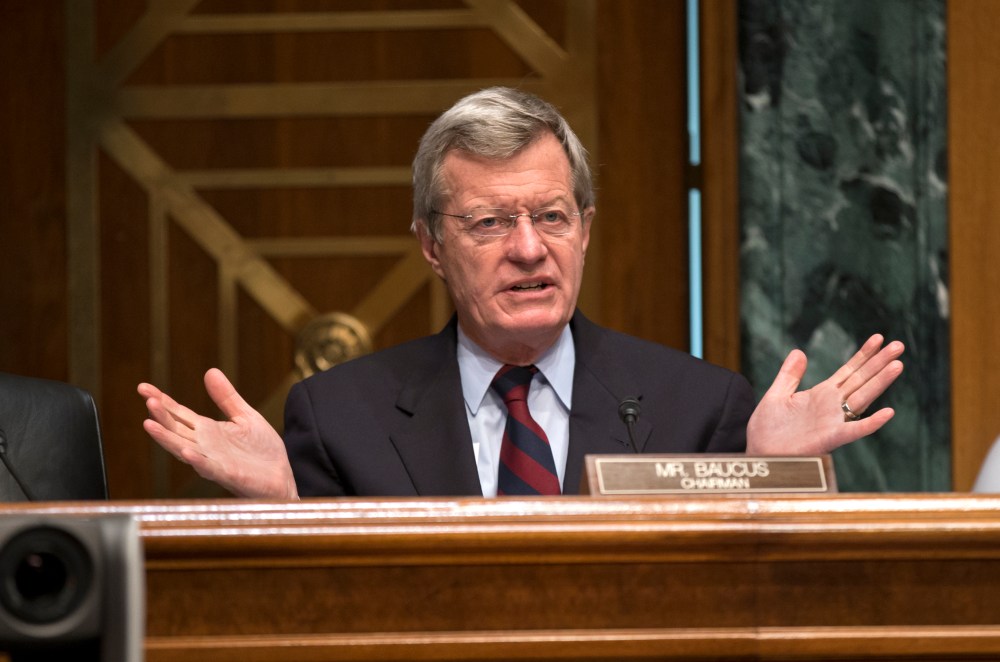
Democratic Sen. Max Baucus’ retirement announcement on Tuesday brought the Senate battleground picture into clearer focus, leaving eight senators eyeing the exits—six Democrats and two Republicans.
The Montana Democrat’s decision essentially ends the bubble watch for which senators may be retiring. Baucus was one of the final unknowns, though some mostly optimistic Democrats think Sen. Susan Collins, R-Maine, could grow frustrated with the upper chamber’s polarization and retire like her now-former GOP colleague Olympia Snowe. For now, that doesn’t seem likely.
But the newly open Montana seat also means if Republicans want to take back control of the Senate, their road is going to have to run through the Midwest and Plains states. While states like Iowa, Montana, and South Dakota may be more competitive without the incumbent, that doesn’t mean the GOP path there is as easy as it may seem. Republicans need to win at least two of those three states, and South Dakota is their best opportunity, while the others aren’t as easy without strong candidates. Republicans need to net six seats for the majority, and while they have more opportunities and less defensive targets than Democrats (just 14 GOP seats are up compared to 21 for Democrats), that doesn’t mean that path forward is a given.
Other than Baucus, here are the senators who won’t be returning after 2014, and the latest competitive state of play in each along with current ratings from the non-partisan Cook Political Report and Rothenberg Political Report.
Sen. Saxby Chambliss (R-Ga.): Chambliss’s greatest problem would have likely been in the form of a primary challenge, and plenty of candidates now in the contest were already licking their chops to take on the second-term senator. They’re upset the Republican appears too apt to compromise, notably as part of the Senate’s Gang of Eight.
For now, GOP Reps. Paul Broun and Phil Gingrey are in, with Rep. Jack Kingston likely to make his run official soon. Question marks still remain as to whether Rep. Tom Price, who’s delayed a decision, will run, but if he doesn’t, expect former secretary of state and 2010 gubernatorial candidate Karen Handel to jump in. It will be a dogfight for the GOP nomination, causing many to privately fear a flawed candidate—like Broun, who’s had a history of controversial statements—could emerge, tipping a seat that shouldn’t be in play.
Democrats look poised to avoid a primary fight, with Rep. John Barrow and Michelle Nunn, daughter of former Sen. Sam Nunn, reportedly meeting soon to decide who will run. Democrats have an uphill fight in the Peach State, but still a fighting chance, especially if Republicans nominate a polarizing candidate. A similar scenario played out last year in Indiana, and Democrats had moderate now-Sen. Joe Donnelly waiting in the wings. They want a chance to play here too, and under the right circumstances this becomes a higher priority to watch. This seat shouldn’t flip parties — for now.
Cook Rating: Likely Republican
Rothenberg Rating: Currently Safe Republican
Sen. Tom Harkin (D-Iowa): Harkin’s exit immediately gives both parties a competitive seat in a swing state, but it’s Democrats who seem to have already sorted out their primary mess in an orderly fashion, while Republicans are still grasping.
Democratic Rep. Bruce Braley has always been Harkin’s heir apparent, but Republicans are still searching for a candidate—and one that can appeal to swing voters in this purple state. NBC News reported Tuesday that Lt. Gov. Kim Reynolds can be crossed off that list. With Rep. Steve King now seeming like he’s leaning against running, and their top prospect Rep. Tom Latham passing earlier, Republicans still need a candidate—and fast. Names now mentioned include Agriculture Secretary Bill Northey, Secretary of State Matt Schultz, and former U.S. Attorney Matt Whitaker, but recruiting has become a headache that shouldn’t be one for the GOP. Meanwhile, Braley raised more than $1 million in the last fundraising quarter.
Cook Rating: Toss Up
Rothenberg Rating: Lean Democrat
Sen. Mike Johanns (R-Neb.): The Republican’s decision to make it one term and done was the most shocking on the list, but it’s also the easiest seat the GOP has to defend. When Sen. Ben Nelson, a Democrat, retired in 2012, his party tried unsuccessfully to defend the seat with former Sen. Bob Kerrey, but Republican Deb Fischer won easily. Democratic prospects don’t look good again in 2014, either.
No candidate has officially announced on either side here, but if Republican Gov. Dave Heineman jumps in, he’d be the immediate frontrunner, though he’s shown some hesitation. State Auditor Mike Foley, Rep. Jeff Fortenberry and former state Treasurer Shane Osborn are also mentioned for the GOP.
Cook Rating: Solid Republican
Rothenberg Rating: Currently Safe Republican
Sen. Tim Johnson (D-S.D.): Johnson’s exit was the least surprising among Democrats, but it’s still unclear who will be his heir apparent from his own party. One potential is Johnson’s actual heir, with his son, U.S. Attorney Brendan Johnson, being floated, but former Rep. Stephanie Herseth Sandlin is eyeing the race too.
Republicans were in a good position whether Johnson ran or not, with former Gov. Mike Rounds announcing early. But a Rounds bid has been met with opposition from conservative groups, including the Senate Conservatives Fund. Sophomore Tea Party favorite Rep. Kristi Noem hasn’t ruled out a bid, and some other state lawmakers may jump in, too. This is still one of the best pick-up opportunities for Republicans, but they could have a primary fight to get there.
Cook Rating: Toss Up
Rothenberg Rating: Pure Toss Up Sen. Frank Lautenberg (D-N.J.): Lautenberg’s retirement seemed almost reluctant, especially for a senator who’s approaching 90. Ambitious Newark Mayor Corey Booker had already made his intentions to run known, clearly irking Lautenberg, but even with the senator out, Booker may not have the field to himself. Reps. Frank Pallone and Rush “My Congressman IS a rocket scientist!” Holt are also interested in. For Republicans, Gov. Chris Christie may be well-positioned for reelection this year, but the Senate seat will be much harder, and no serious names have come forward. Cook Rating: Likely Democrat Rothenberg Rating: Currently Safe Democrat Sen. Carl Levin (D-Mich.): Levin’s decision not to seek another term certainly makes things interesting in the Wolverine State, but Democrats should still feel fairly comfortable about their ability to hold onto this seat. With Debbie Dingell passing on a bid this week, it looks like the field has mostly cleared for Rep. Gary Peters. Republicans see an opportunity here, but it may well depend on who they nominate. The GOP have had some recent successes in the Wolverine State, but Gov. Rick Snyder’s right-to-work push in the state last year may have damaged not just his moderate brand but Republicans, with troubling numbers for the governor in this month’s EPIC/MRA poll. Reps. Mike Rogers and Justin Amash are eyeing the race, but many Republicans privately worry about the Libertarian-leaning Amash’s ability to compete statewide. Former Secretary of State Terri Lynn Land and former GOP state party chairman Saul Anuzis are also mentioned as possibilities. Cook Rating: Lean Democrat Rothenberg Rating: Currently Safe Democrat Sen. Jay Rockefeller (D-W.Va.): Rockefeller kicked off the Senate retirement scurry in January, but Rep. Shelley Moore Capito had already announced her bid last November whether Rockefeller ran or not. The GOP congresswoman remains in in a strong position, both in the primary and general elections. Capito has never been a favorite of influential conservative groups like the Club for Growth and Senate Conservatives Fund, but if they can’t come up with a candidate to oppose her, it may not matter. Former state Delegate Pat McGeehan has jumped in, but he still has an uphill challenge against the well-known Capito. For Democrats, West Virginia is undoubtedly their biggest recruitment headache. More than three months after Rockefeller’s announcement, they still don’t have a declared candidate, while Capito continues to stockpile cash. Secretary of State Natalie Tennant and state Supreme Court Justice Robin Davis are mentioned as possibilities, among others. Democrats can still do well in the Mountaineer State—Sen. Joe Manchin and Gov. Earl Ray Tomblin won easily in 2012—but none of those floated yet seem to have the crossover appeal of the moderate Democrats who’ve won here statewide before. Cook Rating: Toss Up Rothenberg Rating: Toss Up/Tilt Republican
Jessica Taylor Recommended


