








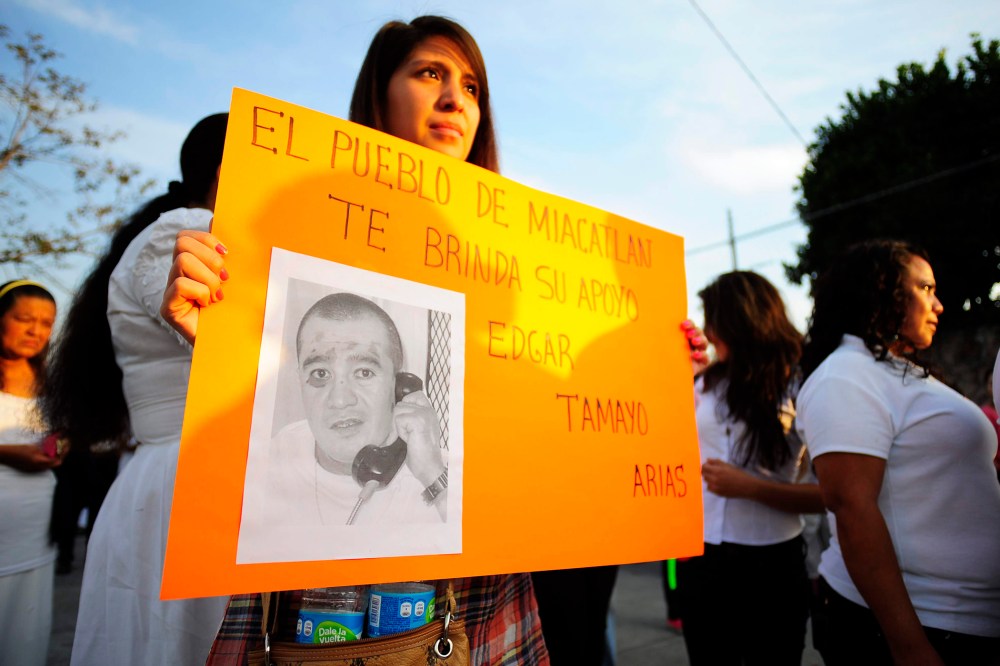
Despite protests from the U.S. State Department, the Mexican government and international human rights organizations, cop-killer and Mexican national Edgar Arias Tamayo wasexecuted in a Texas death chamber on Wednesday evening.
Late Wednesday, the scheduled execution was briefly halted. The US Supreme Court was considering an appeal for a stay, and Jason Clark, of the Texas Department of Criminal Justice, told reporters it is Texas policy to hold off on executions while the High Court mulls an appeal.
But the Supreme Court then said it would refuse to stay the execution. The warrant would have expired at midnight; Tamayo was put to death at 9:32 C.T.
“This case was not just about one Mexican national on death row in Texas,” said a statement from Tamayo’s lawyers Sandra Babcock and Maurie Levin. “The execution of Mr. Tamayo violates the United States’ treaty commitments, threatens the nation’s foreign policy interests, and undermines the safety of all Americans abroad. The international outcry about this, Texas’s third illegal execution of a Mexican national and the first without any review whatsoever of the consular assistance claim, is unprecedented.” The lawyers called the execution of their client “shameful and tragic.”
Tamayo, who in 1994 put three bullets in the back of a Houston police officer‘s head, became the latest foreign citizen to be executed in the United States, a trend that for decades has run counter to international treaties and put the U.S. at odds with much of the Western world.
The scheduled execution drew the ire of the Mexican government which said implementing the death penalty will violate international law, as it contends that Tamayo was not advised of his rights to consular assistance at the time of his arrest and trial. Tamayo’s case also drew the attention of U.S. Secretary of State John Kerry, who said the execution could put Americans abroad at risk and strain international relations.
Kerry and Mexico’s Foreign Affairs Ministry had urged Texas Gov. Rick Perry and Attorney General Greg Abbott to delay the execution to allow a court to review the state’s handling of the case.
“I want to be clear: I have no reason to doubt the facts of Mr. Tamayo’s conviction, and as a former prosecutor, I have no sympathy for anyone who would murder a police officer,” Kerry wrote in a statement last fall. “This is a process issue I am raising because it could impact the way American citizens are treated in other countries.”
At the heart of the debate was not whether or not Tamayo, 46, was guilty of the crime he was sentenced for, but if the process that led to his conviction violated established international law in how the courts deal with foreign nationals.
In late January 1994, Tamayo was arrested by 24-year-old police officer Guy P. Gaddis on suspicion of robbery. Gaddis handcuffed Tamayo and placed him in the back of his patrol car. At some point Tamayo pulled a handgun that Gaddis had missed during an initial search and shot and killed Gaddis. The police car swerved off the side of the road and crashed. Tamayo kicked out a window and fled a few blocks before being caught by police.
Authorities reportedly failed to notify Tamayo that he had the right to assistance from the Mexican Consulate. That failure to notify Tamayo of those rights violated the 1969 Vienna Convention of Consular Relations, which says that “authorities shall inform the person concerned without delay of his rights” to consular assistance.
As of 2012 there were 136 foreign nationals on death row in the United States, over 40% of whom are Mexican citizens, according to Amnesty International.
In 2004, a decade after Tamayo’s arrest, the international Court of Justice ruled that the U.S. had violated the rights of Tamayo and 50 other Mexicans on death row and ordered a review of their cases.
Since the order, Texas has executed two other Mexicans whose cases were part of the ICJ’s order, according to Mexico Ministry of Foreign Affairs. In those two cases, both had their convictions reviewed in accordance with the Vienna Convention violations, according to The New York Times.
In a statement released on Jan. 19, Mexico’s Foreign Affairs Ministry said that Mexico “opposes the death penalty and is determined to use the resources necessary to protect those citizens in danger of being sentenced to death.”
“Should Edgar Tamayo be executed without a review of the criminal proceedings and a reconsideration of his sentence in accordance with the ICJ ruling, this would be the third time a Mexican included in the [ICJ] Judgment has been executed, a clear violation by the United States of its international obligations under the Vienna Convention, whose observance is key to guaranteeing the rights of all individuals to due process, including United States citizens when they are traveling or living abroad,” the statement read.
Babcock, one of Tamayo’s attorneys, said in a statement to CNN that the Texas Board of Pardons has been mute in addressing concerns by a number of American officials and various supporters of Tamayo’s.
“The Mexican Foreign minister, the U.S. Secretary of State, evangelical and Latino leaders, former Texas Gov. Mark White and legal and international organizations have called on the The Texas Board of Pardon and Paroles and Gov. (Rick) Perry to halt the execution of Mr. Tamayo based on the violation of his consular rights, yet the Texas Board of Pardons has refused to even meet to discuss Mr. Tamayo’s clemency petition,” Babcock said.
The United States has ranked among the top 5 in the world for the execution of prisoners in recent years, joining China, Saudi Arabia, Iran and Iraq as global leaders, according to Amnesty International. Texas has been among the most active states in thinning its death row. Over the summer Texas hit a grim milestone with its 500th execution since 1976. And Gov. Rick Perry has presided over more executions than any other governor in U.S. history with more than 261 by last summer. Since 1976, at least 28 foreign nationals have been executed in the United States, according to the Death Penalty Information Center, a group that tracks execution statistics and information. Eleven of those executions took place in Texas, and the vast majority took place in the South. Nearly all of those death penalty cases were in violation of the Vienna Convention treatise. Among those foreign citizens executed is Humberto Leal, a Mexican inmate on Texas death row who’d been convicted of the 1994 rape, torture and murder of 16-year-old Adria Sauceda in San Antonio. Sauceda was never informed of his rights to seek help from the Mexican consulate. Despite an appeal by the Obama administration, Sauceda was put to death in July 2011. Leal was one of the 51 Mexicans whose cases the U.N.’s International Court of Justice ordered the U.S. to reconsider. Another of the 51, Jose E. Medellin, was also executed in Texas in 2008 for the rape and murder of two teenage girls in 1993. Another of the more high profile death penalty case that drew the attention of the international law community was the case of Walter and Karl LaGrand, German citizens convicted of killing a man and severely wounding another during a botched armed robbery in Arizona. The LaGrand brothers had not been told of their rights to consular assistance by law enforcement officials, though they later learned of those rights and contacted the German consulate. The brothers appealed their sentence and conviction based on the violation of their ICJ rights, to no avail. Karl LaGrand was put to death in Feb. 1999. His brother Walter was executed the following month. According to reports, Tamayo had come to the U.S. at 19 years old and worked as a laborer. He had spent a few years in a California prison for robbery before being paroled. On the night of officer Gaddis’s killing, the officer was flagged down by a man who claimed that Tamayo had robbed him. Not long after, Tamayo was in the backseat of a police car, holding a hidden gun. Moments later, Gaddis was dead. On Wednesday afternoon, the Board of Pardons and Paroles in a majority vote denied a clemency request to spare Tamayo’s life. Hector Tamayo, Tamayo’s father, told the Spanish language news site Milenio that his son’s execution would be an injustice. “It’s unjust what they want to do to him knowing full well that he isn’t guilty, that he didn’t kill the policeman,” Hector Tamayo said, according to a translation by the LA Times. “He never said he killed him and nor was he assisted by the consulate nor any of the people that should help when someone commits a crime.”
Trymaine Lee
Trymaine Lee is an NBC News correspondent. Recommended


