









When Amanda Phingbodhipakkiya applied to graduate schools for graphic design, admissions directors gave her a puzzled look. That’s because she studied to be a neuroscientist at Columbia University and worked in an Alzheimer’s lab.
But she had always been an illustrator and painter, and didn’t want to abandon her creative calling.
“I was applying to grad school for design, here I am a scientist … people didn’t understand,” Phingbohidpakkiya told Know Your Value. “The response that I got was: ‘Oh this program is for serious designers, not you.’ But I thought, ‘who can be more serious than me? I am seriously invested in communicating science and finding a way to combine the arts and science for society to enjoy.’ What can be more serious than that?”
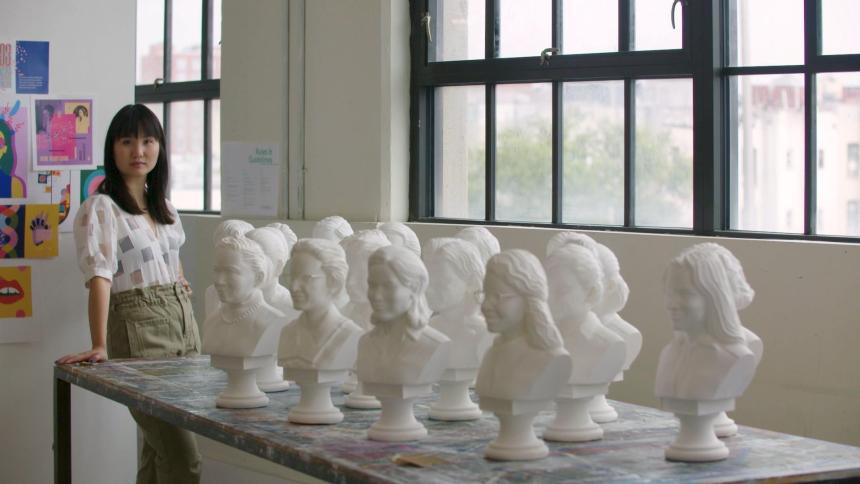
Phingbodhipakkiya got into the Pratt Institute in New York and earned her masters degree in communication design. She eventually became a TED main-stage speaker, professor and award-winning Science, Technology, Engineering and Mathematics (STEM) advocate.
“I started looking at the storytelling of science. Because, as a young scientist I was having trouble communicating what we were doing in our lab and why it was important,” said Phingbodhipakkiya.
She founded The Leading Strand, a company that helps organizations communicate STEM through design storytelling, and The Murdomo Institute, which combines STEM and design to empower young women. Phingbodhipakkiya also launched Atomic By Design, an after-school science club and space for girls to create things like slime and paintings using conductive ink.
“One of the most rewarding things about doing this kind of work is the response from young women who say that seeing my work helps them envision their careers in a different way,” said Phingbodhipakkiya. “They always felt like they had to choose between something creative and something deeply scientific and now they feel like there’s a path forward for them to combine both of them together and make something meaningful.”

One of Phingbodhipakkiya’s creations is an augmented reality experience called “Community of Microbes” that allows viewers to see microbes in the world.
“I’ve worked in labs my entire life. I know what it’s like to see this invisible world come to life, and it’s so exciting,” said Phingbodhipakkiya. “People often think of microbes as ‘ew gross,’ and I wanted to change that perception.”
Her latest exhibition, Beyond Curie, is a portrait series featuring women in STEM including Marie Curie and Katherine Johnson. Phingbodhipakkiya created 3-D printer busts of female scientists, saying that women only comprise 7 percent of the STEM-related busts in the United States.
“If you look around the faculty and STEM you’re going to see a homogenous slot of male mentors and I think that’s a problem,” said Phingbodhipakkiya. “Representation is so important. You need to see someone doing what you want to do in order to feel like you can do it.” Currently, women make up only about a quarter of workers in STEM careers, and they earn considerably less than men. Throughout her career, Phingbodhipakkiya has had to learn to fight for her value. “In 2016, I gave my first TED talk … and a major technology company asked if I might come in and speak to their employees, and they said ‘oh we don’t pay anyone,’” she recalled. “And I said ‘this isn’t right, I should be paid for this.’ I think this was one of the first times where…I put my foot down about my worth. ‘You know what? here’s my rate,’ and lo and behold they paid it.” Phingbodhipakkiya said she hopes that her path and shows like “Beyond Curie” can inspire future generations of women looking into STEM who also have a creative streak. “We curated [Beyond Curie] so that women everywhere can stop wondering whether they had the potential to make an impact in STEM , and instead start asking ‘why are we stopping now?’”
Halley Bondy Recommended


