








This column is part of “The State of America,” an msnbc.com series leading up to President Barack Obama’s 2015 State of the Union Address on Tuesday, Jan. 20. This is the state of the issues you care about, as told by organizations promoting social change and other policy experts.
Leaving his parents’ house at 18, Kenneth Harris had no idea it would take nearly 30 years before he would once again reap the benefits of a stable home. After returning from service with the U.S. Army, Harris had no savings and ended up homeless.
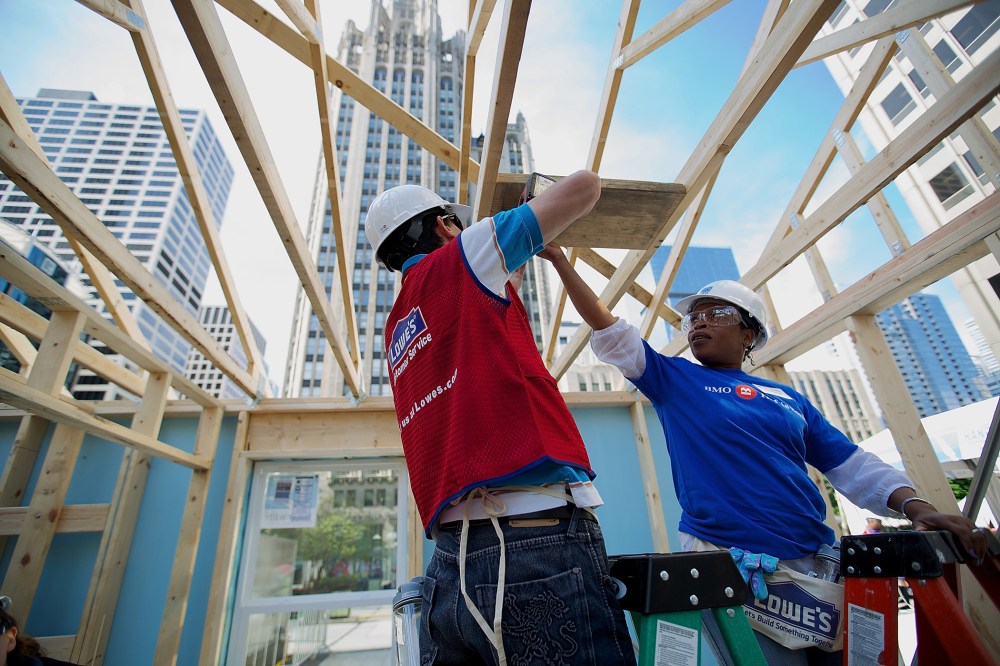
On Father’s Day in 2008, Harris decided it was time to change his life. He began by researching ways to pay off his debt, improve his credit score and gain financial stability. Thanks to a combination of zero percent-interest government loan programs and a loan from the Department of Veterans Affairs, Harris was able to afford a home, which he built in partnership with Habitat for Humanity of Washington, D.C. He helped build his home and the homes of many of his Habitat neighbors, and he has since transformed his life from homelessness to being a community leader.
At Habitat, we often see families who experience the security of stable housing begin to focus on improving other aspects of their lives. Many have gone back to school; others have started their own businesses. Access to credit for housing has opened the door to more opportunities.
%22In%201970%2C%20the%20percentage%20of%20Americans%20who%20owned%20their%20home%20outright%20was%20almost%2040%25%3B%20now%20it%E2%80%99s%20only%20about%2029%25%20…%22′
The Obama administration has been giving significant attention to affordable housing issues lately, and given the role that housing plays for individual families, entire communities, and the economy as a whole, we hope that focus will continue.
Since our founding in 1976, Habitat for Humanity has helped more than 1 million families around the world that now have a new or improved home. Habitat partner families are not the only ones who benefit from quality housing. One of the keys to ensuring the future stability of the housing market and the asset-building potential of homeownership is helping families access credit to purchase their first home. First-time homeownership has historically been a critical component of the market, helping to drive housing price appreciation and spur economic growth across the board.
In 1970, the percentage of Americans who owned their home outright was almost 40%; now it’s only about 29%, according to the real estate site Zillow. As many Habitat affiliates reach their 20- and 30-year anniversaries — and beyond — more and more Habitat partner families across the country are paying off their mortgages.
That success came as a result of preparation, education, accountability and a dogged determination on the part of Habitat homeowners to improve their lives and the lives of their families.
From our perspective, the difficulty in obtaining credit for housing is causing the U.S. economy to miss a significant opportunity for growth. Today, the number of first-time homeowners is at its lowest level in decades. Many young working people who want to become homeowners are unable to access credit to purchase their first homes. Keeping a large group of potential first-time homeowners out of the homeownership market, combined with a growing deficit of affordable housing – both for owners and renters – is weighing down our economy.
At Habitat, we applaud the recent reduction of FHA mortgage insurance premiums from 1.35% to 0.85%. For the typical first-time homebuyers, who are most often members of the middle class, this will translate into a $900 reduction in annual mortgage payments and will enable some families that have been on the cusp of qualifying for a mortgage to become homeowners.
%22Accusations%20that%20low-income%20borrowers%20caused%20the%20recession%20are%20misplaced%20…%22′ We urge President Obama and the administration to continue supporting policies and programs enabling middle-income families to access home loans. We also encourage extending credit opportunities to qualified low-income families through effective federal homeownership programs including HUD’s Self-Help Homeownership Opportunity Program and the USDA’s 502 Direct Loans. Accusations that low-income borrowers caused the recession are misplaced — evidence shows that a borrower’s income level was not a reliable predictor of which homes were foreclosed or abandoned. The structuring and costs of loans were among the biggest factors that led to the housing crisis. Habitat homeowners across the country are demonstrating that the right-sized loan given to a prepared first-time homeowner opens a door to a brighter future. In Phoenix earlier this month, the president emphasized in his speech on housing that the policies he is implementing are directed at responsible, hard-working families who are looking to purchase homes with mortgages they can afford. Purchasing a home, no matter what the income level of the buyer, ought to require a mortgage with fair and reasonable terms that are fully understood by the borrower. Lenders also should confirm sufficient family income to cover monthly mortgage payments and other associated living expenses — including utility and transportation costs. Perhaps helping families realize their dreams of homeownership really is that simple. Perhaps the only real problem is that we strayed so far from this path. Jonathan T.M. Reckford is the CEO of Habitat for Humanity International.
Jonathan T.M. Reckford Recommended


