








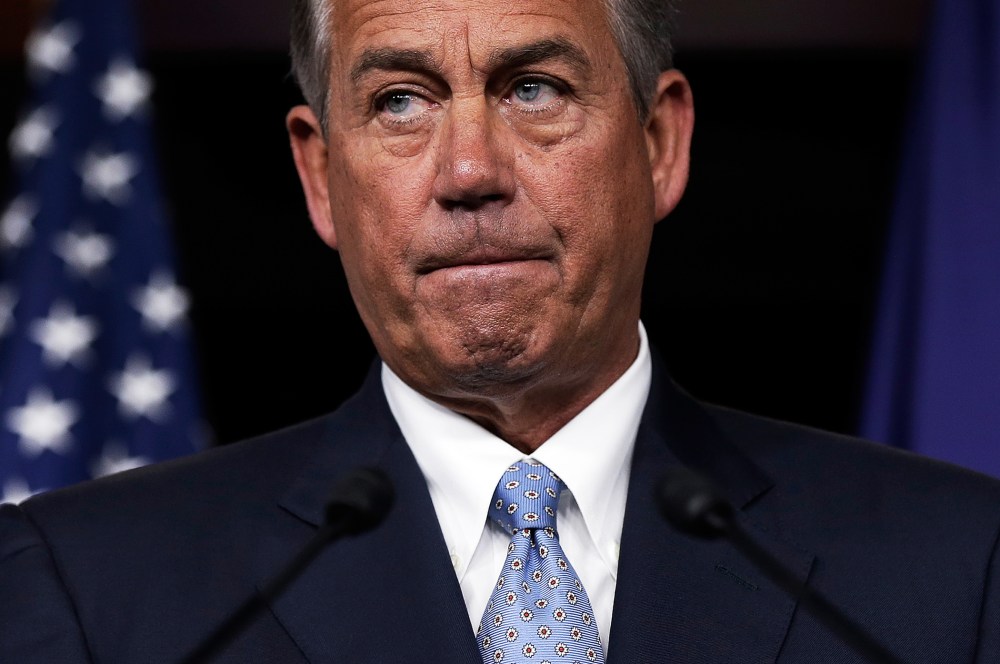
John Boehner thinks President Obama is finally coming around to his position on immigration. What is Boehner position on immigration, you ask? Good question!
On Thursday, Boehner offered rare praise for Obama, who had said earlier in the week he was open to passing immigration via a series of small individual bills rather than the Senate’s large comprehensive bill. House leaders have said for months the Senate bill would not receive a vote and that they’d only move forward with a piecemeal approach.
“I was encouraged that the president said that he wouldn’t stand in the way of a step-by-step immigration reform,” Boehner said. “As you know, that’s the approach the House Republicans have taken.”
The Speaker even sounded a note of confidence that there might be some movement on the issue, despite the House’s unwillingness to take any major action so far this year.
“Is immigration reform dead?” Boehner said on Thursday. “Absolutely not.”
Immigration reform may not be dead, but it’s not exactly alive either. That’s because Boehner’s kind words for Obama don’t really tell us much about what kind of piecemeal approach the two are talking about.
In fact, Obama had already told Telemundo in September he could tolerate passing immigration reform through multiple bills, as long as the package “speaks to the central issues that have to be resolved,” including a path to citizenship for undocumented immigrants. His latest remarks were not a particularly new development.
What’s going on here is that Boehner keeps saying the House wants reform, but he’s yet to commit the House to passing, as Obama has demanded, a piecemeal package that actually covers all the major topics under discussion.
Reform advocates want Congress to tackle the problem all at once for two main reasons. As a policy matter, the parts are designed to fit together: border security improvements and E-Verify requirements make it harder to immigrate illegally, a revamped visa system provides a better legal alternative, and a path to citizenship addresses undocumented immigrants already here and unlikely to ever leave. Politically, all of these individual parts have different interest groups pushing for them: once they get what they want, they’re unlikely to help pass the remaining parts later.
The most difficult question is what to do about the estimated 11 million undocumented immigrants already in the United States. While there are some rumblings from high-ranking Republicans that they might introduce a bill that would grant at least limited legal status to certain qualifying immigrants, Boehner and his deputies have yet to embrace it as a principle of reform. So if Boehner means a “step by step” approach of passing various immigration bills that address the same issues the Senate bill tackles, there’s a good chance the White House and Democrats will be willing to make concessions on the details. Maybe even big ones, like abandoning a relatively clear path to citizenship. If Boehner means a “step by step” approach of passing a border security bill and a couple of uncontroversial visa tweaks and then caling it a Congress, that’s another story. Immigration groups have grown more and more concerned in recent weeks that Boehner won’t follow through with a package that has any chance of gaining their support, let alone the Senate’s. So has the House GOP’s modest pro-immigration wing. Earlier this month, the Speaker said the House would not only refuse to vote on the Senate bill, they wouldn’t even negotiate with them in conference. Reformers fear that if Boehner is ruling out talks already, he’s unlikely to take on the politically difficult process of actually hammering out a compromise that could reach Obama’s desk. Boehner, who does not want House Republicans blamed for killing reform, is doing what he can now to look like the reasonable party. House Republicans have preemptively attacked Democrats throughout the process by claming they might sabotage a GOP reform plan in order to exploit the issue with Latino voters. But so far they haven’t produced much for Democrats to sabotage even if they wanted to, and Obama keeps saying “yes” to Boehner’s procedural demands. That means the ball is still stuck in the Speaker’s court. Maybe he’ll move forward with a proposal dealing with the 11 million undocumented, which would guarantee a backlash from certain corners on the right. But until he decides one way or the other, divining his immigration position and how far apart he and the White House are is mostly an empty exercise.
Benjy Sarlin Recommended


