








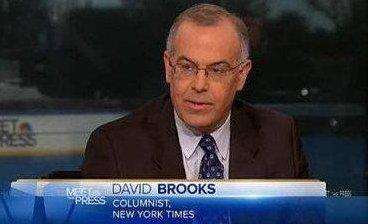
Since I raised some concerns about David Brooks’ column this morning, it’s only fair that I note there’s been some follow-up on the story.
To briefly recap, Brooks built his entire column today around a falsehood: the bogus claim that President Obama “hasn’t actually come up with a proposal to avert sequestration,” despite the detailed, already published plan, built on mutual concessions from both sides, the White House already released.
In the wake of considerable criticism, Brooks followed up today, saying he let his “frustration get the better” of him, which apparently led him to publish a claim that wasn’t true. “I should have acknowledged the balanced and tough-minded elements in the president’s approach,” the columnist added, though Brooks still believes Obama’s proposals “are not nearly adequate.”
Though the walk-back is welcome, Greg Sargent helps highlight why Brooks still has some room to improve his argument.
Brooks has admitted error, but this is still fundamentally a dodge. After all, the plan put forth the other day by Democrats might not be “adequate enough” to make all our fiscal problems vanish forever, but it would, in fact, avert the sequester — which Brooks says will be disastrous to the country — through roughly equivalent concessions by both sides. It is, by definition, a compromise plan. Why, then, is this inadequate as a temporary solution?
More broadly, the basic overall question still stands: Is there anything Obama and Dems can offer to Republicans — anything that falls short of essentially giving Republicans everything they want for little or nothing in return — that would make them drop their no-compromise-on-revenues-at-any-cost stance? If so, name it. If not, then why are both sides equally to blame?
These need not be rhetorical questions. As I argued yesterday, it’s hard to ignore the extent to which the president has played by the rules Brooks likes — the president tried to stop congressional Republicans from crashing the economy on purpose; he accepted deep spending cuts; he adopted over $2.4 trillion in debt reduction even when economists said debt reduction shouldn’t be at the top of the economic to-do list; he accepted far less tax revenue than his campaign platform sought; he put entitlement “reforms” on the table; he offered “grand bargains”; and with brutal sequestration cuts looming, he endorsed a 50-50 compromise that required concessions from both sides, all while leaving the door open to additional negotiations. That is, quite literally, everything that could reasonably be expected of an elected president.
Instead of praising, or even acknowledging, these efforts, Brooks has replaced inaccurate complaining with corrected complaining.
And then Brooks made one more mistake: he argued with Ezra Klein.
This interview is an absolute must-read — really, it is — but consider this exchange. DB: In my ideal world, the Obama administration would do something Clintonesque: They’d govern from the center; they’d have a budget policy that looked a lot more like what Robert Rubin would describe, and if the Republicans rejected that, moderates like me would say that’s awful, the White House really did come out with a centrist plan. EK: But I’ve read Robert Rubin’s tax plan. He wants $1.8 trillion in new revenues. The White House, these days, is down to $1.2 trillion. I’m with Rubin on this one, but given our two political parties, the White House’s offer seems more centrist. And you see this a lot… Ezra was far too polite to say, “Um, David, I don’t think you know what you’re talking about,” but by pointing to the actual numbers, he didn’t have to. On a related note, we also talked yesterday about Ron Fournier’s piece that argued Obama is to blame for the sequester, even if it’s the result of Congress’ intransigence, because the president is the president. Also in the interest of fairness, I should mention that Fournier has a follow-up of his own, though I’m afraid it wasn’t especially persuasive, either.
The place for in-depth analysis, commentary and informed perspectives. Recommended


