








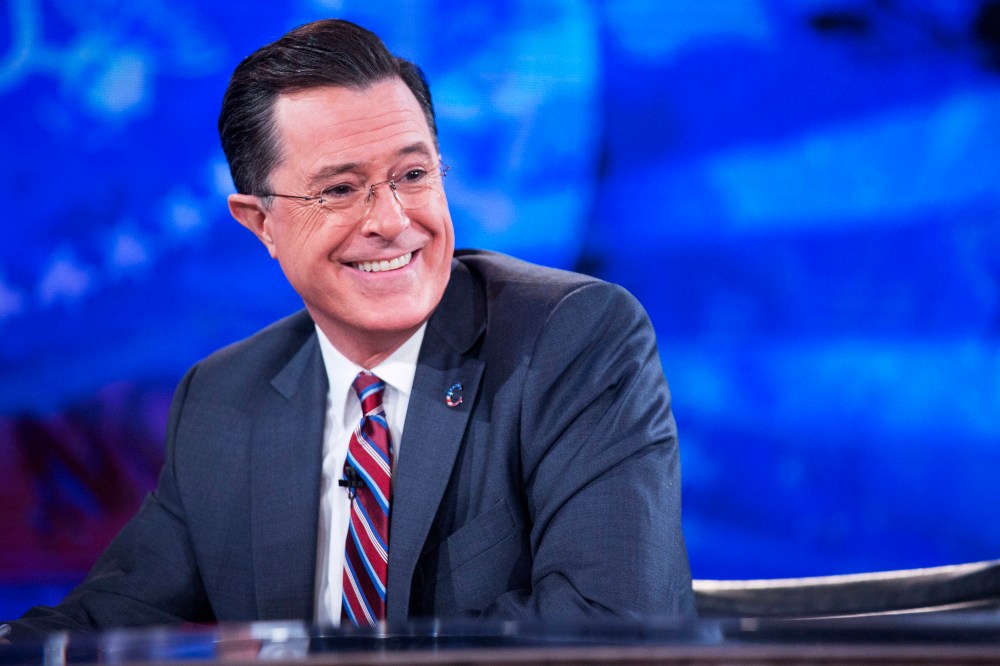
It feels odd to be saying goodbye to Stephen Colbert. After all, he will be returning to television again next year when he takes over for David Letterman on CBS’s “The Late Show.” But the man who will sit behind that CBS late night desk is completely different from the one viewers have watched for nearly a decade behind a desk shaped like a C — for Colbert, of course — on Comedy Central. That’s because America’s late night comedy landscape is losing the “character” Stephen Colbert to make room for the real individual of the same name.
Stephen Colbert’s brilliant faux-right wing persona was cultivated in the early days of “The Daily Show with Jon Stewart.” Colbert would often face off against another now-famous former “Daily Show” correspondent, Steve Carell, in a segment hilariously called “Even Stevphen.” The similarly-named duo would comedically argue over such topics like the weather: good or bad?, responsible drinking, Iraq, reality television, medical marijuana, and even Islam vs. Christianity.
After fully embracing the exaggerated and more conservative version of himself, Stephen Colbert’s commentary — while always funny — could also be quite biting. Arguably, the most damning indictment of America’s political system executed by the host during his tenure at The Colbert Report was his following of campaign finance law to the letter to create his own Super PAC, Americans for a Better Tomorrow, Tomorrow. Colbert’s Super PAC created ridiculous — but very real — political ads for use during actual political campaigns, including spots for Rick Perry.
But the comedian’s most daring in-character appearance came in 2006 when he spoke at the White House Correspondents Dinner. During Colbert’s introduction at the event, journalist Mark Smith told the crowd that when it comes to Colbert, “No one is safe.” That proved to be a prophetic statement as Colbert — for more than 20 minutes — tenaciously went after then-President George W. Bush, his administration, the press, and so many more. Colbert cut to the quick repeatedly during his monologue, taking jabs at everything from the Bush administration’s use of NSA wiretaps and torture, to the fact that Vice President Dick Cheney once accidentally shot a man in the face while hunting.
To Bush’s critics, the moment was a vindication. To his supporters, the material went far too harsh and became squirm-inducing. The only bipartisan agreement on his performance seemed to be that it was worthy of plenty of headlines.
Colbert also spent considerable time on Capitol Hill during his nine years hosting “The Colbert Report.” One of the show’s most popular segments was “Better Know a District” where Colbert interviewed different members of Congress. His very first “Better Know a District” in 2005 was with Rep. Jack Kingston (R-Ga.). So for one of his last shows, Colbert only found it fitting to spend his last “Better Know a District” again chatting with Rep. Kingston, who is also leaving Congress after an unsuccessful bid for the Senate. The two men ran and danced through the halls, stole a bust of Lincoln from Rep. Aaron Schock (R-Ill.), and then left a bust of Colbert hidden in the halls of Congress before riding a tandem bike across the National Mall.
But Colbert’s most noteworthy appearance on Capitol Hill was actually as a congressional witness. In 2010, after working one day with migrant workers picking fruits and vegetables, he discussed immigration — specifically the issue of migrant workers in the farming industry — in front of a House subcommittee. His opening remarks were laced with humor and in character, but when answering lawmakers’ questions Colbert dropped his routine and spoke frankly about the conditions these individuals endure. When asked why he cared about this particular cause, he invoked a biblical passage, Matthew 25:40, before saying saying flatly, “Migrant workers suffer, and have no rights.”
It was only moments like that one on Capitol Hill or a rare out-of-character interview like Colbert’s 2012 appearance on NBC’s Meet the Press — or when he was adorably giving teens advice for the online series, “Ask a Grown Man” — that viewers got to see the real Colbert. Fleeting glimmers of the man behind the persona — a man who is very much in on the joke that is the Stephen Colbert character — could also be found in the hilarious moments when a particularly stellar punchline forced him to break into genuine laughs.
Colbert is the author of several comedic books on politics including, “I Am America (and So Can You!),” and his broadcast-ready voice has also appeared in several animated television shows and movies like “Harvey Birdman, Attorney at Law,” “The Venture Bros.,” “Saturday Night Live,” and “Monsters vs. Aliens.” The last edition of “The Colbert Report” airs on December 18. The show will be replaced on January 19 by “The Nightly Show with Larry Wilmore” who is also a popular “Daily Show” alum. David Letterman is due to retire in May of 2015 with Colbert reportedly taking the reigns of “The Late Show” in late August or early September. In the final days of “The Colbert Report,” the host has looked back at nearly a decade of laughs. From bits like R.E.M.’s Michael Stipe on the shelf, a performance of Sarah Palin’s version of the tale of Paul Revere, and a dramatic reading by actor John Lithgow of Newt Gingrich’s epic 2011 presidential campaign press release — “The Colbert Report” and its immensely talented host have fundamentally changed what a late night comedy show can be. Colbert has been joined on his last Comedy Central broadcasts by a slew of high-profile guests wanting to wish him well and make one last appearance before the end comes — an end, that even after nearly ten years, somehow feels like it’s come too soon.
Nick Ramsey
Nick Ramsey is a senior producer with MSNBC’s “The Last Word with Lawrence O’Donnell.” Recommended


