








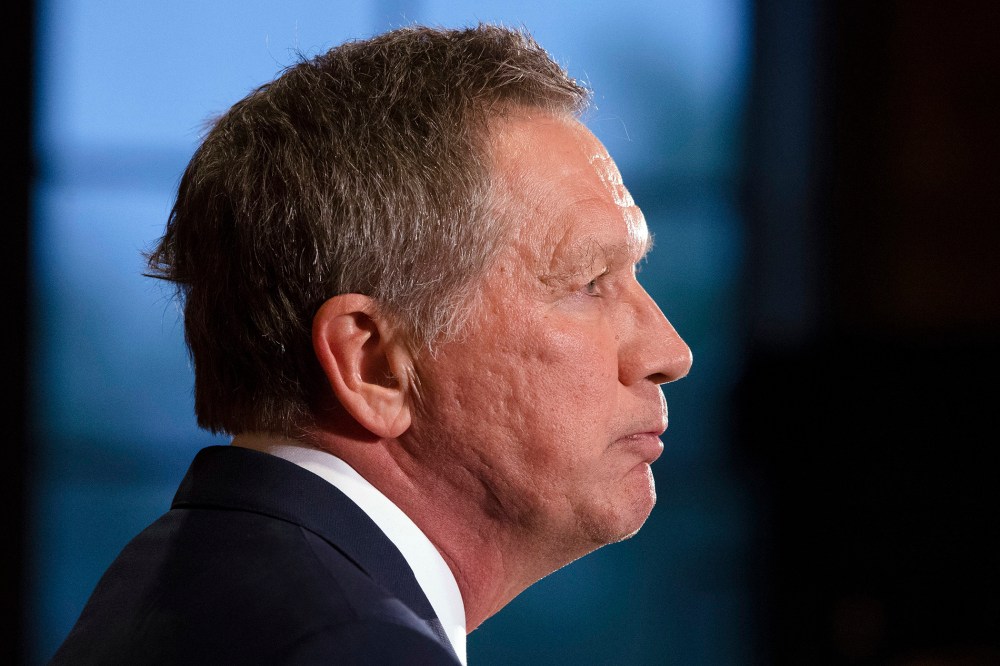
One week after ending his presidential bid, Gov. John Kasich finds himself in the same position as many of his fellow Republicans, grappling with whether or not to endorse presumptive GOP nominee Donald Trump and, if so, how enthusiastically?
Regardless of how he answers the question, Kasich will still play a vital role in the presidential campaign as the still-popular governor of one of the most critical swing states this fall and also the host state for the party’s convention this summer. And just how he squares his own campaign aspirations with the new reality won’t go unnoticed.
For the last few months, Kasich avoided directly saying whether he would support Trump as the nominee, but after violence erupted at Trump’s rallies in March, the governor told reporters that the front-runner “makes it very, extremely difficult.”

The governor painted himself as a “well trod” and “solid” alternative, and called Trump’s proposal to temporarily ban Muslims from entering the country “more of the outrageous divisiveness that characterizes his every breath and another reason why he is entirely unsuited to lead the United States.”
Last man standing
Kasich was a later entry into a GOP field that was initially hailed for its load of political talent — names like Jeb Bush, Scott Walker and Marco Rubio. His frugal campaign largely skipped the Iowa caucuses, hunkered down in New Hampshire and eschewed the kind of massive fundraising operation other candidates had established.
But primary voters made clear which path they favored, delivering the nomination to Trump.
But at the end, Kasich got what he most wanted in the Republican primary race — to be the last candidate standing against Trump in the battle for the party’s nomination, even if for just a few hours after Cruz suspended his campaign.
Kasich won just one state during the primary contest — his home state of Ohio — and lagged behind the front-runner in almost every poll, in almost every election result, and in every delegate count, never posing a considerable threat to win.
Even during the most contentious moments in the free-for-all battle between Trump and the non-Trump field, Trump rarely had to turn any fire or attention to Kasich, only granting him a nickname near the end that encapsulated how he never sensed a serious challenge. Trump dubbed him “1 for 38” or “1 for 41 Kasich.”
Still, up until the moment he bid farewell, Kasich was the embodiment of the anti-Trump faction of the party, with a starkly different vision for America and a message of cooperation, inclusion and larger purpose. Sometimes it seemed as though Kasich was running in an entirely different election.

A different vision
From the start, Kasich didn’t engage his opponents, preferring to operate in an insulated sphere, speaking primarily about his own message and ignoring all the day-to-day squabbles. But as the field condensed and he was forced torepeatedly confront what was in the news or what was happening with his opponents, he began to feel as if his initial message got lost.
“The spirit — the essence of America — lies in the hearts and souls of us. You see, some missed this message,” Kasich said as he suspended his campaign last Wednesday. “It wasn’t sexy. It wasn’t a great sound bite.”
And it most certainly wasn’t what Donald Trump was selling.
On the campaign trail, Trump drew hundreds or thousands of supporters who exhibited much of the same fervor the candidate displays at the podium. Trump railed against his opponents, against specific journalists, against figures in the news, and offered his take on whatever the television talk of the morning was.
In contrast, Kasich generally bragged about how he didn’t like to pay attention to the news, regularly telling crowds he mostly watched “60 Minutes” and the Golf Channel. The governor’s town halls grew larger and larger as the months wore on, but they were always smaller, more intimate affairs than the mega-rallies for Trump. Attendees sat down in chairs around him and politely listened as the governor encouraged his audience to find their “purpose” and “live a life bigger than yourself.”
“When you listen and find your purpose, you are on fire,” Kasich would say, like when he faced a town hall of students at Villanova University in Pennsylvania on March 16, the day after he won the Ohio primary. “And it’s an unquenchable fire when you find it.”
At Trump’s rallies, the atmosphere was palpably charged with live television coverage and chants of “build the wall!” Protesters — and the reception they received — became a common storyline at those events.
Meanwhile, Kasich only seldom saw protesters, and used his folksy demeanor to stroll into events, regale his crowds with stories about life, wisdom, and balanced budgets, and delivered his version of compassionate conservatism.
“I’m raising the bar in American politics,” he said in Strongsville, Ohio, two days before the state’s primary. “Being an example and role model for our kids about the way in which you should conduct yourself.”

Kasich credited this finish partly with his positive message, telling the nation that night: “Maybe, just maybe, we are turning the page on a dark part of American politics, because tonight the light overcame the darkness of negative campaigning.”
But then South Carolina happened. Over the next few days as the race shifted south, the GOP primary in the Palmetto state “lived up to its expectations” as the race among the other Republican candidates turned ugly. Kasich’s rivals turned their fire on each other, with so many barbs flying back and forth that it consumed the airwaves and left little space for breathing room for a candidate unwilling to get in the mix.
Kasich had long banked on a considerable media boost after a strong finish in New Hampshire, but just as soon as he surprised the world with his second-place finish in a crowded field, there were new sparks flying that absorbed headline attention almost immediately.
Then, in the days leading up to the primary, Kasich’s team also took a detour to the March 8 primary state of Michigan, briefly leaving South Carolina, and the national media spotlight, behind.
Kasich was never shy about voicing his frustration with his lack of media coverage. As the months wore on, Kasich slowly moved to the offensive. He was upset with the level of attention on his biggest repudiation of his rivals, a sprawling and stark warning about the “two paths” the nation faced with him versus Donald Trump and Ted Cruz.
At Pawleys Island in South Carolina on Feb. 11 he joked, “I’m thinking about coming into these rooms and doing flying somersaults.” Later that month in Georgia, he wondered if he should “stand on the top of this building and say, ‘I am not coming down until you bring all the microphones in this world.’”
A happy warrior
As Kasich stood before his family, friends, and staff last week to announce his departure from the race, he referred to his town halls as “magic.” He felt those town halls — more than 200 of them across New Hampshire and all corners of the country — became a sort of refuge for people to cry out and share some of the deepest problems in their lives.
Much of what people saw of Kasich in his final weeks might have revolved around food, but it was his constant emotional moments with people at his town halls that propelled him forward amid constant calls from critics and rival campaigns to get out of the race.
After South Carolina, the other candidates in the race quit regularly taking questions from the audience at every event, but the daily interaction Kasich had with voters helped solidify for him what this was about.
“This campaign has changed my life,” Kasich confided in an audience at the Great Neck Synagogue on Long Island in April, in a raw, emotional speech that was widely praised by attendees.
“I’ve come to realize that throughout our nation, that there are many people who feel detached, isolated, polarized, lonely, carrying a burden on their shoulders, and they look for a safe place to share their victories and to share their losses. And you know, we live at the speed of light, it seems, not taking the moment to slow down and pay attention to that person who is just seeking a connection with another individual,” he said.
In Portland, Oregon, on April 28, speaking after a tough defeat in the Northeast primary states, Kasich told the audience he had considered leaving the race, but finally admitted that he would stay in because his candidacy had become more than just about winning at that point. He wanted to offer voters “a choice,” he said.
On the campaign trail, Kasich was notoriously unscripted — a complicated blend of quirky analogies, bursts of prickliness, and unvarnished emotion. He had common themes, favorite lines, and regular riffs he’d turn to, but no two town halls were ever the same.
Kasich had seemingly endless zeal for the experience — pacing in circles around his events, while he would sometimes pull into the towns he was visiting early so he could take a walk around the area and expend some excess energy before walking inside. He never spoke from a teleprompter and reveled in his ability to constantly riff off the cuff, but his extemporaneous style got him in trouble a number of times, like when he said in Virginia that women “left their kitchens” to help him get elected when he first ran for office. The governor partly blames his lack of success in this race on his low name recognition from the start — that he was too focused on being governor of Ohio to appear on more national TV programs or drum up more national recognition. Kasich claimed he wasn’t spending the last few years focused on laying the groundwork for a White House run. But for many that knew him while he was growing up in the tough Pittsburgh suburb of McKees Rocks, they weren’t entirely surprised that he ended up here since they always sensed sky-high ambitions. When Kasich returned there for a town hall the night before the Pennsylvania primary, he recalled moments from his childhood as men from the local barber shop would yell out at him, “Pope, you’re going to be somebody someday!” He had the nickname “Pope” growing up since he was so dedicated to the church and dreamed of the highest positions. “That was 50 years ago and I can still remember them yelling that to me. It made a difference,” Kasich remembered. One of those men was Joe Anthony Panucci Sr., who worked in the barber shop on Valley Street. “He would come into the shop and we would talk and talk and I could see then that this kid was going to be great, and I told him that,” Panucci told NBC News. “I told him when he was 16 or 17, ‘Some day you are going to be the President of the United States.’” Debbie Catanzarite, who knew Kasich growing up through the band and the Christian Youth Organization, recalls a moment when they were around 6th grade when Kasich would not stop talking politics with his group of friends. “All his buddies said, ‘John, that’s enough, stop talking politics,’” she remembers. “He was so mad. He came and sat in the seat by himself, so I went over and said, ‘What’s the matter, Johnny?’ He said, ‘Nobody believes me. Do you think I could be president?’” “I said, ‘John, I think you could be president. Why not?,’” Catanzarite recalled. “He said, ‘Debbie, when I get elected, I’m going to invite you to my inauguration.’” The final hours “The race consolidates, I beat Trump.” That was the strategy Kasich laid out for reporters in Gulfport, Mississippi on Feb. 24. “I think he has a ceiling. And hopefully the race will consolidate and I’ll be in a position to be able to go mano-a-mano and then lay out my stuff and let him lay out his and we’ll see where we are.” When Kasich finally got that one-on-one race against Trump as Cruz exited the race, it was too late. Kasich met with Cruz in San Francisco near the end to talk about their shared goal of stopping Trump, sources told NBC News, and although Cruz did not say as much, Kasich was left with the impression that Cruz could end his run if he lost in Indiana. That’s when Kasich’s team started to solicit outside input about what his chances would be if Cruz left. Ultimately, before the plane ever moved, Kasich got off the plane and scrubbed the flight. He met with a close group of his team members inside a conference room, where sources say they continued to discuss his place in the race and why the campaign was still pushing forward. The governor doesn’t do well with a message that he doesn’t believe in, the sources said, and he did not want to travel and spend days asking people for more money when he did not see a plausible scenario or clear path ahead and could likely drop out a few weeks later. The next two states in the primary calendar, West Virginia and Nebraska, posed considerable challenges, and Kasich’s staff knew they would likely get “blown out of the water” there. Multiple sources in Kasich’s campaign, however, said that it’s likely they could have continued on if the next states to vote were places like Oregon or California — more favorable terrain. Kasich’s aides offered their input about whether he should stay in, but the decision to suspend the campaign was ultimately up to the governor. “Throughout my campaign, I have said the Lord may have another purpose for me,” Kasich said as his campaign came to a close that evening. “And it sent all the pundits a-Twitter: Does that mean he’s not committed, or he’s not focused, or he’s not energetic? It showed to some degree how little they understand about life,” Kasich said. “I have always said that the Lord has a purpose for me as he has for everyone. And as I suspend my campaign today, I have renewed faith, deeper faith, that the Lord will show me the way forward and fulfill the purpose of my life.” NBC News’ Peter Alexander contributed to this report. This article originally appeared on NBCNews.com.
Kailani Koenig Recommended


