








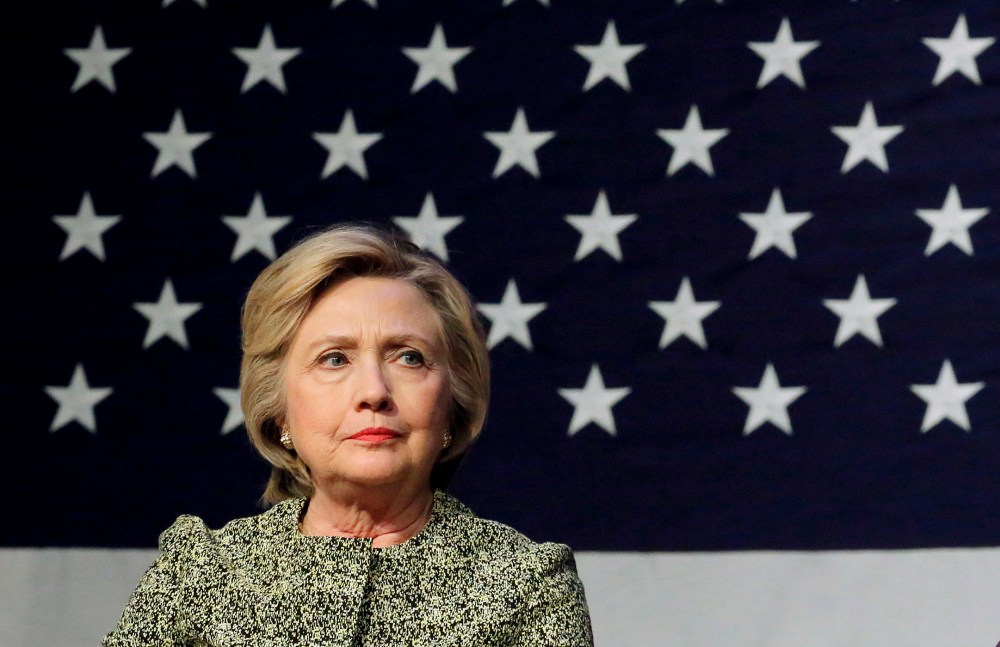
Hillary Clinton has long literally and figuratively stood beside Bill Clinton, fully embracing his policy moves to make the Democratic Party more centrist in the 1990s and defending him after his affair with a White House intern and subsequent impeachment.

But even as she remains a strong favorite to win the Democratic nomination, the 2016 campaign is forcing the former secretary of state to distance herself from her husband’s record.
Sanders’ latest target is the controversial welfare reform law Bill Clinton signed while president, which Sanders opposed as a congressman and said this week was unfairly targeted at the poor.
Sanders mentions voting against welfare reform. #NAN25
— Joy Reid (@JoyAnnReid) April 14, 2016
Liberal activists, particularly in the African-American community, have also criticized Bill Clinton’s presidency, arguing the 1990s, which both Clintons cast as an era of peace and prosperity, was also a time when the Democratic Party embraced a law-and-order vision that unfairly targeted blacks.
RELATED: Analysis: The complex history of the controversial 1994 crime bill
Amid this backlash, Hillary Clinton has carefully defended her husband, but not entirely his record. She has called for new laws to combat racial profiling and broadly reform the criminal justice system, moves that would in effect reverse some of the policies of her husband.
When Sanders suggested Hillary Clinton had used a “racist term, and everybody knew it was a racist term” in suggesting there were “super-predators” in the 1990s who were driving the increase in the crime rate, the former secretary of state did not bother to defend herself against a very sharp charge, instead highlighting her proposals for the future.
“The Black Lives Matter movement has been incredibly effective at challenging many political orthodoxies and these policies,” said Julian Zelizer, a political historian at Princeton University. “The movement has exposed the racialized nature of these policy debates and raised crucial questions about reform.”
For his part, Sanders has also aligned himself with Jesse Jackson, whose racial protest tactics Bill Clinton has criticized in the past.
Politically, it’s not clear these attacks on the 90s-era policies and her husband’s record are having much impact on Hillary Clinton.
The former secretary of state holds a significant lead over Sanders among pledged delegates and is way ahead of him among so-called superdelegates. And despite sharp criticism of Clinton by black intellectuals like Michelle Alexander, author of an influential book called “The New Jim Crow” that lambastes the criminal justice policies of the 1980s and 1990s, Clinton is winning the Democratic primary largely because of her strong support with black voters.
But the debate on the campaign trail illustrates a profound rethinking and reshaping of the Democratic Party.
Bill Clinton ran for president in 1992 facing two different challenges.

First, the murder and crime rates in some cities, such as Washington, D.C., were at very high levels, and officials in both parties felt there was a need for a more comprehensive policy response.
Secondly, the Democratic Party was losing elections at the presidential level, in part because the party was unable to win moderate, white voters.
Clinton’s embrace of tough-on-crime policies as president addressed both problems.
Clinton’s 1994 crime bill included funding for 100,000 additional police officers, offered federal money to states if they imposed harsher sentences to offenders of violent crimes and created life sentences for people convinced of three felonies, referred to as “three strikes” provision.
The 1996 welfare reform bill, which limited the time poor people could get government cash benefits to five years, was at the time strongly opposed by many liberals, but was another policy that was embraced by more centrist Democrats and was a political boon to Bill Clinton.
“That was an easy bill to be for because it scapegoated the poorest people in America,” Sanders said in a speech to the Rev. Al Sharpton’s National Action Network this week, noting he had voted against the welfare legislation.
The crime rate and the number of people on welfare reform both shrunk dramatically in the 1990s, trends that have continued. According to Department of Justice figures, the rate of violent crime has declined from 79.8 victimizations per 1,000 people in 1993 to 23 victimizations per 1,000 people today.
There were 479 homicides in Washington, D.C. in 1991, compared to 162 in 2015, though the decrease can be attributed to a combination of local and federal policy reforms.
But there is intense debate among scholars about exactly why such changes happened and how much Clinton’s policies had to do with them. Many credit the economic growth of the 1990s as creating jobs that removed people from welfare dependence and reduced crime. The Clintons credit their stewardship of the economy as having helped create those conditions. But critics of the Clinton approach argue that if economy growth was the solution, then tougher laws on drug offenders and welfare recipients were unnecessary. “I am ashamed of my vote. I sincerely apologize to my God, I apologize to my community, to my family, that was the worst vote, as I look back over the years, that I’ve taken since I’ve been in the Congress,” Bobby Rush, a black congressman from the Chicago area, said this week in an MSNBC interview that was remarkable because lawmakers so rarely backtrack on their votes. “What happened with the crime bill and its implementation was that there was too much of a focus, too many resources on locking them up, but no resources on love and compassion. And as a result, we have devastated our communities,” he added. Joe Klein, the left-leaning Time magazine columnist who wrote the novel “Primary Colors” that was loosely based on the Clintons, argues these critics are misunderstanding both Clintons’ moves and the time when he governed. “Too many liberals subscribed to the old West Side Story ‘depraved on account of being deprived’ theory of indigence: It was society’s fault. But that theory failed to recognize the good choices made by the vast majority of African-Americans who weren’t criminals or truants or drug addicts. It is tragic, and wildly irresponsible, that Bill Clinton, who brought a measure of sanity to these complicated issues, is being vilified now,” Klein wrote this week. Whether the Clintons were right or not to embrace the crime bill and other legislation in the 1990s, the politics have now clearly shifted. Politicians in both parties now say some of the state and federal policies enacted in the 1970s, 1980s and 1990s helped lead to a surge of incarceration that disproportionately left black men in jail. Crime is down, and with whites fleeing the Democratic Party, Clinton is heavily dependent on the votes of blacks to win the primary. She will eventually need overwhelming African-American backing to win a general election. So her tone, while not critical of her husband, is apologetic about his actions. “I supported the crime bill. My husband has apologized. He was the president who actually signed it. Sen. Sanders voted for it,” she said at Thursday’s debate. “I’m sorry for the consequences that were unintended and that have had a very unfortunate impact on people’s lives. I’ve seen the results of what has happened in families and in communities,” Clinton added. This article originally appeared on NBCNews.com.
Perry Bacon Recommended


