








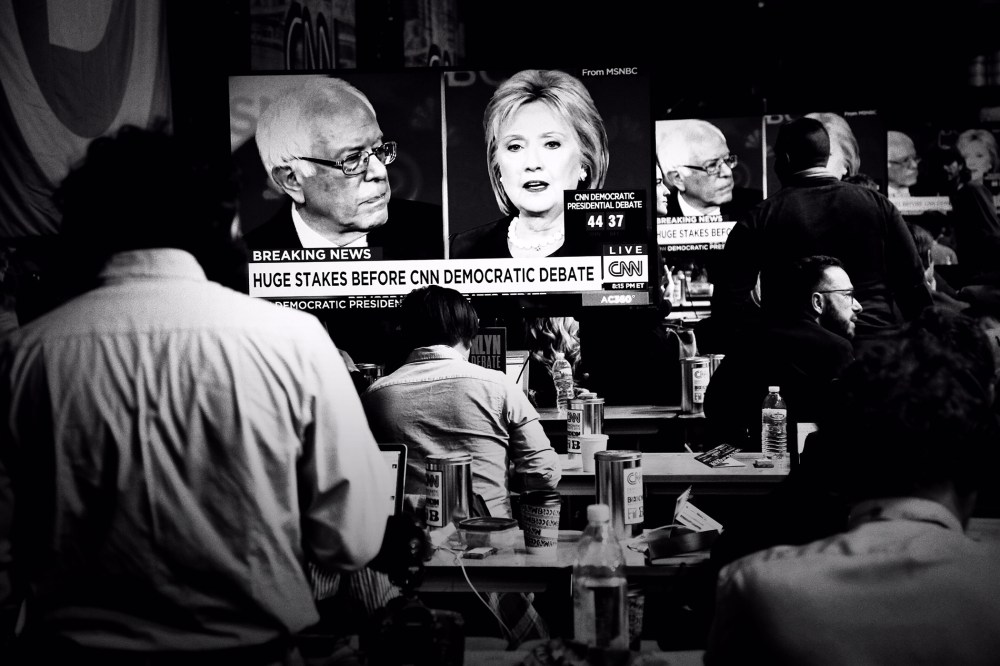
NEW YORK — In what could have been the final Democratic presidential debate of the 2016 election, Bernie Sanders, the 74-year-old socialist insurgent, positioned himself as the future of the Democratic Party, while Hillary Clinton steamrolled her rival with a steady stream of facts and pragmatism.
Thursday’s debate at Brooklyn’s Navy Yard, the ninth this cycle, was the most contentious yet, and it came just days before the make-or-break New York primary on April 19.
“History has outpaced Secretary Clinton,” Sanders said, a day after 27,000 (mostly) young people filled Washington Square Park in Manhattan to see him.
Sanders made that point discussing criminal justice reform, an issue that underscores more than any other how far the Democratic Party has come during Clinton’s career in public life. Her introduction to the political stage came in 1992, when her husband, then-Arkansas Gov. Bill Clinton, made a show of taking time off the presidential campaign trail to oversee the execution of a black man in Arkansas.
Hillary Clinton has evolved with her party and adroitly found the pulse of the broad Democratic coalition. Where she’s out of step with the base, it’s by choice, such as her defense Thursday night of a $12 federal minimum wage instead of the $15 floor favored by Sanders and most labor unions.

The debate reminded voters that Clinton has been in the center of politics for a long time and has had to abandon a lot of former positions to get here.
Her invocation of “super predators” once in the 1990s has haunted her and her husband on the campaign trail this year. “It was a racist term, and everybody knew it was a racist term,” Sanders said Thursday.
Sanders has been in politics a long time as well but always on the outskirts. The progressive base, though so far not the wide party coalition, has caught up with where Sanders has been along.
“I think the future of the Democratic Party is not simply raising money from wealthy campaign contributors,” he said on his signature issue about campaign finance.
The dynamic produced a fiery and illuminating debate. Here are five takeaways.
A debate conducted in all caps
All signs suggested this would be the most feisty debate yet between the Democratic nominees, and it did not disappoint. The tone was loud — the debate was conducted at a near yell for the entire two hours — and at times even sarcastic.
“Secretary Clinton called them out?” Sanders said of his rival’s tough talk on Wall Street. “Oh, my goodness, they must have been really scared by this. Was that before or after you received huge sums of money from them?”
The rowdy crowd, stacked with supporters of both sides, cheered on their candidates and booed the other. Each campaign was given 400 tickets to hand out to loyal fans.

The candidates repeatedly spoke over each other, leading moderator Wolf Blitzer of CNN to scold them like children. “You’re both screaming at each other. The voters won’t be able to hear either of you,” he said.
When not talking past each other, they glared and rolled their eyes.
Clinton on offense
Clinton has typically alternated between ignoring and attacking Sanders, but tonight, she delivered some of her fiercest pummeling yet.
She came swinging immediately out of the gate, saying Sanders was out of his depth on foreign policy and unable to talk about it “without having some paper in front of him.”
In one sentence, she summed up her argument: “It’s easy to diagnose the problem; it’s harder to do something about the problem.”
Clinton landed blows once again on guns. “He kept his word to the NRA,” she said of Sanders. And she delivered one of the loudest applause lines of the entire night by noting that throughout so many debates, “We’ve not had one question about a woman’s right to make her own decisions about abortion.”
Israel Jewish voters make up nearly 1 of every 7 New York Democratic primary voters, according to a new NBC News poll, and Israel emerged as a key issue between Clinton and Sanders. The candidates played against type on the Israeli-Palestinian debate, with Sanders, who is Jewish, speaking up for the rights of Palestinians, while the more hawkish Clinton advocated for Israel’s conservative government. The argument at times was a toxic well of lefty political debates, with each adopting positions that would be familiar to any college dorm room debater. Sander criticized Israeli Prime Minister Benjamin Netanyahu’s rigidity. And he knocked Clinton for devoting so little time to the plight of Palestinians in her recent speech to AIPAC, the Jewish lobby group that Sanders snubbed last month by declining to speak to them. Clinton defended Netanyahu – his job is “very difficult,” she said – and said the U.S. should engage in the region only “without ever undermining Israel’s security.” New York state of mind Both candidates claim New York connections, but Clinton, the state’s former senator, worked harder to highlight them. “I love being in Brooklyn. This is great,” Clinton said at one point. In her opening remarks, she made sure to praise “New York values” — the term Sen. Ted Cruz used to smear Donald Trump as an East Coast liberal. Sanders, with his outer-borough accent, declares his origin with every word he speaks. But he reserved direct appeals for his closing argument. “I grew up in Brooklyn the son of an immigrant,” he said, telling his family’s story. Meanwhile, Sanders continued to downplay Clinton’s large wins with Southern black voters. He got “murdered” in the Deep South, he acknowledged, but “we are out of the Deep South now.” It’s a risky proposition for a candidate who needs to perform better with people of color and who owes many of his own wins to red states like Utah and Nebraska. Failure to disclose Clinton still doesn’t have a good answer on why she hasn’t released transcripts of the paid speeches she gave to Goldman Sachs and other private groups for hundreds of thousands of dollars each. This time, rather than trying to answer the question. Clinton pivoted to attacking Sanders on other issues. First, she moved to a financial reform vote Sanders took and, when that didn’t satisfy the moderators, hit him for not releasing his tax returns. That led to Sanders revealing that he still doesn’t have a great answer on that subject. “Jane does our taxes. We’ve been a little bit busy, you’ll excuse us,” Sanders said of his wife. He did, however, announce that he will release his 2014 tax returns Friday.
Alex Seitz-Wald Recommended


