








When Petty Officer Landon Wilson enlisted in the U.S. Navy as a woman three years ago, on the cusp of the repeal of “Don’t Ask, Don’t Tell,” he remembered thinking everything was going to be OK. The law that had prevented gay and lesbian troops from serving openly was going away, and the military, he hoped, would soon be welcoming transgender service members like him.
“So Sep. 20, 2011, rolled around, and the gay, lesbian, bisexual community, you could almost hear them take this collective sigh of relief that no longer would they be losing their careers over who they were, who they loved,” said Wilson, 24, during an international conference of transgender military service members Monday in Washington, D.C. “But I waited. And it wasn’t until a year later, when I began my transition from female to male, that I really felt like I took my very first breath.”
%22Pentagon%20regulations%20prohibit%20military%20service%20on%20the%20basis%20of%20%27transsexualism%2C%20exhibitionism%2C%20transvestism%2C%20voyeurism%20and%20other%20paraphilias.%27%22′
There are approximately 15,500 transgender troops like Wilson serving in the U.S. military according to the Palm Center, a San Francisco-based think tank that teamed up with the American Civil Liberties Union to sponsor the conference. But because of longstanding — and, many argue, outdated — Pentagon regulations prohibiting military service on the basis of “transsexualism, exhibitionism, transvestism, voyeurism and other paraphilias,” transgender troops in the U.S. may not serve openly.
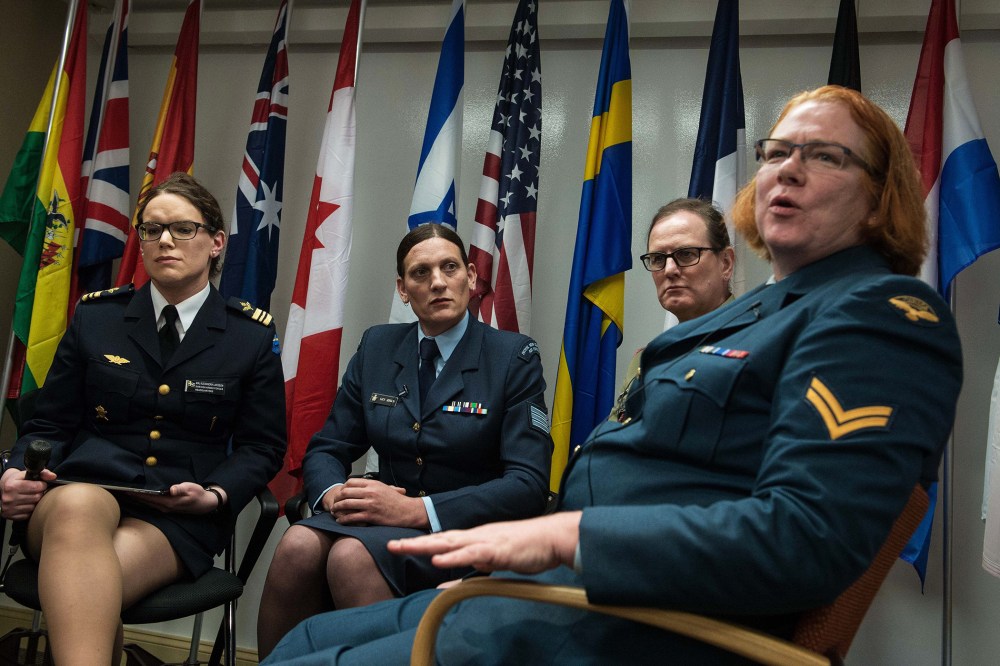
The goal of Monday’s gathering, entitled “Perspectives on Transgender Military Service from Around the Globe,” was to hear from representatives of the United Kingdom, Canada, Australia, New Zealand and Sweden — five of the 18 countries that currently allow transgender service — and determine what, if anything, the U.S. can learn from its allies’ practices.
Seated beside Wilson at the conference were two top-ranking female military officials, one from the Royal Australian Air Force and the other from the U.K.’s Royal Air Force. Like WIlson, both were transgender and had undergone transition-related surgeries. They were wearing uniforms, bedecked with rank and merit bars earned over long careers serving in austere conditions.
Wilson, on the other hand, was wearing plain clothes — a sad reminder of his military discharge for being transgender.
“I need to know what you are,” Wilson recalled his sergeant major asking one night while deployed in Afghanistan. “Your paperwork here says female, but you certainly don’t look like one.”
Hours later, Wilson was sent back to the U.S., where he was ultimately kicked out of the Navy because of his gender identity. And he’s not alone.
Participants in the day-long program offered a range of ideas on how to persuade the U.S. military to soften its position on transgender service. Strong leadership on the issue from the highest level of command emerged as a central requirement to becoming more inclusive, as did repeated education and awareness training at every level. Another recommendation was to adopt a looser culture that de-emphasizes gender roles, norms, and categorizations, and instead focuses on empowering service members to perform at the best of their ability — something that cannot be done under constant fear and anxiety that they’ll be outed and discharged.
RELATED: Is the military ready for transgender troops?
If Wilson’s story illustrated what not to do for military leaders in dealing with transgender service members, then Sergeant Lucy Jordan, the first and only member of the New Zealand Defense Force (NZDF) to transition in uniform, offered the experience to strive for.
When she decided in 2010 to begin the medical process of transitioning from male to female, the chief of the air force sent out a letter informing all unit commanders of her upcoming surgeries. Simple, short, and somewhat vague, the memo nevertheless managed to convey a strong showing of support for Jordan, while at the same time keeping her identity private. The chief also called on other members of the NZDF family to discuss the issue “with an open mind.”
As Jordan read the letter aloud Monday, her colleague in the audience began to cry.
“People don’t hear these stories,” Graeme Field, a remuneration specialist with the NZDF, told msnbc after his tears and Jordan’s panel discussion — one of five that day — had ended. “I think her ability to show how much support the New Zealand Defense Force gave to her, especially reading out [the chief of air force’s] email, really demonstrates how far we’ve come.”
New Zealand is ranked Number 1 in the Hague Centre for Strategic Studies’ LGBT Military Index, which scores over 100 countries on their armed forces’ LGBT inclusion policies. Similar stories were told by representatives from Sweden, ranked Number 4, where the minister for defense has marched side by side with the Swedish Armed Forces’ Supreme Commander in Stockholm’s Pride Parade.
The U.S. is ranked Number 40.
%22The%20U.S.%20has%20more%20estimated%20transgender%20service%20members%20silently%20serving%20in%20its%20military%20than%20the%20entirety%20of%20the%20NZDF.%22′
Questions naturally arose as to whether policies implemented in these much smaller countries’ armed forces could successfully translate to the U.S.’ massive operation. Lucy Jordan is the only openly serving transgender person in New Zealand’s 14,000-member Defense Force. The U.S., by contrast, has more estimated transgender service members silently serving in its military than the entirety of the NZDF.
Countries like the U.K. and Sweden also have strong anti-discrimination laws that provide a framework for their military policies. The U.S., on the other hand, has no nationwide protections for its LGBT citizens; such measures have languished in Congress for decades.
Still, the central takeaway from the conference — billed as the first-ever and largest international gathering of transgender military service members on American soil — was that the Pentagon could and should take tangible steps toward ending its ban on transgender service members, a move that would not only solve a moral predicament, but also strengthen the very core of the U.S. Armed Forces. “Being able to be open and authentic is the key to being able to perform in your job,” said Major Donna Harding of the Royal Australian Army Nursing Corps. “If you’re hiding,” she added, “you’re not going to be able to perform.” Unfortunately, hiding is exactly what thousands of American service members are forced to do. Some transgender service members choose to suffer in silence, either hoping the ban will go away, or waiting for retirement so that they can access medical treatments like hormone therapy and gender reassignment surgery. Others choose to risk their careers and go ahead with transition-related care while serving, paying for it out-of-pocket. “As of right now, I’m currently under investigation for being transgender,” Captain Jacob Eleazer, an officer in the Kentucky Army National Guard, told msnbc. At first, Eleazer would only present as male in his civilian life, asking people to call him “Jacob” and use the correct pronouns. Meanwhile at drill, he’d keep his mouth shut and wear the standard issue uniform for women. The arrangement, while not ideal, worked for about four years. But over the winter, Eleazer underwent “top” surgery to have his breasts removed — a move that forced him to come clean to his female commanding officer. “I was really worried when I talked to her because I had a long relationship with her as a female and as a mentor because there aren’t very many females in my field,” said Eleazer. “I was really worried she was going to feel a little betrayed by that, like I had been hiding something from her. But she wasn’t. She was incredibly open and accepting.” Soon afterward, however, a Kentucky official told Eleazer he had to resign and issued him a separation order. While he was able to get that order rescinded, Eleazer says he’s “been in limbo ever since.” Unlike “Don’t Ask, Don’t Tell,” the military’s former ban on openly gay service members, the ban on transgender personnel isn’t a statutory bar. That means that changing the policy would require only the direction of the president — in this case, the most-LGBT friendly commander-in-chief in history — and the secretary of defense. %22Active%20duty%2C%20guard%2C%20and%20reserve%20service%20%5Bare%5D%20the%20only%20government%20jobs%20where%20transgender%20discrimination%20is%20still%20permitted.%22′ Secretary of Defense Chuck Hagel said in May that he was open to reviewing the transgender ban. But last week, White House Press Secretary Josh Earnest said he didn’t know if President Obama would seek to overturn the policy before the end of his administration. A Department of Defense official later confirmed to the Washington Blade that a review was not underway. Despite the inaction, advocates for military inclusion believe that change is coming. In June, President Obama signed two executive orders expanding LGBT equality — one protecting transgender employees of the U.S. government, and the other barring federal contractors, many of whom work with military personnel overseas, from discriminating on the basis of sexual orientation or gender identity. That leaves active duty, guard, and reserve service as the only government jobs where transgender discrimination is still permitted. “As it relates to transgender inclusion broadly, President Obama has done more than not just any other president, but every other president who’s preceded him,” said Allyson Robinson, founder of Warrior Poet Strategies, to msnbc. “I have to imagine that leaving this bit undone would be a source of regret for President Obama. No, I think we’ll be looking at this in the rearview mirror by inauguration day.”
Emma Margolin
Emma Margolin is a reporter at MSNBC.com. Recommended


